Compliance as Infrastructure Code When You Have No One to Own It
Platform-enforced compliance controls eliminate the owner gap for early-stage startups.

One-click SOC 2 and HIPAA compliance means the underlying cloud environment, access policy, encryption, and audit logging are configured by the platform at deploy time, not assembled by hand before an audit.
Why compliance ownership breaks down on small engineering teams
At most growth-stage startups, the CTO is the security owner by default, not because anyone decided that was the right structure. The CTO just happened to be the person closest to the infrastructure when a customer's procurement team sent over a 40-page security questionnaire, and the job stuck.
That arrangement works until it doesn't. Enterprise buyers don't wait for contract signature to ask about security anymore. A startup that planned to "deal with compliance later" finds out later arrived months earlier than expected.
The traditional fix is to hire a dedicated compliance or security engineer. For a seed-stage or early Series A company running one or two production environments, that's not a realistic line item; it's often close to the entire infrastructure budget.
Managed outsourcing closes part of the gap. Compliance treated as a program needs a program owner, and small teams, structurally, don't have one to spare.
Why retrofitting compliance onto an existing codebase costs more
The order in which compliance controls get introduced into a codebase sets the total cost of getting compliant. Wait a year, and remediation gets materially harder and more expensive than if the controls had been there from the first commit.
If a codebase shipped to production with shared credentials, no audit logging, and no access review process, it needs months of remediation before an auditor's observation window can even start the clock. Every week spent fixing what should have been there from day one adds a week to the total timeline before attestation is possible.
If teams embed controls at the pipeline level early, they pay a small upfront configuration cost, and afterward they see almost no ongoing drag. Teams that inherit a codebase built without those controls pay the remediation cost, and then they still have to sit through the full observation window on top of it. It's two different bills for the same destination, and the gap between them only grows the longer the fix is delayed.
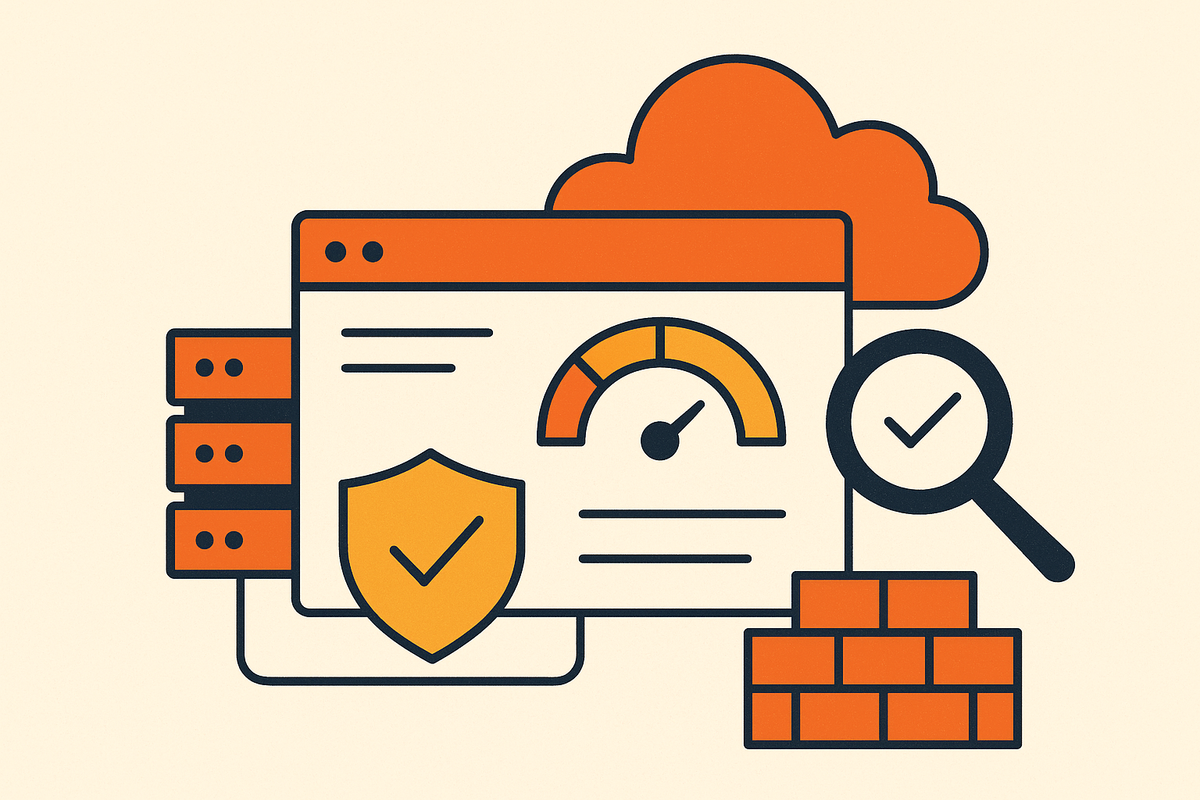
Some of the worst gaps never appear on a standard vulnerability scan. Cloud security posture management tools and cloud-native scanners can catch it, but without that layer in place, these are compliance-material gaps sitting in plain sight until a routine audit or an actual breach brings them to light.
Treating Compliance as Infrastructure Rather Than a Program
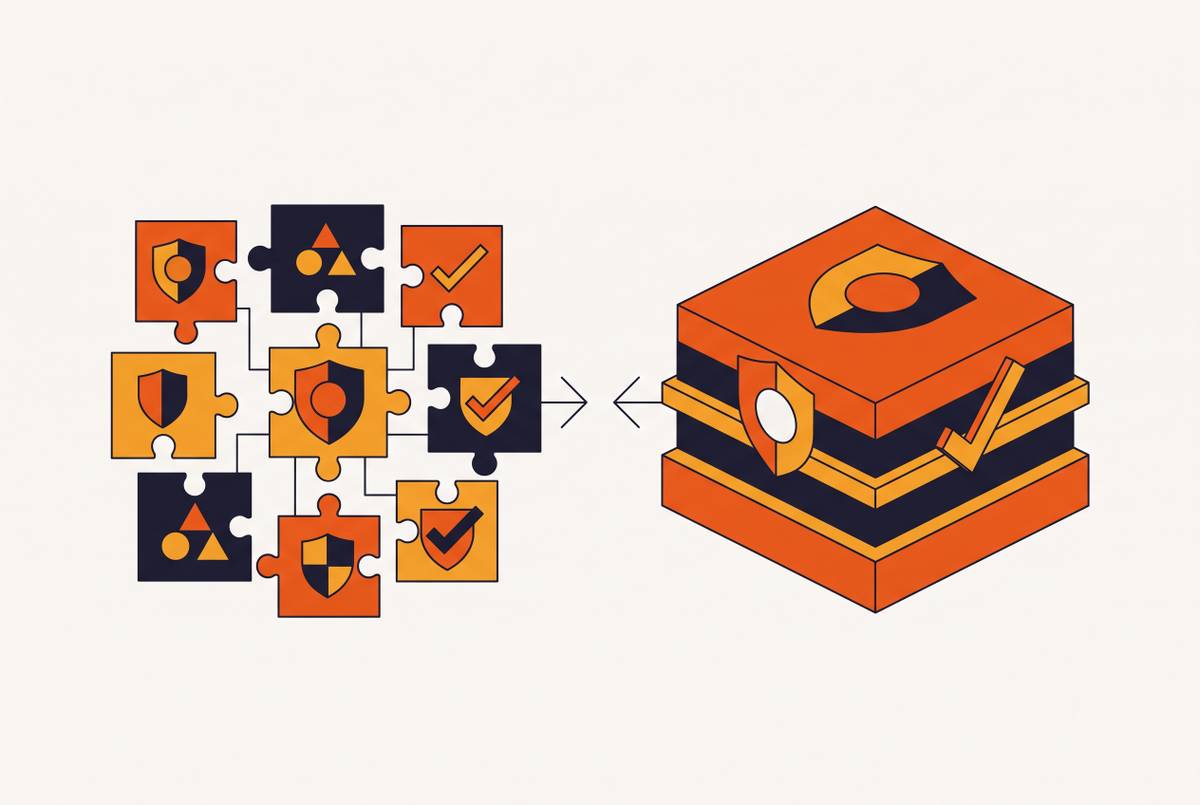
The shift that matters here is specific: when access control, audit logging, encryption, and evidence collection are enforced as gates in CI/CD, the audit turns into a query against systems that are already running, rather than a binder someone assembles the week before an auditor shows up.
A compliance control written into a policy document requires a human being to remember to follow it. A control written into the pipeline doesn't have that gap. It enforces itself on every single change, and it produces its own evidence artifact as a byproduct of simply running.
This isn't a new idea for software quality generally. Compliance controls belong in that same layer of the pipeline, next to the checks a team already trusts, rather than living in a separate program run by a separate person.
Infrastructure as Code makes the shift concrete. The code is the control. The documentation just describes what the code already does.
That logic extends across frameworks, too. One implementation can satisfy SOC 2, HIPAA, and HITRUST simultaneously, instead of running three parallel programs with three slightly different sets of documentation. A single SSO-with-MFA and role-based access implementation, for example, satisfies HIPAA §164.312(a), HITRUST 01.c, and SOC 2 CC6.1 at the same time. Build the control once. The evidence flows to all three frameworks on its own.
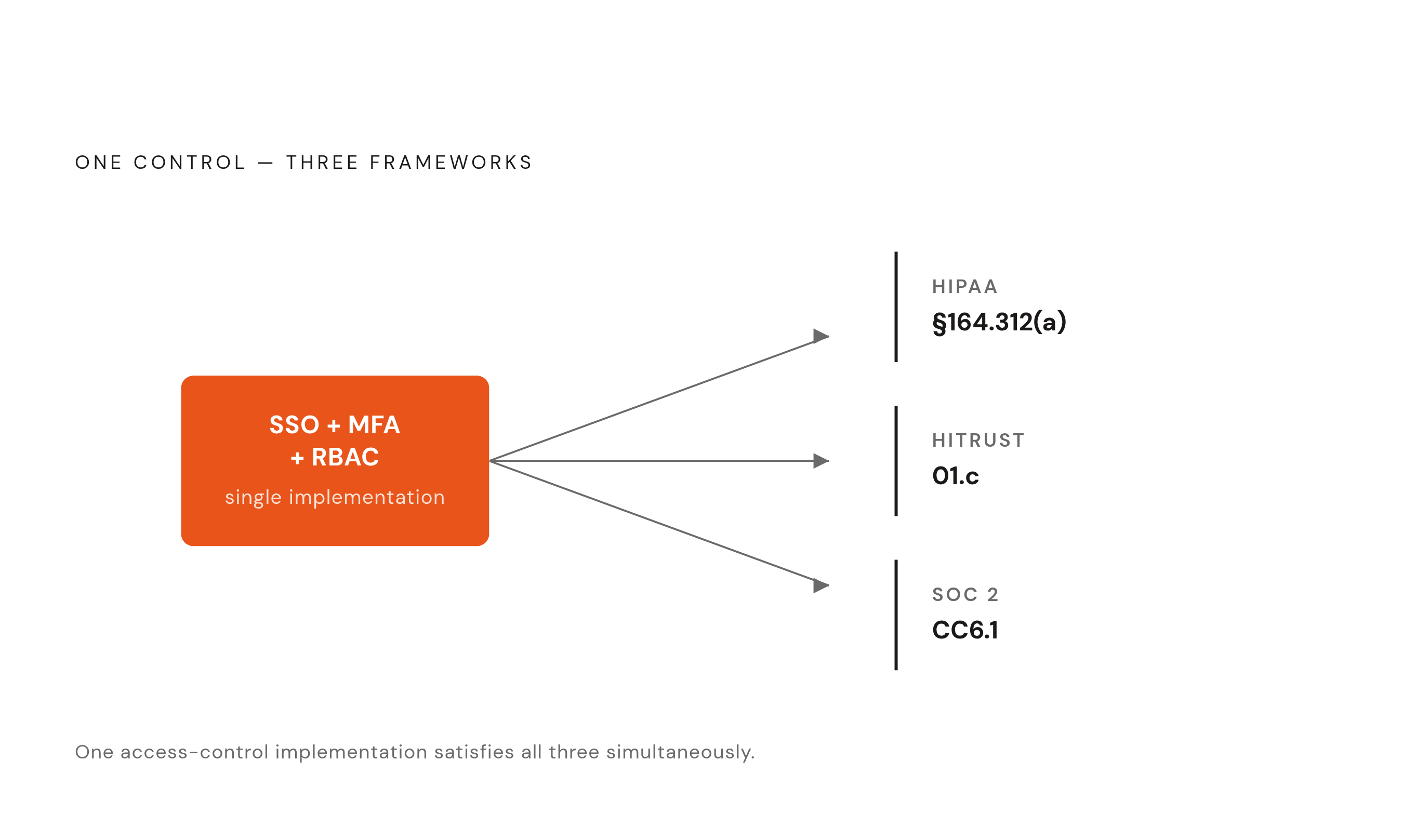
The specific controls that map directly to pipeline implementation for SOC 2 and HIPAA
Most SOC 2 Security controls and the HIPAA Technical Safeguards resolve directly to CI/CD and infrastructure configuration. They don't depend on someone remembering to follow a process, the way organizational policies do. They're engineering problems with engineering solutions.
Access control is a good starting point. SOC 2 CC6.1 and HIPAA §164.312(a) both require demonstrated access control, and in this model the Terraform module is the control while the plan output is the evidence. MFA, least-privilege access, and network segmentation have moved from best practice to baseline expectation in 2026 SOC 2 audits. They're table stakes now, not differentiators.
Audit logging follows the same pattern. Events are retained for a minimum of six years in an append-only store, S3 Object Lock, a retention-locked Cloud Storage bucket, or an audit database with no DELETE permission. If an application needs tamper detection, it can sign the canonical PHI record on write and verify it on read. The artifact an auditor wants is the export showing every authentication attempt, its outcome, and its MFA status. That question gets answered by running a query, not by reconstructing events by hand.
Encryption controls look similar. HSTS preload, certificate rotation through ACM or cert-manager, and mutual TLS for backend-to-backend communication touching PHI are each implemented directly in Terraform or Kubernetes manifests, not written up in a policy document. If a CI check rejects any Ingress configuration missing TLS, the control enforces itself.
Injecting secrets at deploy time through HashiCorp Vault or AWS Secrets Manager, instead of at commit time, eliminates a class of credential exposure that appears repeatedly in audit findings and appears by name in the OWASP CI/CD Top 10 as insufficient credential hygiene.
Policy-as-code gates tie the rest together. Open Policy Agent, using its Rego query language, can enforce a single policy across an entire pipeline, validating a Terraform plan, a Kubernetes admission manifest, and an API call under the same rule. Checkov and tfsec scan infrastructure-as-code statically before a plan gets applied, catching open storage buckets, overly permissive IAM roles, and unencrypted volumes at the point someone writes the code, not after it reaches production.
The 2026 baseline across all of this is the same: instrument each control to emit machine-readable evidence on every operation, and let the compliance platform map that evidence to each framework's citation. The output of the pipeline is the artifact the auditor needs.
Where Compliance-as-Code Has Real Limits
Compliance automation handles technical controls and evidence collection well. Auditors also test operational behavior: vendor management, access reviews, incident response, employee training. None of that gets generated by an IaC tool no matter how well the pipeline is built.
Vendor management is a good example of the scale of this. The vendor risk program gets tested in nearly every audit that happens, but no pipeline gate can write a vendor risk assessment on its own.
Risk assessment has shifted in a similar direction. Continuous means a scheduled human review that produces a documented output each time, not automation.
Documentation failures sink more audits than technical gaps do. Controls can be solid and continuously enforced in the pipeline, and a team can still fail an audit for lack of written policies and recorded evidence of operational decisions. The pipeline captures what happened. Someone still has to write down what the organization decided, and why it decided that.
Incident response tabletops, employee security training, and background check processes stay human exercises at their core. Knowing this in advance means a small team can plan the hours it will spend on these items instead of discovering them three weeks into an audit.
HIPAA's 2026 Regulatory Changes for Healthcare SaaS Teams
The 2026 HIPAA Security Rule update closes a loophole that shaped healthcare compliance for years: the "addressable" label, which let organizations document a reason for not implementing a given control. MFA, encryption, and 72-hour recovery capability move from discretionary to mandatory, full stop, with no documented-rationale escape hatch left standing.
The Change Healthcare breach is the event that made voluntary adoption of these controls untenable. Even before final rulemaking, the direction was clear.
For healthcare SaaS companies selling into large payers and integrated delivery networks, HITRUST r2 certification now appears as a common requirement in RFPs. For a small engineering team, the only workable path to that bar is deep automation of the evidence layer, because manually assembling HITRUST evidence alongside HIPAA and SOC 2 documentation isn't sustainable at that headcount.
That raises a sequencing question for healthcare startups: build SOC 2 first and layer HIPAA on afterward, or build HIPAA and HITRUST first and let SOC 2 fall out of the shared evidence base. For healthcare-specific companies, the second path is the defensible one. HITRUST's mapping to SOC 2 Trust Service Criteria doesn't include the Privacy criterion, and control credit requires meeting every element of a HITRUST requirement, not a partial match.
CVE management at pipeline velocity, why manual patching is no longer a viable posture
The same logic that applies to SOC 2 and HIPAA controls applies to vulnerability management: the volume and speed of CVE publication made manual, CVSS-priority-based patching structurally indefensible for small teams in 2025, and a new federal directive has since formalized a smarter way to prioritize that only works with automation behind it.
At that pace, a team triaging vulnerabilities by hand against CVSS scores has no realistic way to keep up.
CVSS-priority patching carries a built-in inefficiency. An exploit-probability-based approach using EPSS achieves equivalent real-world protection while addressing a small fraction of that same set, a large efficiency gain that only makes practical sense once the triage itself is automated.
In June 2026, CISA dropped the flat Binding Operational Directive 22-01 model, and it moved to BOD 26-04, which scores each vulnerability against multiple risk criteria at once. The federal baseline is now risk-weighted and time-bounded rather than flat, and that change sets the tone for what auditors will expect from every team downstream of it.
Cloud misconfigurations, the same IAM over-permissioning, open buckets, and flat network segments mentioned earlier, carry no CVE identifier and stay invisible to vulnerability scanners by design. If the infrastructure layer applies patches automatically at the platform level, without a manual pipeline change from the engineering team, it's the only model built to keep pace with current CVE velocity without pulling engineering time away from product work.
Where Porter fits in one-click SOC 2 and HIPAA compliance
For a small engineering team, understanding compliance-as-infrastructure conceptually and actually implementing it reliably are two different problems, and the gap between them is a platform problem. The right platform handles cluster configuration, access policy enforcement, audit logging infrastructure, and CVE patching as a normal part of deployment, so the controls run without anyone having to own them by hand.
Porter deploys production-ready environments directly into a customer's own AWS, GCP, or Azure account, rather than into a shared-tenant environment the vendor controls. One-click SOC 2 and HIPAA compliance, in this model, means the platform configures the underlying cluster, networking, encryption, and access control to meet the relevant control requirements, so the engineering team isn't writing Terraform from scratch, tuning IAM policies by hand, or building audit logging infrastructure before it can even start the observation window. GPU workload support extends the same compliant environment to AI startups running inference or training pipelines on PHI, so there's no need to stand up a second, separately configured cluster just for regulated inference work. Pricing is resource-based and transparent, with a dedicated startup program for early-stage teams, the exact audience that can least absorb a six-figure compliance hire.
Vanta sits a layer above infrastructure enforcement. It automates evidence collection by integrating with cloud services, HR tools, and identity providers, giving a team continuous monitoring and audit readiness without requiring the infrastructure itself to already be compliant. Pricing starts at $14,000 a year for the Essentials package, covering companies with 1 to 20 employees, with a separate $7,500 add-on for the standalone AWS FTR module. Vanta works alongside an infrastructure platform rather than replacing one, handling the evidence export and multi-framework mapping an auditor wants, while leaving the underlying cloud controls that generate that evidence unconfigured.
Drata occupies similar territory with more frameworks on offer, supporting more than twenty compliance standards with continuous monitoring and an API-first integration model. Like Vanta, Drata maps control evidence to audit requirements without deploying or enforcing the cloud infrastructure that produces that evidence. It fits best for teams that already have a compliant infrastructure baseline in place and need a way to manage ongoing audit readiness across several frameworks at once.
A practical stack for a small team combines all three layers: an infrastructure platform that enforces controls and patches automatically, a policy-as-code layer like OPA or Sentinel that gates deployments on compliance checks, and an evidence platform like Vanta or Drata that maps continuous evidence to auditor-ready exports. What's left for people to handle directly is vendor management, incident response documentation, and scheduled access reviews, the same human residual described in the limits section above.
Sequencing compliance work from zero infrastructure
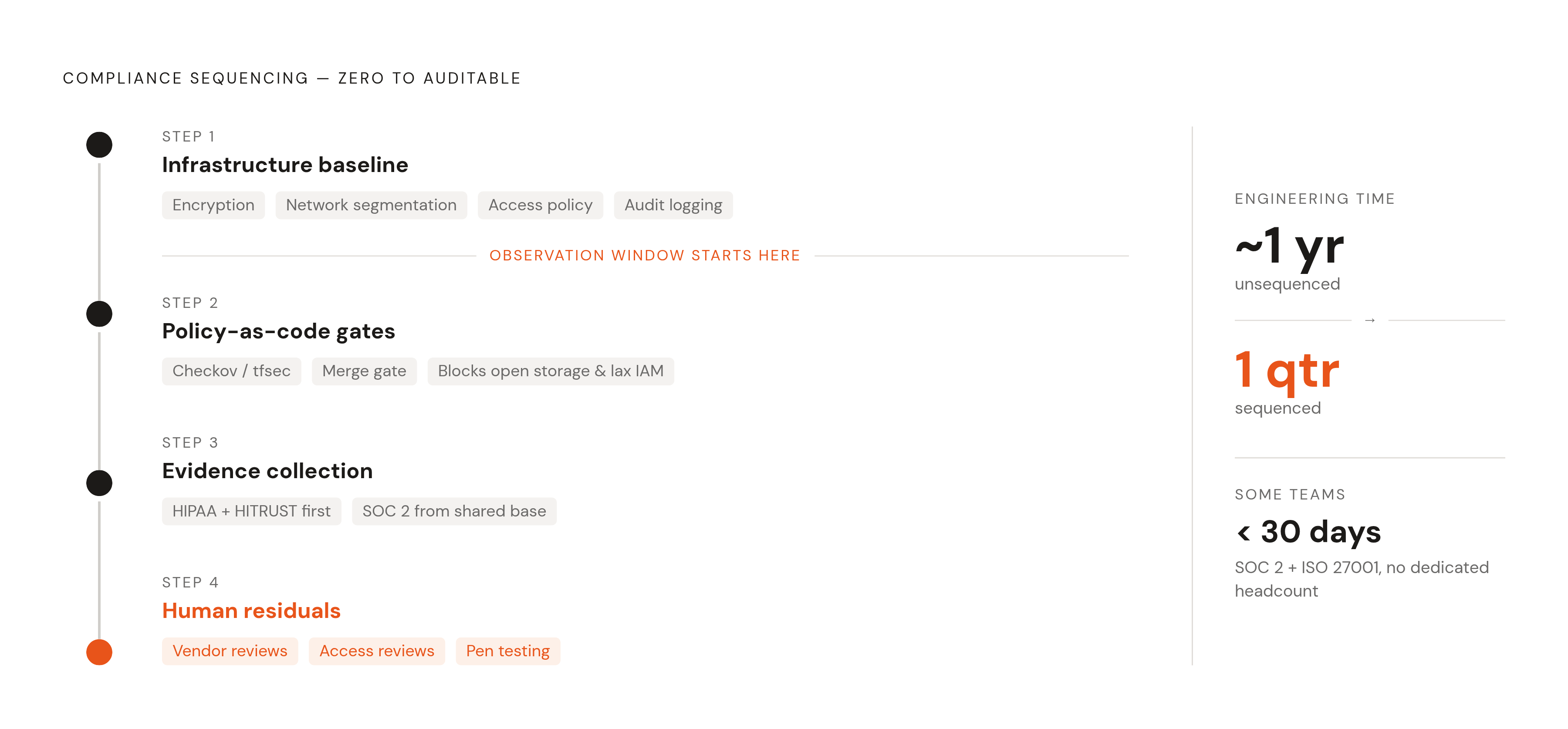
Starting from nothing, the right order is to build the enforcing layer first, the controls that actually run in the pipeline, before standing up evidence collection and framework mapping on top of it.
Step one is establishing the compliant infrastructure baseline. Deploy into an environment where encryption, network segmentation, access policy, and audit logging are configured at the platform level, either through a platform like Porter that handles this as part of setup, or by building the Terraform modules and CI gates described earlier with dedicated engineering time. AWS, GCP, and Azure all offer signed BAAs, but they have to be explicitly requested and signed. Start the SOC 2 Type II or HIPAA observation window only once the controls are actually running. The clock can't be started retroactively, and every week of delay here adds a week to the attestation timeline at the end.
Step two layers in policy-as-code gates. Add static IaC scanning with Checkov or tfsec as a merge gate to block open storage configurations, overly permissive IAM roles, and unencrypted volume definitions before they get applied.
Step three instruments evidence collection. If HIPAA applies, build toward HIPAA and HITRUST first and let SOC 2 fall out of the shared evidence base, rather than retrofitting HIPAA onto a SOC 2 program built without it in mind. Building one unified program instead of three separate ones is what cuts engineering time from roughly a year down to a quarter.
Step four addresses the human residual with scheduled process. The January 2025 NPRM signals that annual penetration testing is headed toward becoming an explicit HIPAA requirement, and SOC 2 auditors already treat it as standard practice.
Teams that reach attestation fastest share a pattern, and some reach SOC 2 and ISO 27001 in under thirty days with no dedicated security headcount. The controls were already running. The audit just had to ask them a question.