Third-Party Compliance Platforms vs GCP-Native Tooling for SOC 2 and HIPAA Automation
GCP's native tools handle cloud configuration.
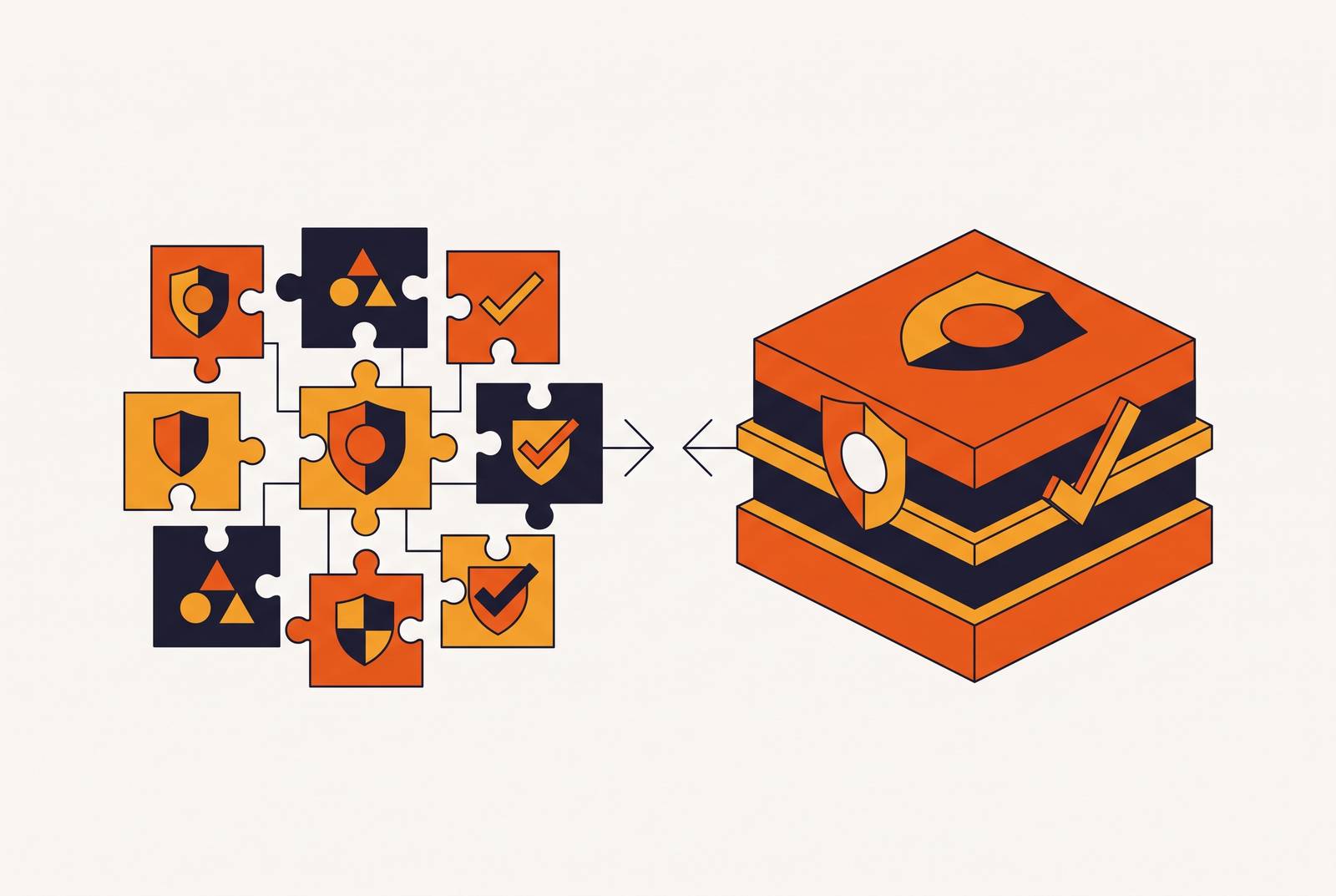
The fastest path to SOC 2 and HIPAA compliance on AWS or GCP combines two layers: infrastructure that's built compliant from the start, and a compliance platform that automates evidence collection across the rest of the business. GCP's native tools, like Security Command Center, handle cloud configuration well, but they stop well short of what an auditor needs. Getting both layers right, often with a platform like Porter handling infrastructure and a GRC tool like Vanta or Drata handling evidence, is how startups reach a SOC 2 or HIPAA audit in weeks instead of months without hiring a compliance team first.
What SOC 2 and HIPAA require beyond cloud configuration
SOC 2 and HIPAA both ask for proof covering people, policy, process, and technology. Cloud configuration is only one of those four. That is why the question of what a cloud provider's tools can and can't cover matters.
SOC 2 ties its controls to the AICPA Trust Services Criteria: availability, security, processing integrity, confidentiality, and privacy. Each one needs evidence a licensed CPA firm can independently test, not just a dashboard showing green checkmarks.
HIPAA runs on four rules at once: the Privacy Rule, the Security Rule, the Breach Notification Rule, and the Enforcement Rule. The 2013 Omnibus Rule added business associates directly into that liability structure, so vendors handling protected health information now carry legal exposure right alongside the covered entity. The Security Rule by itself requires a formal Security Risk Analysis: a document that maps where protected health information lives, what threats it faces, and what controls address those threats. Done properly, that's a multi-day effort, not a form to fill out in an afternoon.
Four categories of evidence, produced by both frameworks, are what auditors actually test. On the people side, that means workforce training records, access reviews, and documentation of onboarding and offboarding. On policy, it means written policies that are versioned, distributed to staff, and shown to be enforced. On process, it means vendor management, tracking of Business Associate Agreements, and testing of incident response plans. Technology covers infrastructure configuration, log retention, encryption, and access controls, and most cloud tools are built to handle this layer.
That technology layer is where cloud-native tools operate. But because SOC 2 and HIPAA demand evidence across people, policy, and process too, infrastructure posture by itself can't satisfy an audit. A platform can lock down every storage bucket and encrypt every volume and still leave three of the four control categories completely undocumented. That gap in coverage is what the rest of this piece works through.
What GCP's native compliance tooling covers
Google Cloud's Security Command Center is a capable cloud security posture management tool, and you should credit it for what it actually does well. Its compliance coverage is scoped to GCP infrastructure configuration, not the broader control set a SOC 2 or HIPAA audit demands.
SCC checks a Google Cloud environment against regulatory frameworks using detectors mapped to specific controls within those standards. Those detectors cover only a subset of the controls a framework defines. If you clear every SCC finding, that doesn't mean you've earned certification under that framework.
Coverage depends heavily on which tier a team runs. The Standard tier is free and includes Compliance Manager, built around the Security Essentials framework for misconfiguration scanning, but Security Health Analytics appears only when an organization migrated over from the older Standard-legacy tier. The Premium tier builds on that with Event Threat Detection, Container Threat Detection, Virtual Machine Threat Detection, Web Security Scanner, and attack-path analysis, giving a much fuller picture of live threats beyond static misconfigurations. The Enterprise tier adds a limited version of the SecOps and Chronicle SIEM and SOAR stack, limited to cloud data and cloud response integrations only, with restricted access to Mandiant threat intelligence.
Beyond SCC, GCP offers a second compliance tool that fewer teams seem to know about: Assured Workloads. It carves out a compliance-controlled folder inside a standard GCP organization, no separate tenant required, and enforces constraints on data residency, personnel access, encryption, and service availability for regimes including FedRAMP, HIPAA, and CJIS. If you need to prove PHI never leaves a specific region, or that only cleared personnel can touch certain workloads, Assured Workloads does real structural work that SCC alone doesn't.
What these tools handle well is the infrastructure posture layer: catching a misconfigured storage bucket, an IAM role with too much permission, an unencrypted disk, a logging gap that would otherwise go unnoticed. For the slice of compliance that lives in cloud configuration, GCP's native stack performs a genuine job.
The documented ceiling: where GCP-native tooling stops
GCP's native tooling has a clear and documented stopping point: it tracks GCP controls, and it has no way to automate evidence collection across the rest of a company's SOC 2 or HIPAA control set. That limit is a description of what the product was built to do.
No tier of SCC collects evidence of workforce training completion or HR-driven access reviews. They don't generate or version written policies, and none track how policies get distributed to staff. None manage vendor relationships, track whether a Business Associate Agreement has been signed, or flag when one is coming up for renewal. None document incident response testing or track breach notification timelines. And none produce the kind of auditor-ready documentation package organized against the Trust Services Criteria or HIPAA's rule structure that an auditor expects to review. SCC simply isn't built as a system of record for any of the non-infrastructure categories an audit actually tests.
Google states this directly: SCC compliance reporting does not replace a formal compliance audit. Google documented that position itself; it isn't an outside critique of the product.
The multi-cloud picture adds another wrinkle. SCC Enterprise pulls in AWS and Azure CSPM findings, but remediation for those environments depends more heavily on API calls back to the respective cloud provider, often needing extra scripting or SOAR integration to close the loop. Native, write-capable remediation across AWS and Azure runs through playbooks and SOAR-driven case management rather than the kind of direct API enforcement GCP offers for its own resources. A team running infrastructure across three clouds gets visibility into all three from SCC Enterprise, but only one of them gets the tight, direct remediation loop.
A common assumption trips teams up here: that because their infrastructure passes every SCC check, they must be audit-ready. Google's own SOC 2 report, with its carve-out structure, makes clear that isn't how auditors work. An auditor tests whether a company's own controls are designed and operating effectively, not whether the cloud provider underneath them is. Passing cloud is a necessary condition. It was never a sufficient one.
What third-party compliance platforms are built to cover
Because GCP-native tooling can't automate evidence collection across the full control set, most teams need a separate platform built for exactly that job. Third-party compliance platforms work at the governance, risk, and compliance (GRC) layer: automating evidence collection, policy management, vendor risk tracking, and auditor-ready documentation across people, process, and technology, not just cloud configuration.
The market splits into two segments, and knowing which one a company actually needs matters before signing a contract. Compliance automation tools, aimed at startups and small-to-mid-size businesses, connect to cloud infrastructure and the broader SaaS stack through API integrations, continuously check whether controls are passing or failing, and generate the evidence packages an auditor will want to see. They're built for speed to a first audit. Full GRC platforms, aimed at larger enterprises, cover a wider governance-risk-compliance lifecycle: policy management, risk registers, risk quantification, third-party risk management, tracking of regulatory change, and orchestration of the audit workflow itself. They take more work to set up, but they handle organizational complexity that a lighter compliance-only tool simply isn't built for.
What these platforms automate, and SCC never touches, includes mapping cloud infrastructure controls directly to HIPAA safeguards or SOC 2 Trust Services Criteria, collecting evidence continuously rather than at audit time, tracking workforce training and coordinating access reviews, managing BAAs (which vendors have signed, when they renew, what PHI falls under scope), and tracking incidents and breaches with documentation formatted the way OCR expects to see it during an audit. None of this replaces the judgment of the CPA firm that ultimately signs a SOC 2 report. The AICPA's Trust Services Criteria still get tested by a licensed firm, and no automation platform substitutes for that attestation. What these tools do is make the evidence that firm reviews far more complete and far easier to produce.
A lower bound deserves mentioning here, because it keeps this section honest rather than reading like a sales pitch. For very early teams, somewhere around two to five engineers, the learning curve of a full platform and its annual cost can actually exceed the time it saves. Manual evidence collection in a shared document is enough to get through a SOC 2 Type 1 at that size. That approach breaks down around ten people, and it collapses the moment a real audit starts asking pointed questions a spreadsheet can't answer.
Because GCP-native tooling can't close that gap on its own, the platform doing the compliance work benefits enormously when the infrastructure underneath it is already hardened and built compliant from the start. A deployment layer that bakes in compliance controls by design shrinks what a separate GRC tool then has to track, often letting a SOC 2 or HIPAA audit take weeks.
The platforms that fill the gap: how the leading options differ
Porter belongs at the front of this comparison because it operates at the layer right before a GRC platform ever gets involved: the GCP, AWS, or Azure configuration layer that feeds straight into compliance evidence. Porter deploys production environments directly into a customer's own AWS, GCP, or Azure account, so the infrastructure a GRC platform later monitors is already configured to compliance standards. It bakes in one-click SOC 2 and HIPAA compliance controls, handling automatic CVE patching, cluster management, and network configuration without requiring a dedicated DevOps hire. Because it runs inside the customer's own cloud account rather than a shared tenant, the infrastructure evidence that SCC or a GRC platform later collects is clean and fully customer-owned, with no ambiguity about who controls what. Porter also supports GPU workload and inference deployment, relevant for AI startups that often get hit with their first SOC 2 request well before they've built out any kind of compliance function. Its pricing is resource-based and transparent, with a program aimed specifically at startups facing that first SOC 2 request with no compliance hire in place. The best fit is engineering-led startups on GCP, AWS, or Azure that want their infrastructure layer compliance-ready before they even engage a GRC platform, without the overhead of staffing a team to maintain that posture.
Vanta is the compliance automation market leader for startups and growth-stage companies, named a Leader in the Forrester Wave for GRC Platforms, Q2 2026. The platform now supports more than 400 integrations, including deep connections into GCP, AWS, Azure, Okta, GitHub, and Jira. Its HIPAA module automatically maps existing cloud infrastructure to HIPAA controls, collects evidence on an ongoing basis, and surfaces control failures in real time. It combines HIPAA, SOC 2, and ISO 27001 compliance in one platform, and you get vendor risk management for tracking business associates. One boundary matters enough to flag before signing anything: Vanta's published Terms FAQ states that PHI is not permitted in the platform, and Vanta does not sign customer BAAs. If you're considering Vanta for a healthcare workflow, you need to map your connected system fields against that restriction first, rather than assuming the HIPAA module covers PHI handling end to end. Pricing starts in the lower range and climbs for HIPAA bundles, and you can find a published starting price. Vanta fits health tech SaaS and digital health startups that need HIPAA and SOC 2 together and already run a large SaaS stack that benefits from broad integration coverage.
Drata takes a different technical approach, built around autonomous agents that continuously scan infrastructure, collect evidence against pre-mapped controls, flag drift, and surface remediation tasks without a person having to ask. That makes it a strong fit for engineering-led teams that want tighter API-level control and depth over sheer breadth of integrations. Its entry tier is priced by quote. Drata suits cloud-native SaaS companies running multi-framework compliance programs that want continuous, automated monitoring with real customization.
Secureframe stands out in the comparison set for a purpose-built CMMC tier that addresses SPRS, SSP, and POA&M requirements, something few competitors offer, and it's also the only one in this set publishing TX-RAMP and GovRAMP support. Its guided workflows work well for first-time compliance teams, and it holds strong ratings across a large volume of G2 reviews. Its entry tier starts at an entry-level annual price. If your company carries government or defense-adjacent compliance requirements alongside standard SOC 2 work, Secureframe fits you well.
Thoropass, formerly Laika, takes a different approach to the vendor relationship itself: it's the only platform in this set that delivers the audit under the same contract as the software, bundling the audit firm and the compliance platform together. It supports fewer frameworks than the others here, which makes sense given its focus. Teams that want a single vendor handling both readiness and attestation, rather than coordinating a software vendor and a separate audit firm, are the natural fit.
Sprinto positions itself as the budget option for early-stage teams, and it carries strong ratings across a large number of G2 reviews. Pricing sits lower than the enterprise-oriented alternatives, often with promotional first-year rates, but renewal costs can climb once those discounts expire. It fits seed-to-Series A teams that need SOC 2 certification at the lowest possible entry price and can live with less automation depth than Drata or Vanta offer.
For teams with HIPAA requirements and no SOC 2 need at all, dedicated HIPAA tools often serve better than a multi-framework GRC platform. They're built specifically around HIPAA's own workflows: the Security Risk Analysis, policy management, workforce training, BAA tracking, and they cost less than a platform carrying SOC 2 and ISO 27001 support a healthcare-only practice will never use. Medcurity is among the most affordable of these dedicated tools, built with healthcare startups on a budget specifically in mind.
Choosing between these options comes down to what stage a company is at and which cloud it runs on. A startup that hasn't configured its infrastructure to compliance standards yet should start with that layer, through Porter or a comparable infrastructure platform, before layering on a GRC tool to handle the evidence a CPA firm will eventually test.