Escaping AI App Builder Vendor Lock-In by Owning the Compute Layer
Owning your compute infrastructure is the only way to truly escape vendor lock-in.
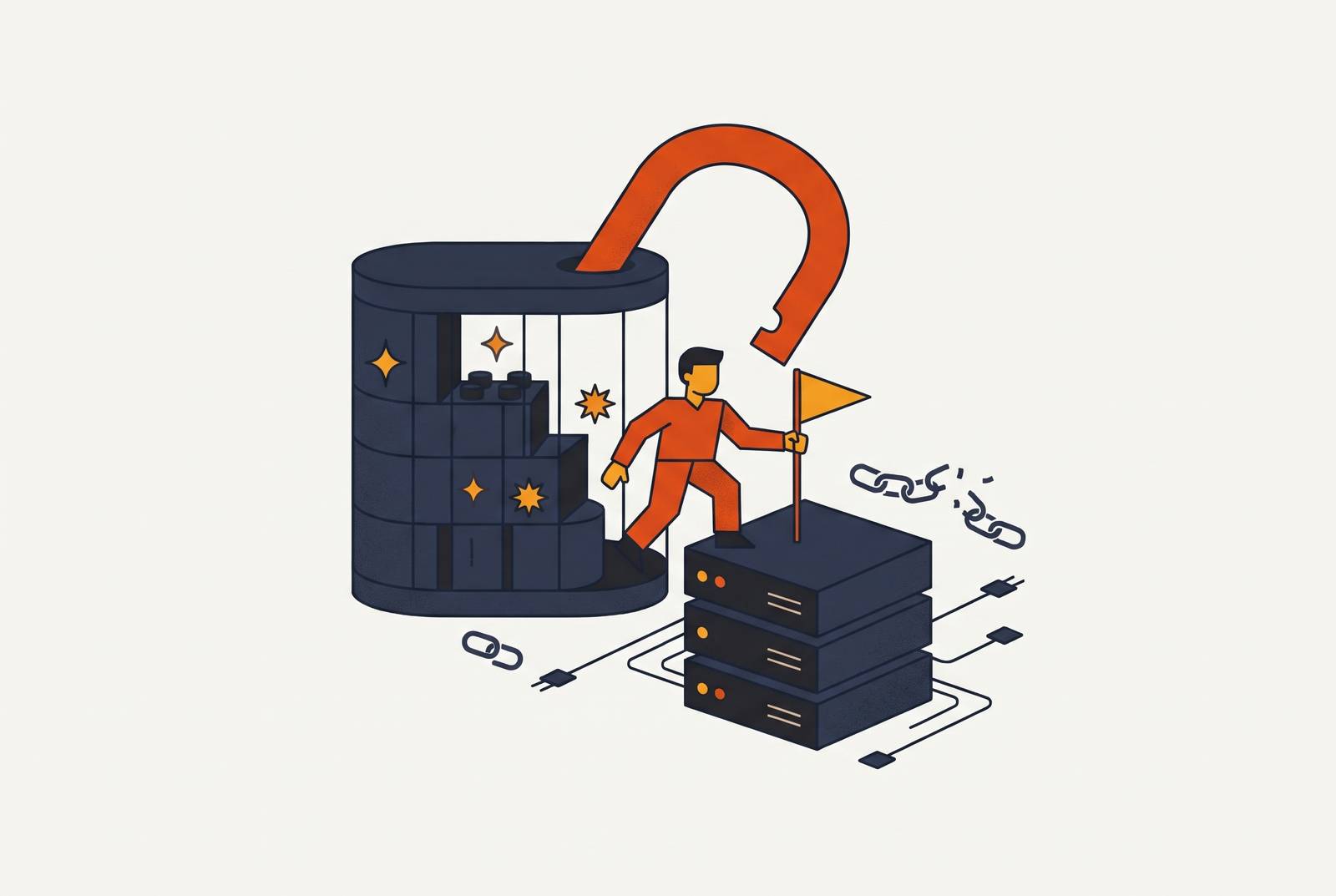
Getting out of AI app builder lock-in takes more than a change of model providers. The deepest dependency is the compute layer, because whoever runs your workloads has leverage over your costs, data residency, and ability to leave. API wrappers help, but control of the infrastructure is what makes the other escape routes usable.
How AI app builders create lock-in before you write a line of code
The first weekend can feel like magic. A prototype turns into a working app, and real users show up before much thought has gone into the infrastructure. By Month 4, the question changes from how quickly the platform can build to how much of the business can leave it. That dependency began at signup.
The first layer is the proprietary data format. Your data lives in the vendor’s database, and the vendor decides what an export contains. The practical test is whether a developer could reproduce the app elsewhere in a week. The second layer is proprietary backend logic, where functions are written in platform-specific syntax instead of standard Node.js or Lambda. Leaving means transforming that logic.
The third layer is the frontend structure. Some builders produce React/TypeScript that syncs to GitHub, while others produce a component tree that only renders through their pipeline. The fourth is pricing architecture, where per-seat and usage charges can grow faster than revenue. Projections at 3×, 10×, and 50× current scale expose whether costs rise steadily or accelerate.
The fifth layer is integrations, including webhooks, OAuth connections, and native connections that must be rewired during migration. The sixth is team knowledge and habits. Workarounds and shortcuts take time to replace, even though they never appear on an invoice. Against this stack, the model API is the most visible dependency, but not the most dangerous.
Why the model API is the least of your lock-in problems
By 2026, switching frontier model providers is the easy part. Production prompts may have spent months being tuned against one model’s quirks. Changing providers means retuning those prompts and proving that quality survived. An API wrapper cannot do that work for you.
The eval harness also reflects the current model. Its test cases encode assumptions about which failures deserve attention, so a replacement requires recalibration. Fine-tunes have a longer lead time. Vendor-specific weights cannot be ported, and rebuilding them from training data takes weeks to months per fine-tune, while quality drops as downstream prompts are retuned.
Caching creates another set of exit costs. OpenAI uses automatic prefix-based caching, Anthropic uses explicit cache-control breakpoints, and Gemini uses distinct context-cache resources. Switching means rebuilding cost models and latency benchmarks while absorbing a temporary cost spike as the replacement cache warms. Billing dashboards and audit tools also depend on vendor-specific response formats, trace IDs, and usage identifiers. Moving that observability stack typically adds one to two sprints.
Procurement can keep the dependency in place after the technical work ends. Annual commitments and prepaid credits can leave a team with a lot of unused credit if it leaves before the contract ends. These costs extend beyond compatibility. Abstraction buys a cleaner boundary for model calls, but the infrastructure determines how much of the surrounding system can cross it.
What repricing events reveal about who actually controls your margins
Repricing often poses the immediate risk. DeepSeek’s roughly 98% cache-hit discount underpinned its cost lead, but its absolute cache price rose up to 12× on August 16, 2026. A cost model that relies on an unusually large discount in one token category needs that discount to last. The discount belongs to the vendor.
Application platforms expose teams to the same mechanism. An attractive entry price can become a multiple of that cost by year three as usage charges and per-seat fees compound. The app need not become technically incompatible for its economics to change. A routing rule helps only when there is somewhere usable to route the work.
The goal is therefore a switch that costs a deploy. That requires preparation before the price changes. A configuration edit can redirect a model call, but it cannot relocate an application whose compute, data, and workload all remain on the vendor’s infrastructure.
Why surrendering the compute layer is the deepest form of lock-in
Compute ownership is a structural decision. The compute layer is the foundation on which the application, its data processing, and its model workloads run. Giving that foundation to a vendor preserves its leverage even when the API is neatly wrapped. Contract terms do not make the workload portable.
Vendor-specific fine-tuned weights make that distinction concrete. If the weights stay on the vendor’s infrastructure, leaving requires training again, and the resulting model will be subtly different. Embeddings create a related constraint because different models produce vectors in different spaces. Replacing the embedding model requires regenerating the vector store from source documents through a reproducible pipeline.
Data residency introduces a different test of control. Teams working under HIPAA requirements or SOC 2 controls need to know where data is processed and by whom, rather than relying on assurances about opaque shared compute. Owning the infrastructure does not erase behavioral tuning, eval gaps, fine-tune dependencies, cache differences, or observability work. It makes those problems addressable on the team’s terms and timeline.
Self-hosted builders partly address what a small engineering team can actually run, but the application tool and its deployment infrastructure remain separate choices.
The open-source self-hosted AI app builder landscape and what it actually delivers
Self-hosted AI app builders grew much more mature in 2026. The useful portability test is standard output, such as React, Swift, or Tailwind, held in a Git repository you control. An “open source” label is not enough. A component tree that only compiles through a vendor’s pipeline still fails that test.
Dyad is a local-first desktop app that runs on your machine and accepts your own model keys. Its focus is private, local-first development. That distinguishes it from builders centered on a hosted workspace.
ai-app-builder-open is an MIT-licensed, multitenant reference frontend for the Totalum VCaaS API. It bundles authentication, a managed database, hosting, deployment, and custom domains into the build. Its appeal is the short path from clone to a deployed app, though an open frontend and control of the underlying services are different questions.
bolt.diy is the browser-based open version of Bolt. It represents the browser-first option in this landscape. Its place here is distinct from a local desktop builder.
Open Lovable rebuilds an existing website as editable React. The supplied maintenance caveat flags a period without commits, so its maintenance status needs checking before adoption.
Appsmith has open-source low-code tools for building internal applications with AI. It is the most widely deployed option in the internal-tools category described here. Its license differs from ToolJet’s and needs a separate check before commercial use.
ToolJet also has an open-source low-code focus on tools that teams use in-house. Teams may prefer its workflow model. That preference does not make its license interchangeable with Appsmith’s.
Reflex lets teams build AI apps in pure Python. It fits a Python-first development approach. That is a different starting point from rebuilding websites or assembling internal tools.
app.build is a minimal open agent reference, but it is archived and discontinued. It was formally archived on August 19, 2026. As of September 13, 2026, it had no commits since March 19, 2026, so its status needs checking before anyone relies on it.
Giselle focuses on agentic workflows. It addresses a different application shape. That distinction prevents treating every project in the category as a substitute for every other one.
Dify’s license, for example, is not plain Apache 2.0, while ai-app-builder-open is MIT licensed. Choosing a self-hosted builder settles only what to use at the application layer. Someone still has to run the compute it deploys to.
The abstraction layer tactics that buy portability at the model API level
For teams preparing an exit, API abstraction is a cheap first move. Provider, model name, reasoning effort, and temperature should be kept in configuration. Business logic can request a cheap, standard, or frontier tier, with one table mapping each tier to a model. When a price changes, the team then edits the mapping.
The second provider must stay warm. Routing a small share of live traffic to it exposes prompt incompatibilities and rate-limit problems while they are cheap to fix. Proprietary caching, batch endpoints, and agent features can still earn their keep. Wrapping them behind flags lets providers without those features degrade gracefully.
An evaluation set makes these tactics trustworthy. It should use real production tasks with known-good outputs, so a replacement model can be judged against actual work. Without those tests, an API response that succeeds says little about how well the application still works. The harness also needs recalibration for the replacement model’s failure modes.
These tactics stop at a clear boundary. They do not export fine-tuned weights, make embedding spaces interchangeable, or establish data residency. Compute control completes this work.
What owning your compute layer actually requires in practice
Owning compute means having control over where workloads run, even if someone else runs some of the parts. The two main exits from a managed PaaS are a managed self-hosted PaaS or Docker on a bare VPS. Deploying a Next.js app alone can take approximately 15 minutes on the first path, compared with one to two hours on the second. The main steps are to replace platform-specific imports, copy environment variables, and update DNS.
Inference adds a different cost problem. GPUs cost much more than CPU compute, and when they get little use, money goes to time they spend idle. Quantization reduces precision from FP16 to INT8 or INT4 to cut memory needs and inference costs. Continuous batching handles requests together, while speculative decoding has a smaller model draft tokens for a larger model to check. Reserved or savings-plan commitments can reduce costs for stable workloads.
Private inference starts to pay off at around one billion monthly tokens or when GPU utilization stays above 70%, while organizations that spend approximately $100,000 per month on cloud GPUs are usually at the point where dedicated infrastructure is an option. For training, spot or preemptible GPUs can reduce costs, provided frequent checkpoints keep an interruption from losing a whole run.
Data preparation needs equal attention. Embeddings are model-specific, but retained source documents and a reproducible, vendor-agnostic pipeline make regeneration possible. Control also needs evidence. Protected production branches, pull request reviews, passing CI checks, and disabled force-push make code changes traceable to authors, reviewers, and approvals. Access control, audit logging, encryption, and evidence collection can be built into CI/CD gates so they are done before the last-minute rush for an audit.
A platform deploying into your own AWS, GCP, or Azure account can handle cluster management, CI/CD, autoscaling, and CVE patching. That gives a small team control of its infrastructure without having to build every system needed to run it or hire dedicated DevOps staff. Compliance support belongs in that arrangement, but it does not replace the controls and evidence themselves. The decisive distinction is whose account runs the workload.
The seven-day plan for a team that wants to stop renting its infrastructure
A focused week can establish the provider boundary and migration checks. The infrastructure move is a parallel project that extends beyond the seven days. The immediate work makes model switching testable while the deeper audit identifies what cannot yet move.
On Day 2, put all model calls behind one internal interface so business logic no longer imports provider SDKs directly. On Day 3, move model names into configuration and add the tier-to-model mapping table.
Use Days 4–5 to build the evaluation set from real production tasks with known-good outputs.
On Day 6, connect a second provider through the same boundary and run the eval set against it. Find prompt incompatibilities before they cause problems in production.
Start work on the infrastructure during the same week. Audit which workloads run on vendor-controlled compute, which generate fine-tuned weights that cannot be exported, and which embed data in vendor-managed vector stores. Use that inventory to build the longer migration plan.
When API shape, prompt format, behavioral tuning, the eval harness, and compute sit on infrastructure you control or can migrate at will, a vendor’s pricing decision becomes your next sprint.