NIST Cloud Security Best Practices for SaaS Startups
NIST guidance helps SaaS startups pick security controls that actually fit their size.
Federal cloud security guidance from NIST isn't red tape bolted onto startup life. It answers questions a SaaS founder is already sitting with: who gets access to what, how customer data stays separated, what happens when something breaks. NIST is a non-regulatory federal agency, so none of this is law, and that's exactly why it's worth using: guidance can be picked apart for the parts that fit a five-person engineering team and set aside where it was clearly written for a federal contractor with 500 employees.
A handful of publications matter here. SP 800-145 gives you the vocabulary, what SaaS, PaaS, and IaaS actually mean, and how deployment types differ. SP 800-144 and SP 800-146 are decision guidance, the "should we move this workload to the cloud, and how" layer. SP 800-210 covers access control for cloud delivery models specifically. SP 800-53 is the big one, a full catalog of security and privacy controls spanning access control, audit, risk assessment, and incident response. The Cybersecurity Framework (CSF) ties all of it together as an operating lens, and the AI Risk Management Framework (AI RMF 1.0) extends the same thinking to AI systems.
None of this demands full implementation on day one, and trying to implement all of it on day one is the wrong move. NIST's own principle is that risk management gets tailored to an organization's mission, data, and risk posture, not applied as a blanket checklist. A startup doesn't need every control in SP 800-53. It needs to know which document answers the question it's actually facing this quarter.
How the NIST CSF five functions map onto decisions a SaaS startup already makes
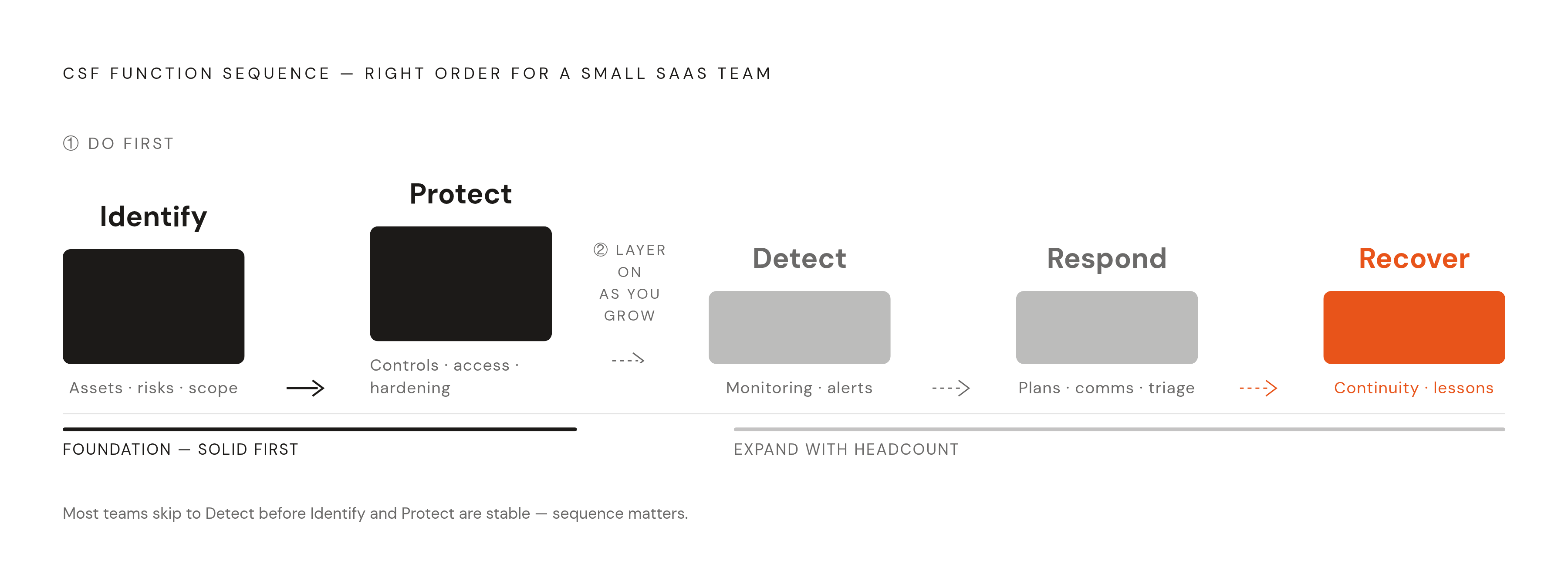
The CSF's core functions, including Identify, Protect, Detect, Respond, and Recover (with Govern added in CSF 2.0), sound like consultant-speak until you notice they describe the loop a small engineering team already runs, just without the labels.
Identify means knowing what's deployed, who has access to it, and which third-party integrations carry risk. That last part matters more than founders tend to assume: supply chain risk isn't a problem limited to the largest companies. It shows up the moment a startup connects a billing tool, an analytics SDK, or a support widget to production data, and a compromise anywhere in that chain becomes a compromise of the whole system.
Protect covers identity, access control, and data security, the daily-grind controls covered in more depth further down. Detect maps to log aggregation, alerting, and runtime visibility, and NIST calls for monitoring that's automated and continuous, tuned to how SaaS actually ships (multiple deploys a week, not a quarterly audit cycle). Respond is the incident runbook and the on-call rotation. Recover is the RTO and RPO targets, plus the after-action review once the fire's out.
Most teams get the order backwards. A seed-stage team should run Identify and Protect solidly and layer Detect and Respond on as headcount grows, not the other way around. Nobody expects a 12-person startup to run a security operations center staffed around the clock, and trying to build one anyway, instead of nailing identity and access control first, is how a small team burns its first security hire on the wrong problem. NIST CSF works as the starting map, with SP 800-53's controls as the next layer once the program has some maturity to it.
The multi-tenancy problem and what NIST says about isolating customer data
Multi-tenancy is the defining fact of SaaS architecture: one codebase, one application, many customers' data sitting somewhere in the same infrastructure. The risk that follows is obvious once you say it out loud: a misconfiguration in one place exposes tenant A's data to tenant B.
Misconfiguration, not some novel exploit, is the failure mode that actually shows up, and most teams are still pointed the wrong direction because of it. Far more engineering hours go into hardening the network edge than into checking whether a query filter can leak across tenants, and that's backwards, given where the breaches actually start.
SP 800-210 speaks directly to this with its access control guidance for cloud delivery models: controls need to go beyond the network edge and follow identity throughout the system. NIST's guidance, spanning SP 800-145 and SP 800-146, addresses the shared responsibility model: a SaaS provider owns much of the security stack, but data classification, identity and access management, and endpoint security remain areas where the startup building the product carries significant responsibility. That's exactly the slice an enterprise buyer's security team will interrogate during a vendor review.
A few patterns line up with this guidance in practice:
- Row-level security or schema-per-tenant design at the database layer
- A tenant ID embedded in every API call, validated server-side before any data goes back to the client
- Separate encryption keys per tenant, so one compromised key doesn't cascade across the whole customer base
- Per-customer cloud accounts or namespaces, so tenants stop sharing blast radius entirely
That last pattern is the strongest version of the principle, and it deserves to be the target, not a nice-to-have tacked on later. Infrastructure that deploys into a customer's own cloud account, instead of pooling everyone into shared multi-tenant infrastructure, makes the isolation guarantee structural instead of a matter of careful query-writing.
Access control and identity: the NIST controls that prevent the majority of cloud breaches
Start with where the breaches actually happen: identity, not some exotic zero-day. Weak or missing credentials, phished logins, stolen session tokens, an OAuth grant nobody remembers approving. That's the pattern behind most cloud compromise, and it's also the pattern NIST's SP 800-53 and SP 800-210 controls are built to close.
The fix isn't complicated, but it does take discipline most small teams skip in year one. Multi-factor authentication belongs on every user and every admin interface, no matter where the login request comes from. Role-based access control should run on least privilege, where each person's access matches the minimum their job requires, not the maximum that's convenient. Identity-based access control replaces the old assumption that being on the corporate network means you're trusted, and access lifecycle management means provisioning, periodic review, and prompt deprovisioning the day someone leaves, not the following quarter.
SP 800-210 isn't generic IT policy repackaged for the cloud. It addresses access control across cloud service delivery models specifically, which matters for a startup where infrastructure gets spun up and torn down constantly, sometimes hourly.
For a small team, the order of operations matters more than the wish list. Single sign-on comes first: route every application through one identity provider before touching anything else. Then move to phishing-resistant MFA, hardware keys or passkeys, for admin and production access, with TOTP as the bare floor for everyone else. Service accounts and machine identities need the same rigor as human ones: scoped, rotated, audited on a schedule, not when someone remembers. Every OAuth integration connected to the product deserves a standing review, because third-party OAuth grants are one of the more common ways an attacker walks in the front door without ever touching a password.
CI/CD pipelines deserve the same scrutiny as production, and most teams don't give it to them. Deploy keys, pipeline credentials, and repository secrets are an access control surface just like customer data, and a stolen deploy key can do as much damage as a stolen admin password. They need the same RBAC discipline applied to them, not an exemption because they live in a different tool.
Encryption and data security: what NIST requires and where SaaS teams typically fall short
NIST's position on encryption doesn't leave much room for interpretation: data encrypted in transit, data encrypted at rest, and access to the encryption keys guarded as tightly as access to the data itself.
Early-stage teams tend to trip on the same few things. Encryption at rest gets turned on at the storage layer, but the keys stay under the cloud provider's default service, with no tenant-specific isolation, which means one key compromise touches every customer at once. Internal service-to-service traffic runs unencrypted because a private network feels safe, even though NIST's zero-trust posture treats internal traffic as untrusted by default, and for good reason: a compromised container inside the network is still a compromised container. Sensitive fields, PII, tokens, session data, end up logged in plaintext, opening a second exposure surface that auditors will flag on sight. Without a documented data classification scheme, there's no way to know what actually needs encrypting in the first place, so teams either encrypt everything (slow, expensive) or guess (wrong, eventually).
Shadow data, meaning data nobody was tracking or logging in the first place, carries some of the highest breach costs observed in practice. Not knowing where the data actually lives makes it harder to detect and contain, and the cost compounds the longer that gap persists.
The SC family (System and Communications Protection) within SP 800-53 covers API security too, and NIST's newer guidance in this space addresses secure API gateways as integration points. A few controls line up directly:
- Authentication on every endpoint, with no unauthenticated surface left exposed in production
- Rate limiting and input validation to cut down injection risk
- Audit logging on every API call, with enough context to reconstruct what actually happened afterward
Credential attacks still cause more breaches than API or UI compromise does. But API security is arguably the one piece most fully within a SaaS team's own control to close off. Nobody else's misconfiguration is involved. It's the team's own endpoint, sitting there either locked down or not.
Continuous monitoring and incident response: the Detect and Respond functions in a lean team context
CSF 1.1 split the Detect function into three categories: anomalies and events, security continuous monitoring, and detection processes. CSF 2.0, the current version, folded those down into two, Continuous Monitoring and Adverse Event Analysis. Either way, NIST's expectation is monitoring that runs continuously and matches how SaaS ships, not a point-in-time review once a quarter.
Software vulnerabilities are now a leading cause of breaches, and detection lag, not just the initial failure, is usually what drives the eventual cost up. Patch cadence and vulnerability visibility carry as much weight as perimeter defense at this point. A vulnerability that sits unpatched for months does more damage than the vulnerability itself; the gap between "known" and "fixed" is where the real cost lives.
Practically, continuous monitoring for a lean team means a few things running at once. Log aggregation pulled together from cloud infrastructure, application, and identity layers, rather than three separate silos nobody cross-references. Alerts on anomalous authentication activity: impossible travel, credential-stuffing patterns, a new device logging into an admin account. Automated CVE scanning wired into the deployment pipeline so vulnerabilities surface at build time instead of six months down the line. And drift detection on cloud configuration, so a change to a security group or an IAM policy triggers an alert instead of going unnoticed for a sprint or two.
NIST's Respond function calls for response planning, communication, analysis, mitigation, and improvement, which in plain terms means a written incident response runbook exists before an incident happens, not one drafted in a panic during it. The minimum viable version covers defined roles for who declares an incident and who talks to customers during it, containment playbooks for the likely scenarios (credential compromise, data exposure, ransomware), communication templates ready for customer notification (enterprise buyers will ask to see this during security review), and a post-incident process that feeds back into the Recover function's improvement step.
Infrastructure that handles CVE patching and cluster upgrades on its own takes a whole category of detect-and-respond work off engineering's plate. When the platform patches itself, the team's monitoring attention stays where human judgment actually adds value: the application layer, where the business logic and the customer data actually live.
AI-enabled SaaS introduces attack surfaces that NIST's classic controls don't fully cover
The AI RMF 1.0 was built to help organizations manage the risks that come with AI systems and push toward development that's trustworthy and responsible by design. It sits alongside the CSF, not in place of it, because the attack surfaces AI introduces don't fit neatly into the older controls. Treating an LLM endpoint like any other API is where teams get caught.
Prompt injection is one: malicious input crafted to hijack an LLM's behavior, potentially pulling data out or slipping past authorization logic that was never designed with a chat interface in mind. Data leakage through retrieval-augmented generation (RAG) is another risk, and arguably the more dangerous one for a multi-tenant SaaS product. If the retrieval step isn't scoped to the requesting tenant's identity, the system can surface documents that belong to somebody else, and it'll do so politely, in a well-formatted answer, which makes the leak harder to notice. Model extraction, meaning repeated API calls designed to reverse-engineer a proprietary model, threatens the product's intellectual property, not just its data. And AI agents that can call tools, touching files, hitting APIs, running code, need least-privilege constraints tighter than what standard RBAC frameworks were built to enforce, because an agent's blast radius is whatever tools it has access to, not just whatever data it was trained on.
The controls that hold up under an enterprise security review tend to cover the same ground: tenant-scoped isolation at the retrieval layer, held to the same discipline as a database query; least-privilege API access for any AI agent or model-serving component; logging that's privacy-aware, capturing what's needed for debugging while redacting PII that doesn't need to sit in a log file; and a signed data processing contract with any third-party model provider that touches customer data.
GPU workloads and inference infrastructure bring their own configuration risks, too: model endpoints left open to the public internet, inference servers running on default credentials, training data sitting without access controls around it. The same encryption and access control principles from NIST apply here, but most teams miss it, because it's new infrastructure layered on top of controls written for a different kind of workload. The team just has to recognize the surface exists before it can be locked down. Enterprise buyers evaluating AI-enabled SaaS are already asking about these controls, and the standard security questionnaire has expanded to include AI data handling as a matter of course.
How NIST controls translate into SOC 2 and HIPAA evidence, and why they shouldn't be managed separately
Security has moved from a late-stage procurement hurdle to an early sales conversation. It comes up on the first call now, not at the term sheet stage, and a missing certification kills deals outright rather than just slowing them down. That's a sales problem as much as a security one, and treating it as purely a security team's job is a mistake that shows up in lost revenue before it shows up in an incident.
The controls underneath SOC 2, HIPAA, and NIST overlap heavily, and that overlap is the whole opportunity. Access control policies built to satisfy SP 800-53 also satisfy SOC 2's CC6 series and HIPAA's access management requirements, more or less at the same time. The controls themselves aren't different from one framework to the next. What differs is the evidence collection and the paperwork each auditor wants to see.
CMMC Level 2 maps directly onto the 110 controls found in NIST's SP 800-171, which means a team building toward CMMC is, in effect, building toward the same access control, audit, and incident response foundation that SOC 2 and HIPAA already expect. Treating these as three separate compliance projects wastes engineering time on duplicate work, and it's the wrong call every time someone makes it. A single control implemented once, MFA enforcement, tenant isolation, audit logging, whatever it is, should generate evidence for every framework that asks about it. The moment a startup starts managing NIST, SOC 2, and HIPAA as parallel checklists instead of one underlying control set with three sets of paperwork attached, it's paying twice for the same security.
Sources
- SaaS Company | NIST Security Guide (2026)
- NIST AI Cybersecurity Guidance for SaaS Startups - Gensys Technology
- What Is NIST? Understanding Its Role in SaaS and AI Security
- NIST Cloud Security: Framework, Controls & Checklist 2026
- What Is NIST CSF? Framework 2.0 Explained
- konfirmity.com
- ones.com
- media.defense.gov