Automating CVE Patching in Containerized Production Environments
Layering exploit data and reachability analysis cuts CVE backlogs from unmanageable to actionable.

Most engineering teams treat CVE management like a counting exercise: more disclosures means more work, so the fix is more scanning and more patching capacity. That framing misses the actual crisis. Annual CVE disclosures are headed for a new high in 2026, and a container fleet running thousands of images doesn't need a faster scanner so much as a way to know which findings deserve attention today versus next quarter. A team that tries to patch a running container the way it would patch an old-school legacy server is fighting its own infrastructure, because containers are meant to be replaced, not edited in place.
Scanners already do their job. The actual bottleneck sits downstream of detection, in the slow, manual work of deciding what matters and then rebuilding the right images fast enough to matter. A single OpenSSL patch can eat half a sprint when a team has to manually rebuild a fleet of microservices, each one sitting on a slightly different base image, each one needing its own verification pass. It's a failure of process and architecture working against each other, which repeats every time a new high-profile CVE lands, because nothing about the underlying system changed between incidents.
AI adds pressure from both directions at once. The volume of disclosures climbing year over year isn't a temporary spike that will level off. Solving that problem starts with recognizing what it actually is: not a shortage of scanning, but a shortage of prioritization and a mismatch between how containers are meant to be updated and how most teams still try to update them.
How scoring systems — CVSS, EPSS, and KEV — differ in what they tell you about a CVE
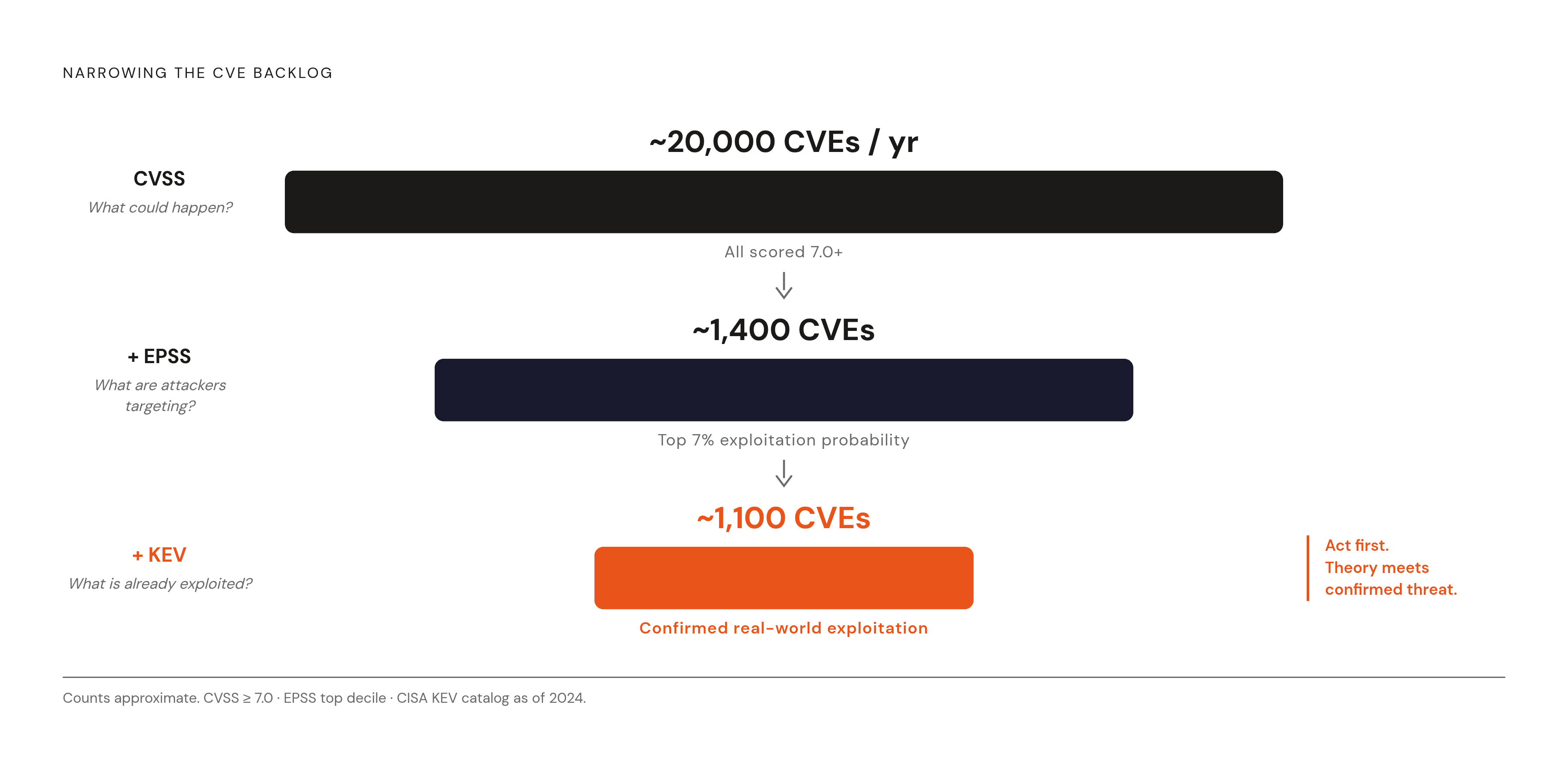
Three scoring systems get used almost interchangeably in most vulnerability reports, and that habit is how teams end up treating theoretical medium-severity bugs as five-alarm fires while flaws under active exploitation sit untouched in the backlog. CVSS, EPSS, and CISA's KEV catalog each answer a different question, and knowing which question each one answers is the first real step toward a workable triage process.
CVSS measures severity of potential impact, in the abstract. A high CVSS score tells you what could happen if the flaw were exploited: how much damage, how much access, how much blast radius. It says nothing about whether anyone is actually exploiting it anywhere. A high score sitting in an unreachable code path can be far less urgent than a lower score sitting on an internet-facing endpoint.
EPSS, the Exploit Prediction Scoring System, estimates the probability that a given CVE will be exploited in the near term, built from observed threat intelligence rather than theoretical severity. A meaningfully elevated EPSS score is a signal grounded in real-world attacker behavior: this flaw is the kind attackers are actually going after right now, not just the kind that looks scary on paper.
CISA's KEV catalog is the tightest filter of the three. If a CVE is in KEV, someone has already used it against a real target.
Used alone, CVSS produces a backlog too long for any team to realistically clear. Layering EPSS and KEV on top of it turns that same backlog into something closer to a short, ranked worklist where the items at the top carry either documented exploitation or strong predictive signals of it. A few recent CVEs make the gap between raw severity and real urgency concrete. CVE-2026-53492, a containerd flaw, carries a CVSS score of 9.6. CVE-2025-23266, known as NVIDIAScape, scores 9.0 and can be triggered with a three-line Dockerfile. All three are severe by CVSS alone, but severity alone doesn't tell a team which one to drop everything for. Context of exposure does that work.
NVIDIAScape deserves a closer look, because it shows how severity, exploit simplicity, and exposure can stack into something urgent. On shared, multi-tenant GPU infrastructure, that flaw opens a path for one tenant to reach and compromise the underlying host, not just their own workload. A high CVSS score, a minimal and confirmed exploit path, and broad surface area across shared infrastructure, together, are what should trigger an immediate response rather than a scheduled one. That combination is rarer than CVSS alone would suggest, and recognizing it is the whole point of layering these three systems instead of relying on any one of them. Not every serious flaw has a patch waiting, and when no vendor fix exists yet, the right move is a compensating control built from the vulnerability advisory itself, rather than sitting idle until a fix ships that may be weeks or months away. GPU and AI infrastructure carry enough of this pattern that it gets its own treatment later in this piece.
Triaging the real queue: a risk-based prioritization workflow before any automation runs
Scoring systems give a team the vocabulary to describe risk. Turning that vocabulary into a daily decision process is a separate job, and skipping it is how automation ends up executing the wrong remediation faster than a human ever could. A workable triage workflow runs in four layers, applied every time a new scan comes back, not configured once and forgotten.
The first layer is the exploitability filter itself: cross-reference every scanner finding against CISA's KEV catalog and against EPSS scores above a meaningful threshold. Anything below that line gets scheduled for normal maintenance, not treated as an emergency. This single filter does most of the work of turning an unmanageable report into something a team can actually act on in a day.
The second layer is reachability. A medium-severity flaw buried three layers deep in a Node.js dependency tree, one the app never executes, doesn't belong in the same bucket as a high-severity bug sitting in the HTTP layer that handles live traffic. Reachability analysis is what separates theoretical exposure from real exposure, and it often reclassifies findings that CVSS alone would have flagged as urgent.
The third layer is surface area: how many images carry this CVE, how many services run those images, and how many environments, staging, production, internal tooling, are affected? Surface area tells a team how much is actually riding on a single fix landing correctly.
The fourth layer is fixability. Does a patch exist? If no patch exists yet, what compensating control can stand in until one ships? This is often where teams get stuck, because a fix that exists in theory but breaks three other packages on upgrade isn't really a fix a team can ship that day.
ActiveState's analysis of why traditional remediation breaks down identifies a structural cause: the full picture of what's actually vulnerable gets lost between the security team's scanner, the developer's package manager, and the CI/CD system, because those three tools rarely talk to each other. A triage workflow has to deliberately bridge those three contexts, or the four layers above stay theoretical no matter how well they're defined on paper. IBM Concert's prioritization approach is a useful illustration of what production-grade triage looks like in practice: its AI-driven risk scoring weighs dependency mapping, system topology, service criticality, and maintenance windows together, rather than issuing a blanket instruction to patch everything that shows up on a report.
Rebuilding at the base image layer: why the fix starts upstream of the application
The most durable fix to this entire problem is maintaining a small set of hardened base images that rebuild automatically the moment an upstream CVE gets disclosed. Every application image built on top of a clean base inherits that fix the next time it rebuilds, with no engineer needing to touch a single service by hand.
This only works because of how immutable infrastructure is supposed to behave. You never patch a running container. You build a new image, test it, and replace the old one. That's not a limitation teams have to work around; it's the mechanism that makes automation possible.
A shared base image strategy concentrates the entire remediation surface into one place. Fix the vulnerability once, upstream, in the base image, and every application built on it picks up the fix on its next rebuild. Fixing the vulnerability once in the shared base image is the structural answer to the OpenSSL delay described earlier: the half-sprint lost manually rebuilding a fleet of slightly different microservices disappears once those services all derive from the same maintained base.
Dependency depth is where this gets genuinely hard. In-place patching can't resolve that cleanly; rebuilding from source can, because it forces the whole dependency graph to resolve correctly rather than getting patched piece by piece and hoping nothing breaks. Building containers from source with signed software bills of materials (SBOMs) gives teams a documented, verifiable foundation and closes the provenance gap that makes manual patching so fragile. When a new CVE drops, a signed SBOM tells a team immediately which images are affected, rather than leaving someone to grep through package lists under time pressure.
Minimal base images help structurally too. A distroless or stripped-down image carries fewer packages. Fewer packages means fewer CVEs even show up to triage. Getting the rebuild cadence right is the last piece. Daily rebuilds against upstream package repositories, or rebuilds triggered the moment an upstream CVE is disclosed, should be the target. Teams that track Mean Time to CVE (MTTC), the time between an upstream patch becoming available and that fix landing in a production image, have a concrete number to drive down instead of a vague sense that patching "should be faster."
Assembling the automated patching pipeline: scan, patch in-pipeline, generate PRs, and deploy via GitOps
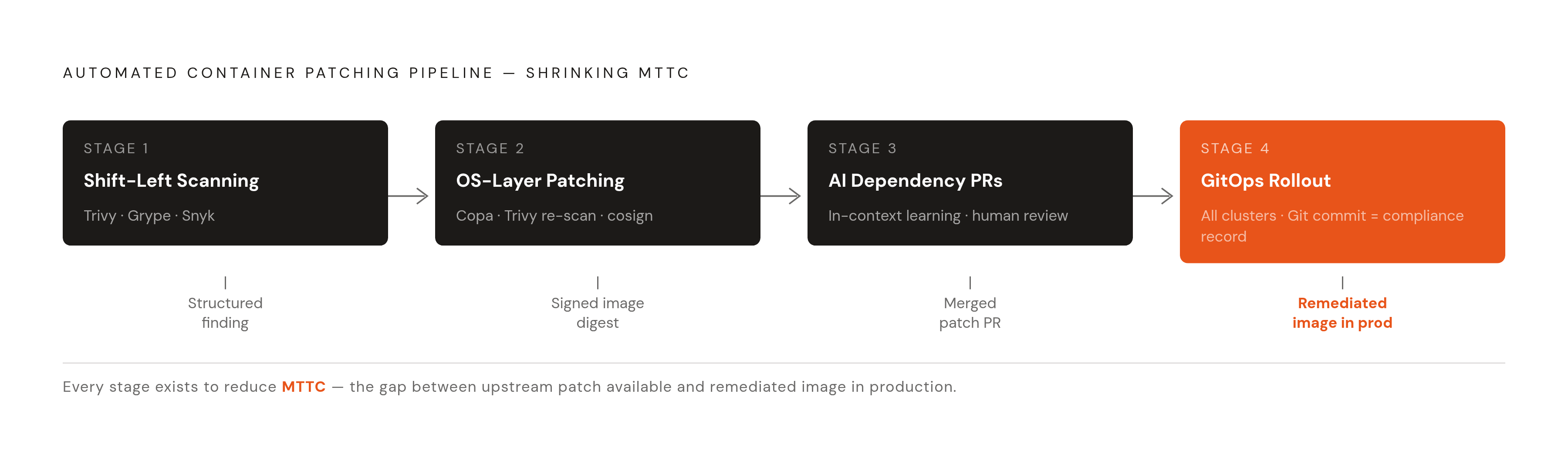
Everything built so far, the scoring vocabulary, the triage layers, the base-image rebuild strategy, comes together as a four-stage pipeline: shift-left scanning, in-pipeline patching, AI-generated dependency PRs, and GitOps-driven rollout. Each stage hands a verified artifact to the next, and for anything that's already cleared triage, the whole loop runs without anyone needing to step in.
Stage one is shift-left scanning, built directly into CI. None of the three handle runtime monitoring on their own, so a dedicated tool like Falco fills that gap. The output isn't a report for a human to read line by line but a structured finding the next stage can consume on its own.
Stage two handles OS-layer patching inside the pipeline, using a tool like Copa (short for Copacetic). The loop runs like this: Trivy scans, Copa patches, Trivy scans again to confirm the CVE is actually gone, and cosign signs the resulting digest. The whole sequence runs inside the pipeline with no manual step in the middle. One detail matters a lot here for any team running third-party or upstream images: Copa can patch images it didn't build, pulled from registries it doesn't own, which covers a huge share of what actually runs in most container fleets.
Stage three covers dependency-layer CVEs that live in application code rather than the OS layer, and this is where generated pull requests come in. An architecture used by AWS relies on in-context learning: building a prompt from the current dependency list plus a worked example of what a correct PR looks like, so the generated fix stays scoped to the actual problem instead of guessing at unrelated changes. Every one of these PRs still goes through normal human review before merging. That keeps the regression safety net fully intact while removing the hours a developer would otherwise spend researching the fix and drafting the change by hand.
Stage four is GitOps-driven rollout. A GitOps agent picks up that change and rolls it out automatically across every targeted cluster. This produces a clean, auditable history of every remediation that's ever happened: the Git commit itself becomes the compliance record, instead of a separate ticketing system someone has to maintain in parallel. Mean Time to CVE, the gap between an upstream patch becoming available and a remediated image reaching production, is the number this entire four-stage pipeline exists to shrink.
On the enterprise end of this spectrum, IBM Concert Protect brings continuous vulnerability detection, AI-driven risk prioritization, and orchestrated patch deployment together across hybrid and multi-cloud infrastructure. IBM states this lets companies deploy patches up to ten times faster, with container and language-environment patching on its public roadmap and Deutsche Telekom named as a production adopter. It's a useful marker of where this kind of pipeline can scale to once the fundamentals above are in place.
GPU and AI workloads need a distinct patching cadence inside this pipeline
GPU and AI workloads introduce a vulnerability class the standard pipeline above doesn't fully cover: container escape through the GPU driver boundary. That risk lives below the OS package layer that Trivy, Copa, and the rest of the pipeline are built to patch. It needs its own cadence and its own set of controls, not a bolt-on to the existing flow.
GPU workloads operate in a way that makes the mechanism behind this specific to them. When input validation on that boundary breaks down, it exposes the underlying host kernel directly, not just the application sitting inside the container. A flaw in the NVIDIA Container Toolkit, the standard path for GPU access, on shared multi-tenant infrastructure, can let one tenant reach straight through to the host underneath everyone else; this is a host compromise path that sits entirely below the image, not a flaw in application code or in an OS package, and it is why NVIDIAScape mattered enough to dwell on earlier. Teams running GPU and AI workloads on shared infrastructure need a patching cadence built around this driver-boundary risk specifically, layered on top of the pipeline already doing the rest of the work.