SOC 2 vs ISO 27001 for SaaS Startups
SOC 2 vs ISO 27001 comes down to where your customers are and what they contractually demand.
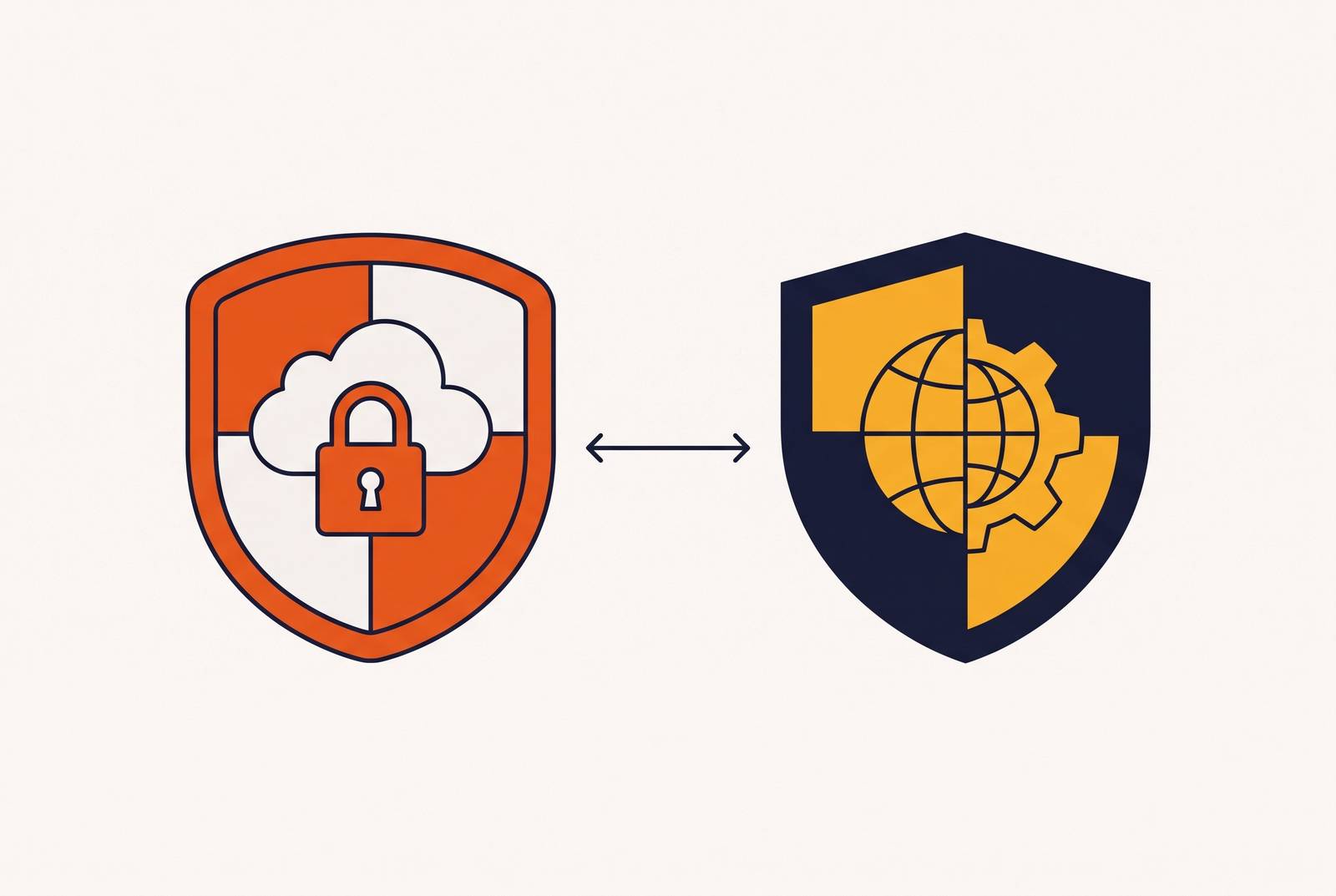
SOC 2 vs ISO 27001 is a practical choice driven by customer and market demands rather than framework values. It's a logistics problem: match the credential to where your buyers sit and what they've already written into their contracts, and the decision makes itself. Most founders spend weeks debating this like it's a branding question. It isn't.
Security now comes up in the first sales call for most B2B buyers, and missing or unverifiable credentials disqualify companies from competitive evaluations regularly. Treat compliance as paperwork and it costs you revenue. Treat it as a sales asset, which is what it actually is, and the framework choice stops being confusing.
What SOC 2 and ISO 27001 actually are, and where the terminology trips people up
Start with the mistake nearly every founder makes the first time someone explains this to them: SOC 2 is not a certification. It's an attestation. The AICPA developed it, and what a company walks away with is an auditor's report, not a certificate from a standards body. Say "SOC 2 certified" in front of an actual auditor and watch the wince. The correct phrase is "SOC 2 attested" or "SOC 2 compliant," though almost nobody bothers with the distinction in a sales conversation, and honestly, nobody on the buyer's side cares either.
SOC 2 grades a company against five Trust Services Criteria. Security is mandatory. Availability, Processing Integrity, Confidentiality, and Privacy are optional, chosen based on what the business actually does. There are two report types. Type I is a snapshot: are the controls designed correctly, as of one date. Type II is the harder one. It measures whether those controls actually worked over a minimum six-month window. Enterprise buyers want Type II, full stop. Type I, doable in two to four months, is really just a stopgap to unblock a deal while Type II is still in progress.
Scope is a lever founders underuse. A company defines its own SOC 2 boundary, which means a startup can scope the audit to just its core SaaS product and leave out the messier, less mature corporate functions that aren't ready for scrutiny.
ISO 27001 works differently. Published by ISO/IEC, it results in an actual certificate, the kind you can hand to a procurement officer or post on a trust page. Getting there means building an Information Security Management System (an ISMS) within a defined scope, which can also be narrowed to one product or business unit. The certificate lasts three years, with annual surveillance audits keeping it valid in between.
Timing matters here in a way a lot of founders miss. The current version is ISO 27001:2022, and the transition deadline from the 2013 version passed on October 31, 2025. Old certificates no longer count, and vendor security reviews will flag them immediately. The 2022 revision cut Annex A controls from 114 down to 93 (57 merged into 24, 58 stayed mostly the same), and added 11 new ones, including Threat Intelligence, Cloud Services Usage, Data Masking, and Secure Coding. Companies also have to produce a Statement of Applicability: a document walking through all 93 controls and explaining which are implemented, which are excluded, and why.
Here's the number that should actually drive sequencing decisions: the two frameworks overlap by roughly 80% in the controls and criteria they cover, per AICPA mapping. That overlap is the whole reason the second certification, whichever comes second, ends up dramatically cheaper than the first.
The primary decision variable: where your customers are and what they contractually require
Geography decides more of this than anything else does, and founders who skip this step end up chasing the wrong credential for months.
SOC 2 is the default in US enterprise procurement. A startup selling into that world hits SOC 2 questionnaires early and often. Cross into Europe, Asia-Pacific, or the Middle East, though, and the ground shifts. ISO 27001 carries more weight there, and European enterprises often treat SOC 2 as insufficient on its own. In regulated sectors, banking, insurance, healthcare, particularly across the EU and APAC, ISO 27001 carries significant weight and is frequently written into supplier contracts.
The EU's DORA regulation, enforced since January 17, 2025, has already pushed SaaS companies serving European financial institutions toward holding both certifications simultaneously. This is not a prediction. It's already happening, and it tells you where the market is heading for any startup with international ambitions.
Skip the industry folklore and pull the actual evidence: the recent enterprise deals that stalled or died in procurement. What got requested, in writing? Not what people assume buyers "usually" want. The real document trail. US-only or US-first pipeline points to SOC 2 first. EU or APAC-heavy pipeline, or genuine global enterprise ambition, points to ISO 27001 first, or both running in parallel.
The five questions that produce a clear answer for most startups
Five questions, asked in order, filter almost every startup down to a clear answer.
Who are the largest current or target customers, and where do they sit? US mid-market SaaS and IT buyers point to SOC 2. EU, UK, or global enterprise buyers point to ISO 27001.
What do the biggest target accounts actually require, in writing, in contracts or security questionnaires? Not industry assumption. Actual contract language, sitting in an email or a procurement portal somewhere.
How fast does a credential need to exist to unblock a deal? When a deal is stalled now and speed matters most, SOC 2 Type I is the fastest path to an unblocking credential. When there is more runway on an enterprise pilot, ISO 27001 planning can begin, or SOC 2 Type II can run in parallel.
Is the market US-only, US-first, or already multiregional? Multiregional, especially anything touching EU, APAC, or public sector, puts ISO 27001 on the near-term roadmap whether the founder feels ready for it or not.
Does the business need a controls-focused attestation for one defined product, or a governance-level system that scales across multiple business units? The first points to SOC 2. The second points to ISO 27001.
Answer the first three honestly, and most US startups land on SOC 2 Type II as the right first move. That's the outcome in the large majority of cases, not a coin flip. The exceptions are real but narrow: substantial EU or APAC expansion already underway, regulated-sector customers like banks or hospitals demanding ISO 27001 by name, or a founding team with European enterprise roots where ISO 27001 was the expected credential from day one.
How cost and timeline differences should factor into the sequencing decision
Money and time separate these two paths sharply. Budget for both honestly instead of guessing, because the guessing is where founders get burned.
SOC 2, first year, all-in, typically runs $25,000 to $50,000 for a small SaaS startup. Roughly $7,000 to $30,000 goes to the audit itself, $8,000 to $20,000 to a compliance platform, and $5,000 to $15,000 to a penetration test if the auditor requires one. After year one, ongoing maintenance runs $15,000 to $40,000 annually across re-audits and platform subscriptions. Adding trust categories beyond Security costs more: Availability or Confidentiality each tack on roughly 10% to 20%, and Privacy can add up to 50%. The cost founders miss most is time. It's staff time. A first SOC 2 effort, which typically eats 100 to 300-plus internal hours across security, engineering, legal, and operations, is the line item that blows up timelines when nobody plans for it.
ISO 27001 costs more, often meaningfully more for an early-stage company building an ISMS from nothing. The timeline gap tells the same story: ISO 27001 certification typically runs longer than SOC 2, with SOC 2 Type II generally completing faster. SOC 2 Type I, at two to four months, has no equivalent shortcut anywhere in the ISO 27001 process. Once certified, ISO 27001 locks in annual surveillance audits across a three-year cycle, so the recurring cost never really goes away.
Run the ROI math: if SOC 2 unlocks one enterprise deal worth $100,000 or more annually, the first-year spend pays for itself immediately. When that same report also replaces ten or fifteen separate custom security questionnaires from different customers, the cost stops looking like overhead and starts looking like leverage, which is the correct way to think about it. And the downside case deserves naming too. IBM's 2024 Cost of a Data Breach Report put the average US breach at $4.9 million. Compliance spend is cheap insurance against a failure that costs orders of magnitude more.
The 80% overlap means pursuing both frameworks isn't double the work, whatever the sticker price suggests at first glance. Companies that go SOC 2 first and add ISO 27001 later do it at a fraction of what a from-scratch ISO 27001 effort would run.
What AI SaaS startups face that general SaaS guidance misses
AI SaaS companies carry a heavier burden than the standard SaaS playbook accounts for. They handle sensitive data for training and fine-tuning, plug into enterprise workflows in ways that are hard to fully inspect from the outside, and route information through pipelines that don't map cleanly onto a normal procurement questionnaire.
That's exactly why SOC 2's Processing Integrity criterion matters more here than it does for a typical SaaS vendor. Enterprise buyers evaluating an AI product want proof that model outputs and data pipelines are accurate, complete, and resistant to tampering. Encryption at rest doesn't answer that question.
ISO 27001:2022's new controls line up unusually well with AI infrastructure concerns, and this is where the timing of the 2022 revision actually works in a startup's favor. Threat Intelligence, Information Security for Use of Cloud Services, and Data Masking speak directly to the data governance questions AI buyers ask, questions the 2013 version never anticipated because it predates the problem. For a startup building toward ISO 27001 today, that's a real edge over anyone still running the older standard.
There's a regulatory current underneath all of this too. The EU AI Act introduces risk management and documentation obligations that share common ground with an ISMS-based approach. For an AI company with any EU ambition, ISO 27001 stops being just a security credential. It becomes the governance foundation the AI Act compliance work gets built on top of.
One thing AI startups consistently under-scope: GPU workloads, inference endpoints, and training pipelines raise data residency and access control questions that a narrow SOC 2 or ISO 27001 boundary won't cover. Draw the scope too tight, and a sophisticated buyer's security team catches it within the first round of follow-up questions, and then the whole review slows down while you go back and re-scope.
When dual certification makes sense and how to pursue it without doubling the work
Dual certification isn't overkill across the board, but it's the right call for a specific set of companies: startups selling into both US enterprise and EU or APAC markets, companies in regulated sectors like fintech, healthtech, or insurtech where buyers won't negotiate the requirement away, and companies approaching Series B and beyond where deal sizes finally justify the spend.
Investors care about this too, and that preference only strengthens as a company matures, which is exactly why the case for dual certification compounds with stage instead of staying flat.
The sequencing that works for most US-first startups looks like this: SOC 2 Type I first, to unblock deals stuck in procurement right now. SOC 2 Type II next, to satisfy the ongoing enterprise requirements Type I alone can't cover. ISO 27001 after that, once the international pipeline is real instead of aspirational.
The 80% control overlap is what makes this sequence efficient instead of exhausting. A company that's done SOC 2 Type II properly has already built most of what ISO 27001 asks for. What's left is largely documentation, ISMS structure, and the Stage 1 and Stage 2 audits, not rebuilding a security program from zero. Compliance automation platforms cut the duplicate paperwork substantially here, which matters most for lean teams trying to run both processes without hiring dedicated compliance staff.
DORA's enforcement is the clearest real-world proof of where this is heading. SaaS companies already serving EU financial institutions haven't chosen dual certification out of ambition. They've been pushed into it by contract language they can't negotiate around. That's a forcing function already reshaping how internationally minded SaaS companies plan their roadmap, not a future scenario.
A practical starting point: the first 90 days regardless of which path you choose
Whichever framework wins the decision, the first 90 days look almost identical.
Pull the last ten procurement questionnaires from the sales pipeline and count which credential shows up most. That's a factual answer, not a guess, and it should outweigh whatever the industry conventional wisdom says. Define scope before an auditor ever gets involved: for SOC 2, that means scoping the SaaS platform itself, not the whole company; for ISO 27001, it means drafting the ISMS scope statement with legal and engineering in the room early, not after the audit firm asks for it. Pick a compliance automation platform sooner rather than later. The $8,000 to $20,000 it costs tends to pay itself back fast in engineering hours saved on evidence collection and policy upkeep. And before signing with an audit firm, ask for a gap assessment first. Most firms offer this as a low-cost step, and it surfaces remediation work that changes both the timeline and the budget before anyone's locked into a contract they can't easily unwind.
One more thing worth flagging for startups running on shared-tenant infrastructure: when the line between a company's own controls and the underlying platform's controls gets blurry, the compliance story gets a lot harder to tell cleanly to an auditor, or to a buyer's security team reading the report six months later. That's the moment to ask whether infrastructure running in a company's own cloud account, with SOC 2 and HIPAA tooling already built in, actually shortens remediation, because in a lot of cases it does.
SOC 2 Type I, done in two to four months with a tightly defined product scope and a decent compliance platform, is within reach for almost any US-focused startup. It's the right first move for any founder who has already watched a deal die over a missing security credential, and there's no real argument against starting there. None of this closes a door, either. Picking SOC 2 first doesn't rule out ISO 27001 later. Given the 80% overlap, it builds the foundation for it.