Achieving SOC 2 Readiness Without a Dedicated Security Team
Enterprise buyers now require SOC 2 Type II reports to close deals.
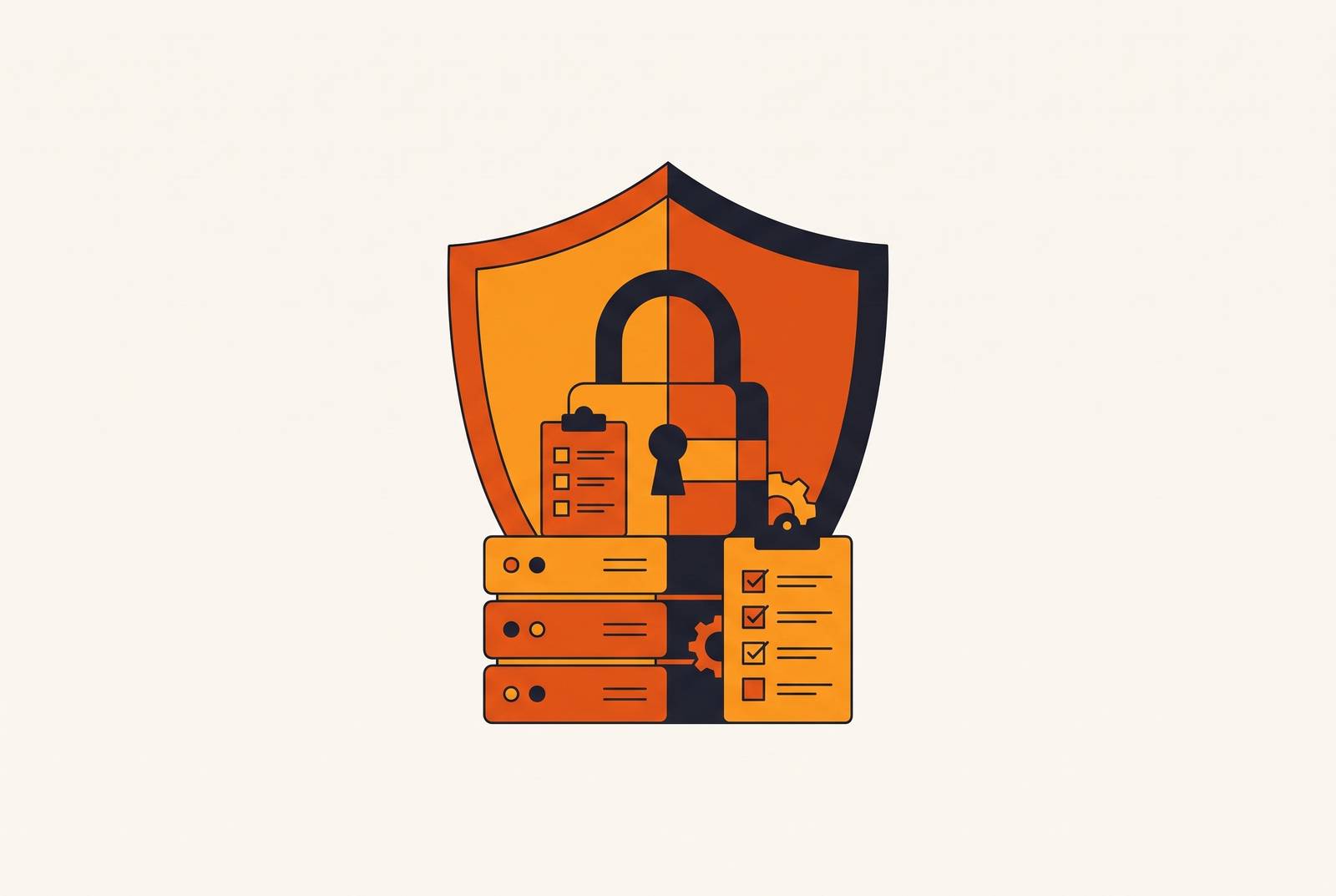
Startup founders who think SOC 2 is out of reach without a security hire have it backwards. What it actually takes is three things: infrastructure decisions made early, automation tools that collect evidence instead of a person doing it by hand, and a roadmap that treats the whole project as revenue work, not paperwork.
And it is revenue work. Enterprise buyers stopped taking a vendor's word for it on security, full stop. Most mid-market buyers and nearly every Fortune 500 company now ask specifically for a Type II report, not just any SOC 2 document, and without one a startup ends up answering security questionnaires by hand, sometimes past 100 questions per prospect, burning weeks of a sales cycle on paperwork instead of closing. Every decision below should get treated as a revenue decision, because that's what it actually is.
What SOC 2 actually requires and what the two report types get you
SOC 2 is an attestation, not a badge. A licensed CPA firm examines the evidence and signs off on whether the controls exist and actually work. No seal, no logo for the website. Just a signed opinion that sits behind an NDA.
The framework covers five Trust Service Criteria: Security, Availability, Confidentiality, Processing Integrity, and Privacy. Security is the only mandatory one, and that's where most lean startups should stop. Each extra criterion tacks on real audit cost, so scope should follow what's actually showing up on enterprise security questionnaires, not a founder's instinct to look thorough by piling on categories nobody asked about.
Type I versus Type II is the decision that actually matters. Type I checks whether controls are designed and in place on one specific date. It's the cheaper, faster report, done in weeks. Type II asks whether those controls operated effectively over a much longer stretch, several months to a year, and that's the report enterprise buyers actually want. Skipping straight to Type II without ever running Type I means leaving a usable, sellable interim asset on the table for months while the clock runs.
The AICPA updated its official SOC 2 Description Criteria implementation guidance in July 2025. The Trust Services Criteria themselves didn't change, but any auditor engaged after that date should be working from the current version, not an old one sitting in a drawer.
SOC 2 reports are restricted-use documents, shared under NDA with specific prospects, not something to post on a marketing page. A SOC 3 report is the public-facing version, if that's the goal. Type II reports cover a fixed observation period, which turns this into an ongoing project without a finish line. It's an annual rhythm, not a certificate you frame and forget.
The smart move for most lean teams is a bridge strategy: run Type I fast to unblock whatever deal is stuck right now, and start the Type II observation window on that same day. Evidence builds in parallel from day one, so by the time the Type II audit rolls around, a full year of data is already sitting in the system waiting to be pulled.
Deciding when to start and which report to pursue first
Start now if an enterprise deal is stalled on a security questionnaire. Start now if a Series A or B is underway and investors are asking pointed questions about compliance posture. Start now if the product touches personal, health, or financial data at any real scale.
Wait if infrastructure changes weekly. Controls can't prove they're operating consistently if the environment underneath them won't hold still, and an auditor catches that immediately. Wait if nobody on the team owns security decisions, because there's no one to answer the auditor's questions. Wait if there's no enterprise pipeline in the next six months, since the timing just doesn't pencil out yet.
Start three to six months before the first enterprise deal is expected to close. That's not a guess so much as arithmetic: the Type I audit itself runs a matter of weeks, but everything before it (the gap assessment, the remediation work) eats up months on its own.
Run the bridge strategy and here's what it actually looks like in practice. Type I closes out fast and unblocks the deal on the table today. The Type II observation window opens on day one of that same process, so no calendar time gets wasted waiting for ink to dry on the first report. A year later, the evidence is already banked and ready to hand to the auditor.
Infrastructure readiness is the part nobody budgets time for, and it's the real bottleneck underneath all of this. A team spinning up new services ad hoc, shifting access permissions week to week, can't demonstrate the steady, almost boring consistency an auditor is checking for. That thread runs straight into the infrastructure section further down.
The gap assessment: mapping what you have against what auditors will examine
A gap assessment is an internal inventory, done before an auditor ever sees the environment. Walk through what controls already exist, which ones are half-built, and which ones don't exist at all.
Auditors dig into six domains. Access controls and identity management: who can reach what, and how access gets granted and pulled back. Security policies: documented, approved, and communicated to the team, not living in a founder's head where nobody else can check it. Monitoring and logging: continuous proof that controls are doing what they claim to do, not a screenshot from three months ago. Vendor and third-party risk management: documentation on every supplier that touches customer data. Incident response: a process that's actually been tested, not written down once and forgotten in a drive. And a risk assessment program: a live risk register with named owners, updated on a real schedule.
Access controls are where early-stage teams fall down hardest, and the reason is concrete: stolen or weak credentials, brute-force attempts, and phishing drive the majority of breaches industry-wide. MFA enforcement and tight access management aren't extras here. They're the first thing an auditor checks, and often the first thing a five-person team never got around to.
The output of all this is a prioritized remediation list, owners and deadlines mapped against the Trust Service Criteria. That list becomes the actual project plan, not a document that sits untouched in a shared drive.
No software fixes what a gap assessment finds. Vulnerability management, encryption, network segmentation: these take real engineering hours, not a subscription fee. If the team already runs on CIS, NIST, ISO, or PCI standards, a lot of the required evidence probably already exists somewhere in the org. Check that first, before assuming the project starts from zero.
Where compliance automation tools genuinely help and where they stop
Automation platforms are good at exactly two things: telling a team what's broken, and collecting proof that what got fixed stays fixed. They do not fix anything themselves, and that distinction is worth being blunt about. A red flag in a Vanta dashboard reading "vulnerability management" still means an engineer opens a terminal and patches something by hand.
Here's what these platforms handle well. They pull continuous evidence from cloud providers, HR systems, and code repos, replacing what used to be manual screenshot collection done at 11pm before a deadline. They hand over policy templates so a five-person team gets a documented security program without anyone drafting one from a blank page. They fire real-time alerts when a control fails or a document expires, which matters enormously once Type II maintenance kicks in. And they package audit-ready evidence that cuts down the back-and-forth with the CPA firm.
Vanta covers SOC 2, ISO 27001, HIPAA, and GDPR with several hundred integrations. Drata runs continuous control monitoring across dozens of integrations, pulling from AWS, GCP, GitHub, and HR platforms on its own. Secureframe leans on guided setup and checklists for teams with zero compliance background. Scrut handles SOC 2, ISO 27001, GDPR, HIPAA, and PCI DSS in one dashboard, with automated vendor risk assessments built in. Scytale pairs automation with actual GRC experts who walk a team through the process, aimed squarely at companies with no in-house compliance staff at all. Sprinto offers real-time visibility through cloud and dev tool integrations.
Pick based on team shape, not a features list. A team with no compliance background at all wants Scytale's paired-expert model over a pure self-service tool, every time.
None of this holds still, either. Evidence expires, and SOC 2 evidence needs constant refreshing rather than a one-time upload and walk away. The alerting function is really what keeps a small team from quietly blowing past a renewal window a year down the line.
How infrastructure choices made before the audit determine how hard the audit is
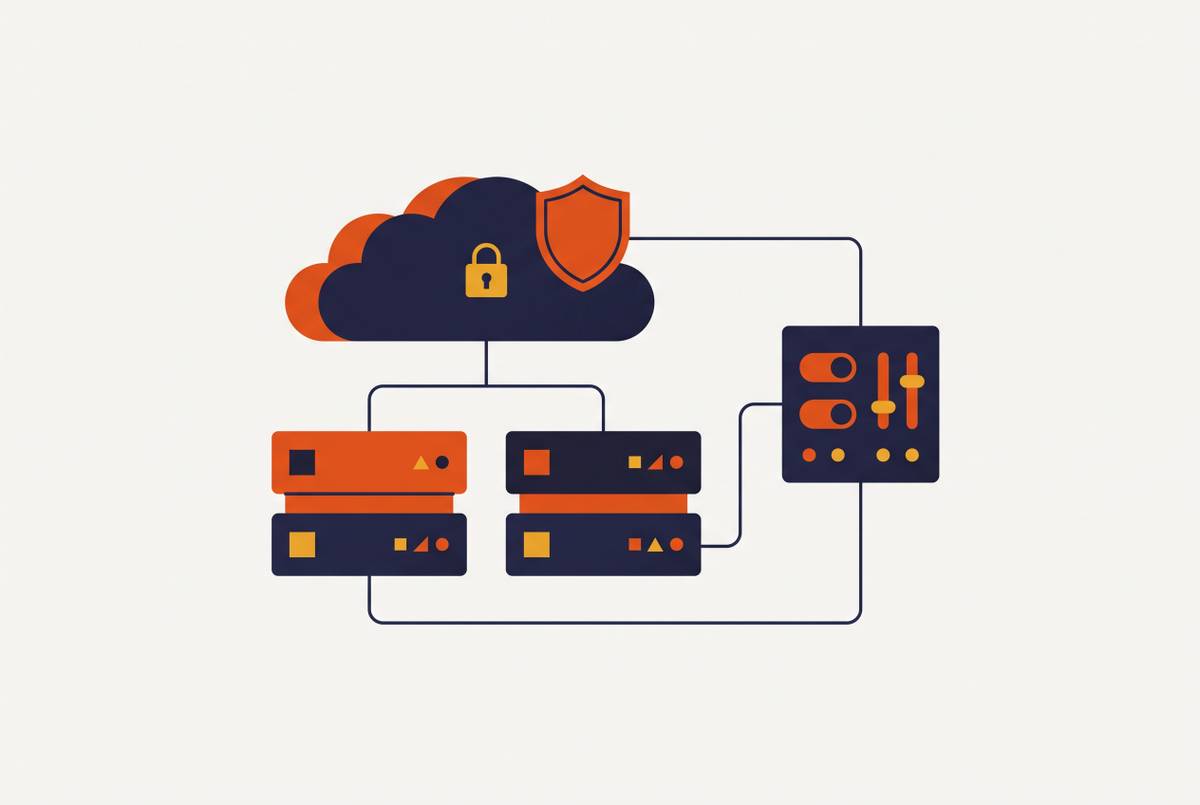
A compliance tool can only collect evidence that already exists in the environment. If logging, encryption, access controls, and network segmentation aren't already built into the infrastructure layer, someone has to instrument all of it by hand before any automation platform has anything to pull from.
Infrastructure should already handle five things by the time SOC 2 prep starts. Encryption at rest and in transit, configured and verifiable, not just assumed to be switched on somewhere. Audit logging that's continuous and tamper-evident, tracking who touched what and when, down to the timestamp. Network segmentation that keeps production walled off from development, no shared credentials bridging the two. Access control enforcement, meaning RBAC, least-privilege defaults, and MFA baked into the infrastructure layer rather than bolted on later as an afterthought. And automated vulnerability and patch management, since CVE detection is one of the most commonly failing controls for early-stage teams.
Not every hosting platform earns its keep here. Heroku moved into sustaining engineering in February 2026, which means its compliance posture is now frozen: no new features, nothing evolving to meet what audits require going forward. It also abstracts away the underlying cloud provider by design, which makes strict compliance configurations and private networking harder to set up, not easier. Render is SOC 2 Type II compliant and launched a HIPAA workspace in 2025, though that workspace is new enough that it doesn't have a long enterprise audit track record behind it yet. Render's pricing is modest relative to the audit fees above.
Then there's bring-your-own-cloud: deploying into a startup's own AWS, GCP, or Azure account instead of a shared-tenant provider. Under BYOC, compliance evidence lives inside the team's own account, auditable under its own logging and access controls, and doesn't depend on some third-party provider's compliance roadmap eventually catching up to what the audit needs.
Infrastructure with one-click SOC 2 and HIPAA configurations, automatic CVE patching, and audit logging built in means the GRC tool starts collecting evidence on day one, instead of waiting on an engineering team to build the instrumentation first. Teams running on infrastructure that wasn't built with compliance in mind end up spending a disproportionate chunk of the whole project on remediation that a better infrastructure choice would have made unnecessary from the start. That's the real cost of picking hosting on convenience alone: it shows up months later as engineering hours nobody planned for.
Stage-by-stage roadmap from gap assessment to Type II report
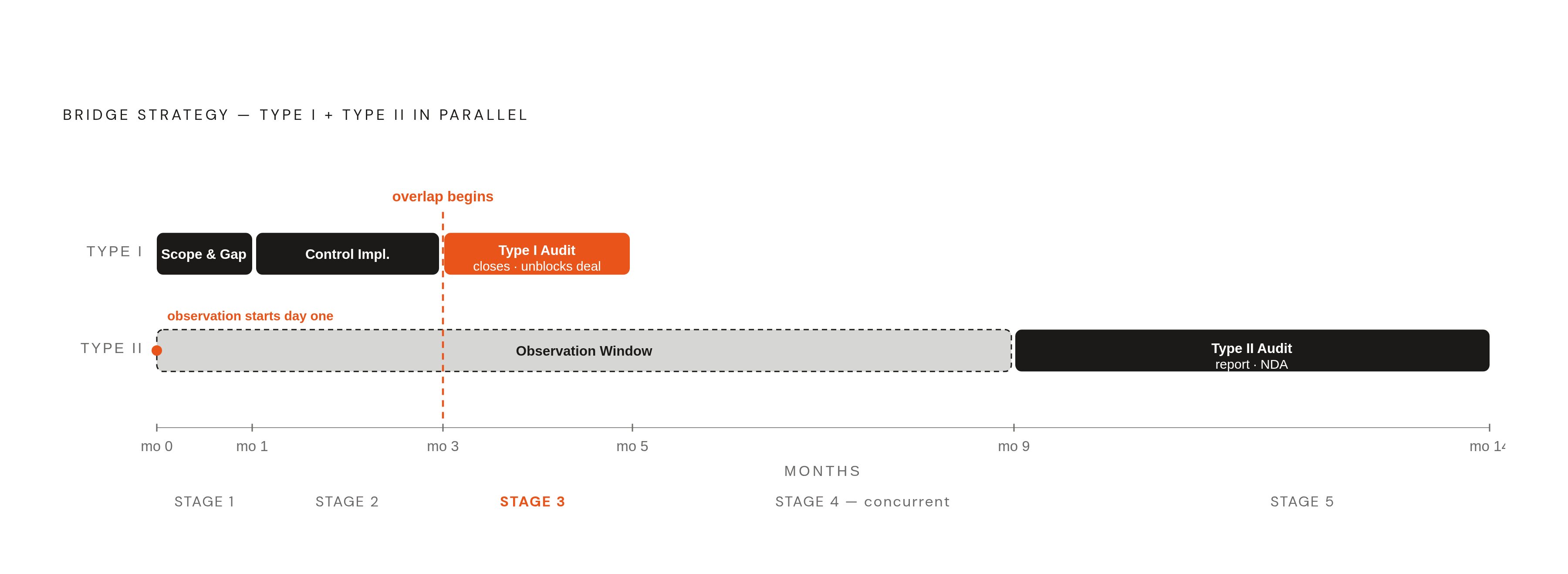
Stage 1, weeks 1 to 4: scope and gap assessment. Pick which Trust Service Criteria to include (Security only, for most early-stage teams, and there's rarely a good reason to add more). Run the gap assessment across all key control domains. Produce the prioritized remediation list with named owners and deadlines attached to each item. Pick a GRC platform based on team size, weighing whether a paired-expert model like Scytale fits better than self-service tools like Vanta or Drata.
Stage 2, weeks 4 to 12: control implementation and policy documentation. Fix access management and MFA first, ahead of everything else, since credential compromise drives most breaches industry-wide. Then logging, then incident response, then vendor risk, in that order. Use the GRC platform's policy templates instead of drafting from a blank page. Stand up the risk register with owners and a set review cadence. Confirm infrastructure logging, encryption, and segmentation are actually producing evidence the platform can pull on its own, without someone manually exporting a CSV every week.
Stage 3, months 3 to 5, running the bridge strategy: the Type I audit. Bring in a licensed CPA firm working from the AICPA's updated July 2025 Description Criteria. Submit the evidence package the GRC platform assembled. Use the finished Type I report to unblock the deal sitting on the table right now, while Type II observation keeps running underneath it the whole time.
Stage 4, months 3 to 9, running concurrent: the Type II observation period. This window runs several months to a year, and starting it alongside Type I prep is what keeps calendar time from getting wasted twice over. Continuous monitoring flags any control failure during this stretch, and a failed control mid-observation can knock the audit down to a qualified opinion. So evidence needs to build continuously here, not get reconstructed after the fact from memory or old email threads.
Stage 5, months 9 to 14: the Type II audit completion and report delivery. The finished report goes out under NDA to enterprise prospects and answers most of what's sitting on a security questionnaire, substantially cutting the per-prospect response burden that previously consumed weeks of a sales cycle.
Teams with no security hire have two real paths forward. A founder or CTO runs the project directly, spending roughly 100 to 200 hours spread across 6 to 12 months, evenings and weekends included. Or a fractional CISO runs the whole program end to end: implementing the compliance software, coordinating the external penetration test, handling audit interviews, then sticking around afterward in an ongoing role. For most lean teams, the fractional route is the better trade. The founder's hours are worth more spent closing the deal the audit is meant to unblock in the first place.
Maintaining
SOC 2 doesn't end when the report lands. A Type II report expires after 12 months, and most enterprise contracts expect continuous coverage, so the whole exercise turns into an annual cycle, not a finish line crossed once and done. Evidence collection keeps running through the GRC platform, controls stay monitored, and the risk register needs a real review on a schedule, not a once-a-year dusting-off the week before the next audit shows up.
Teams that built compliance into infrastructure from the start have it easiest here, and that's no coincidence. When encryption, logging, and access controls are the default setting rather than a retrofit bolted on under deadline pressure, renewal turns into a lighter lift every single year instead of a rerun of the original scramble. That's the actual payoff of getting infrastructure right early: not passing the first audit, but making every audit after it cheaper, faster, and a lot less of a fire drill for the engineering team stuck doing the work.