Automated CVE Patching for Container Images in Production
Automation replaces manual CVE cycles with continuous rebuilds and registry scanning.
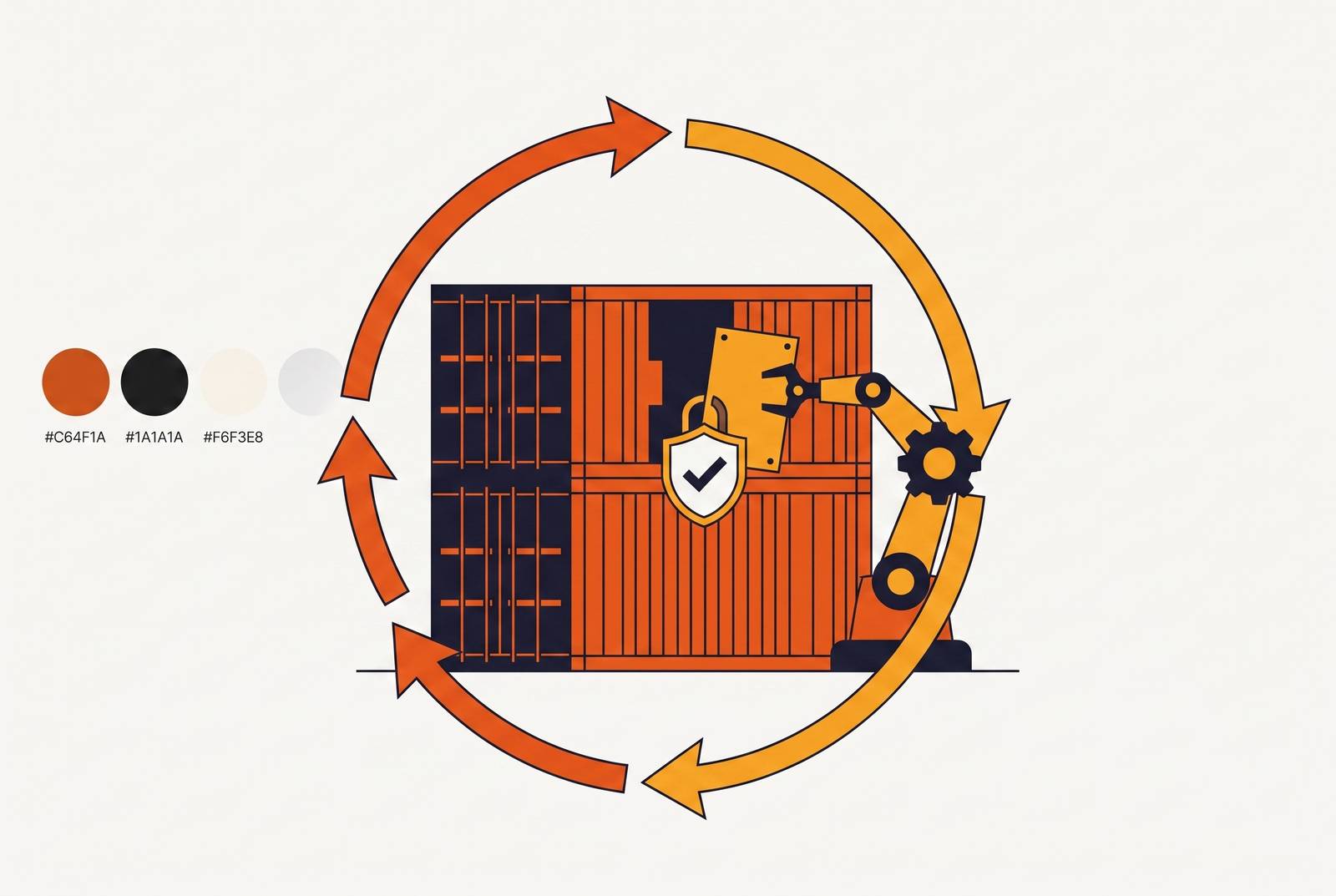
CVE volume in the container world stopped being a schedule problem years ago. New vulnerabilities land around the clock, outpacing any monthly patch cycle. The old model — read the advisory, check severity, backport the fix, test it, cut a release — dies on arrival at any real scale. What holds up instead is treating patching as a pipeline that runs continuously, rather than a pile of tickets someone works through when they get around to it.
What makes container image vulnerabilities structurally different from traditional patch management
Traditional patch management assumes a running system, where you update a package on a live host and the fix takes effect right there, no drama.
Containers work differently, since you can't reach into a running container and swap out a library. The image is immutable, so the only path forward is rebuild, push to the registry, redeploy.
This changes what a base image actually is: a supply-chain artifact carrying real weight, rather than a mere convenience layer. A vulnerability sitting in the foundation layer doesn't stay put. It rides into every service pulling from that image, and in most companies that means dozens of services owned by teams who've never opened the base image's Dockerfile and might not know it exists.
Two surfaces need watching here, and they don't behave the same:
- OS-level packages baked into the base image: libc, openssl, curl, the usual system tooling
- Application dependencies stacked on top: language runtimes, libraries, whatever got pulled in at build time
A CVE in a base image maintained by a platform team becomes, instantly, a vulnerability in production services owned by five other teams who had nothing to do with it. Ownership gets messy fast, and this isn't some rare edge case, either: pull a large share of images sitting in public registries today and you'll find at least one critical or high-severity finding already waiting inside. That's the starting line most teams inherit before they've written a single line of application code.
The unit of remediation here is the build, not the patch command. If fixing a CVE means rebuilding an image, remediation only works long-term when it's wired into the build pipeline itself, rather than handled as a side task somebody remembers on a Friday afternoon.
The two philosophies for reducing CVE exposure in base images: patching in place versus rebuilding from minimal foundations
Teams generally land on one of two strategies, and they pull in genuinely different directions.
The first: patch the image you already have. Tools like Copacetic inject updated packages into an existing image without a full rebuild, which is fast and a reasonable stopgap if you don't have a rebuild pipeline running yet. Coverage has a hard ceiling, though, because these tools can only fix what upstream has already published a fix for. No patched package upstream means the CVE just sits there, waiting, with no path forward until someone else ships a fix. Run auto-patching across a broad set of popular images and you'll clear out a modest slice of total CVEs; some images barely budge, because the fixes simply don't exist yet at the package level.
The second philosophy goes the other direction entirely: shrink the image so there's less to exploit in the first place. Distroless images, Google's Distroless project, Red Hat's Project Hummingbird, strip out everything the application doesn't need to run, leaving no shell, no package manager, no general-purpose OS tooling sitting around waiting to be abused. Fewer packages means fewer CVEs, by construction, not by remediation effort. Project Hummingbird, which Red Hat opened as an early access program in late 2025, applies this at the OS vendor level: minimal images rebuilt automatically the moment upstream packages change. There's a real trade-off, though: smaller images are harder to debug when something breaks in production, because the shell access engineers reach for during an incident just isn't there anymore.
Most pipelines that actually work well run both philosophies together. Minimal base images push the standing CVE count down from day one, and automated rebuild triggers keep new disclosures from piling up between releases. Pick your philosophy early, because bolting one strategy onto infrastructure built for the other is a slog nobody enjoys.
How to structure a scanning pipeline across the full software delivery lifecycle
Scanning only at deployment time is one of the most common mistakes I see, and it's an expensive one, since vulnerabilities are cheapest to catch early, long before an image ever reaches a production registry.
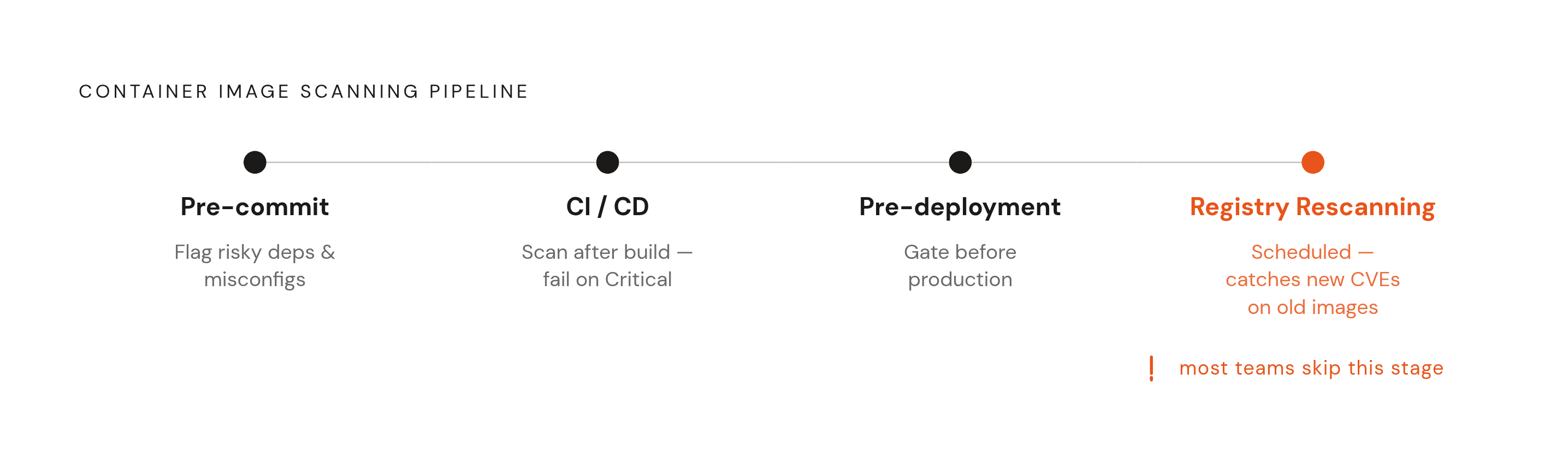
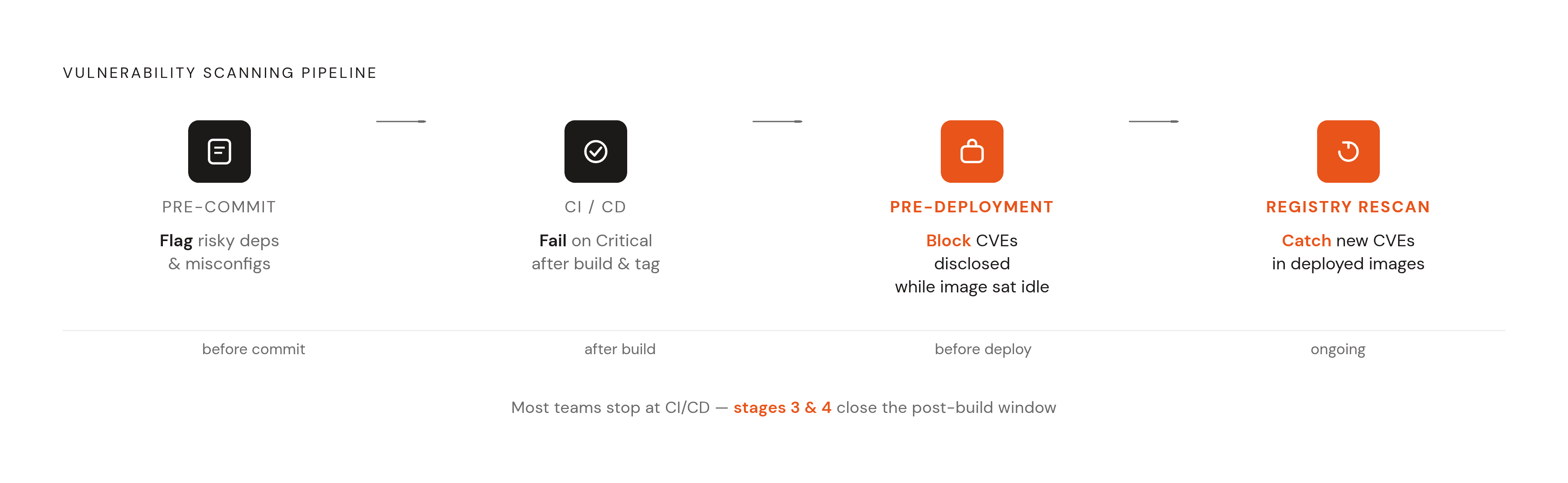
A scanning setup that holds up runs across four stages:
- Pre-commit: flag risky dependencies and misconfigurations before they land in the repo
- CI/CD: scan right after build and tag, fail the build on thresholds you set, say any Critical finding, or more than some fixed number of Highs
- Pre-deployment: a second gate before anything reaches production, since an image can sit in a registry for weeks while new CVEs get published against it
- Continuous registry rescanning: images already deployed need rescanning on a schedule, because a CVE disclosed today can hit an image built last month
Trivy, Clair, and Grype are open-source scanners commonly integrated into CI/CD pipelines. Each handles different language ecosystems and output formats a bit differently, so the choice usually comes down to what your stack actually looks like.
SBOMs, software bills of materials, tie all of this together. Generate one for every image at build time and store it alongside the image in the registry. When a new CVE drops, you query the SBOMs to see which images are affected instead of rescanning your entire fleet from scratch. This is turning into a compliance expectation in regulated industries already, and it's fast becoming table stakes for supply-chain transparency everywhere else too.
Inline scanning, running the scan directly from the pipeline instead of shipping images out to a separate staging system, keeps image contents from ever leaving your environment, since only scan metadata goes out. For teams handling sensitive workloads, that distinction actually matters. Policy enforcement tools like Aqua Security act as hard gates too: an artifact that fails policy doesn't move forward, with no manual override and no exception email from someone in a hurry.
Prioritizing which CVEs to act on first using runtime context
Point a scanner at a production image and you'll get a long list back. Treat every line as equally urgent and you'll burn your team out on alert fatigue while the findings that actually matter get buried in the noise.
The real question is whether the vulnerable component is even reachable, given how the workload actually runs in production, not merely whether a CVE exists in the image.
Runtime-correlated prioritization, the approach tools like Sysdig take, cross-references scanner findings against what's happening at runtime: which packages actually load, which network paths are active, what permissions the container is running with. A vulnerable library that never loads during execution sits way lower on the list than one sitting directly in the path of inbound network traffic. This surfaces the vulnerabilities that intersect with a real attack path and filters out the ones that only look scary on paper.
CVSS scores alone won't get you there. A Critical-rated CVE in a package your workload never touches matters less than a High-rated one in a package handling untrusted input, and runtime monitoring also catches things static scanning can't see at all: zero-day exploits, privilege misuse, behavior that only shows up once code is actually running.
Route scanner output through a prioritization layer before it triggers a rebuild. Patching everything automatically isn't realistic for most teams, so the goal is patching what actually matters, automatically.
Building the automated rebuild and rollout pipeline
Rebuilds need a trigger, and three of them do the real work:
- An upstream base image gets updated in the registry (event-driven)
- A new CVE gets disclosed matching a component sitting in a stored SBOM (CVE-feed-driven)
- A scheduled rescan of registry images turns up a finding that's now patchable (time-driven)
Some tools, like Echo, take the image reconstruction approach: instead of patching a finished image, rebuild it from source the moment an upstream package changes. That stops CVEs from quietly stacking up between planned releases. For this to work, reconstruction pipelines need to be idempotent and fast enough to run on every relevant upstream change without turning into the bottleneck that slows everything else down.
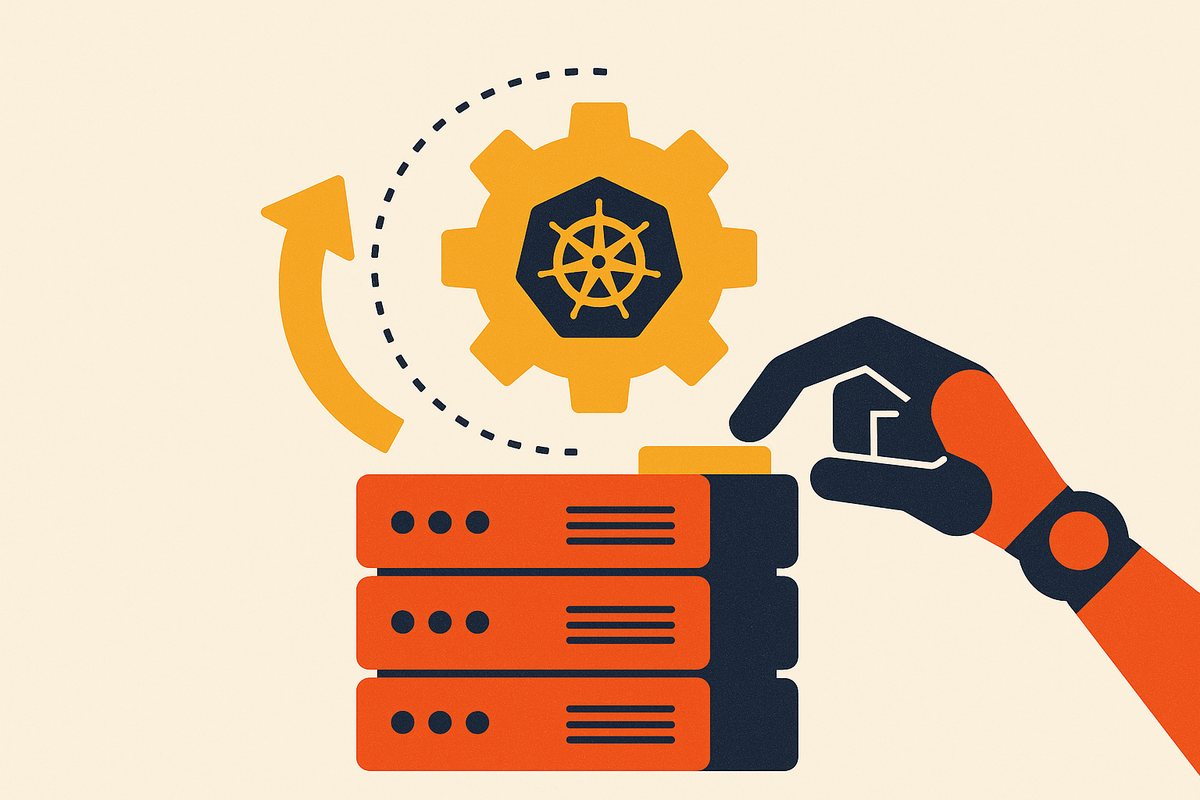
GitOps carries the patch from build to production. Once a rebuilt image clears scanning and policy checks, the image reference gets updated in the Git repo. GitOps tools like Argo CD or Flux CD pick up that change and reconcile the cluster state, so the patch rolls out without anyone clicking deploy. Git becomes the audit trail: which image changed, which CVE triggered the change, which scan cleared it, all traceable after the fact, months later, when an auditor asks.
Rollouts still need care, even for security fixes, maybe especially for security fixes. Canary or rolling deployment strategies limit the blast radius if a rebuild goes sideways, and automated smoke tests and runtime checks after rollout confirm the patched image behaves the same as the one it replaced, before anyone calls the rollout done.
Supply-chain integrity needs its own gate too. Images get signed once they clear scanning and policy checks, with signatures verified at admission time. Deploying an unsigned or unscanned image carries real risk, and in a growing number of contracts it's a flat compliance violation, since image provenance has become something enterprise buyers actually ask about by name. JFrog Xray adds another layer here, giving visibility at the dependency level, useful for catching a single upstream library quietly causing CVEs across dozens of otherwise unrelated images.
What this pipeline looks like when it runs on a team without dedicated security or DevOps staff
Here's the reality most startups and growth-stage companies live in: the engineers building this pipeline are the same ones shipping product features that week. Nobody's full-time job is infrastructure security, because there's no headcount for that yet.
Day-2 Kubernetes work, patching, upgrades, monitoring, takes real expertise that small teams typically don't have sitting on the bench. Below a certain team size, the effort of self-managing this whole pipeline can end up costing more than the security benefit it buys back.
Low-friction setups tend to share a few traits:
- Scanning built into the CI/CD workflow you already use, rather than a separate tool someone has to babysit
- Rebuild triggers that fire on their own, without a human reading an advisory at 11pm and deciding to act
- Policy gates that block a bad image automatically, no security review meeting required for every single finding
- Rollouts that verify themselves and roll back automatically on failure, without a page going out first
This is where managed platforms come in: ones that deploy into a team's own cloud account (AWS, GCP, Azure) and handle cluster upgrades, CVE patches, and rollout orchestration as built-in features, sparing your team from configuring all of it from scratch over a few painful sprints. That gets a team real security posture without needing to hire a platform engineering function just to keep the lights on.
For teams building this up piece by piece, here's a reasonable order:
- Add Trivy or Grype to the CI build, fail on Critical findings
- Generate and store an SBOM with every image build
- Turn on continuous registry rescanning, with alerts when a stored finding becomes patchable
- Automate rebuild triggers whenever the base image updates
- Route deployments through a GitOps tool so patched images roll out without a manual deploy step
None of these need the full pipeline to be worth doing on their own, since each one cuts real exposure by itself, which matters a lot if you're a five-person engineering team without the headcount to do all five at once.
How CVE patching connects to compliance obligations teams are already under pressure to meet
Every new CVE disclosure carries the same compliance weight as any other security event: it needs a documented response, evidence it got fixed, and a clear timeline of how long the exposure lasted.
An automated pipeline that rebuilds, rescans, and redeploys patched images generates that audit trail as a side effect of simply running. The logs, the timestamps, the policy gate records, that's just what the pipeline leaves behind as it does its job.
For SOC 2 Type II, this maps almost directly. Continuous monitoring and documented vulnerability remediation sit at the core of the availability and security trust service criteria. A pipeline with automated patching, policy gates, and signed images hands auditors exactly the kind of repeatable, evidenced controls they're looking for. Enterprise buyers increasingly treat SOC 2 Type II as a bare minimum, too; without it, a company gets locked out of certain deals no matter how good the engineering underneath actually is.
Healthcare-adjacent teams face a related wrinkle. HIPAA's scope doesn't fully cover the security concerns modern cloud-native systems raise, so health-tech vendors selling into hospitals or insurers usually get asked for SOC 2 on top of HIPAA anyway. For teams running patient data through container workloads, a known unpatched CVE sitting in a production image is a direct compliance exposure, not some minor technical debt line item to revisit next quarter.
Platforms like RapidFort frame CVE elimination as a way to satisfy multiple frameworks at once, since the controls that satisfy SOC 2 overlap heavily with what PCI DSS, HIPAA, and FedRAMP ask for. Build the patching pipeline well, and its compliance value compounds across every framework you're on the hook for. The pipeline produces the controls and the evidence as one piece of engineering work, alongside the security benefit itself, rather than as two separate projects fighting for the same sprint.