Deploying Hugging Face Models to Production Without MLOps Teams
Skip the MLOps hire by matching infrastructure to your actual requirements.

Most ML projects don't die at the modeling stage. The model is usually fine. What kills them is everything around it: the serving layer, the scaling behavior, the cost model, the compliance posture.
Production is a checklist before it is an architecture. A system earns the label when it delivers reliable uptime without manual restarts, autoscales under variable traffic without human intervention, keeps latency within user-acceptable bounds, and costs money proportional to actual usage rather than idle reservation. Observability is non-negotiable on top of those: logs, error rates, latency percentiles at minimum. Security follows immediately: model weights not publicly exposed, access controls enforced, an audit trail that can survive a review. For teams with compliance obligations, health data, financial data, government contracts, SOC 2 and HIPAA are gating requirements, not retrofit items. Legal does not get looped in at the end and wish you well about it.
Here is the practical reality for small engineering teams, two to eight engineers building a real product: they historically had no dedicated MLOps person. Now they largely don't need one, provided they know which requirements actually trigger the move to the next infrastructure layer. Without that clarity, teams either over-build too early and lose months, or under-build too long and create a production incident that lands on the wrong desk. The managed inference ecosystem has matured enough that the path is traversable in genuine stages. The goal at every stage is the same: borrow infrastructure that already satisfies the current requirements rather than construct it.
Hugging Face Spaces as a Structured Prototyping Environment, Not a Shortcut to Production
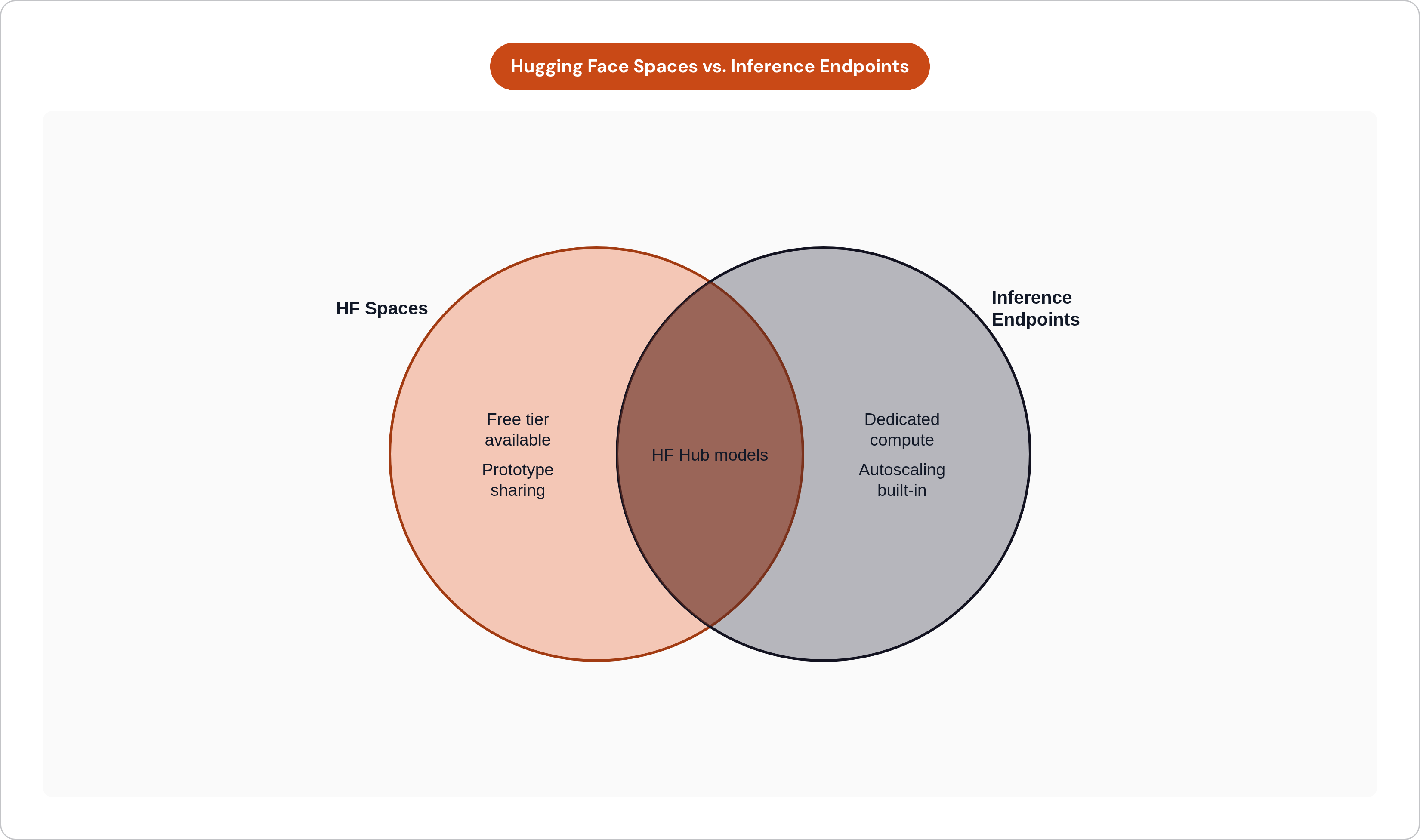
Spaces does a few things exceptionally well, and the temptation to overextend it is understandable. You can deploy a Gradio or Streamlit app in minutes, free, with minimal configuration. It operates like a Git repository: push changes, Hugging Face rebuilds and redeploys automatically. For sharing prototypes with stakeholders, running user feedback sessions, or validating a model's behavior before committing to real infrastructure spend, nothing in the ecosystem matches it for speed.
The ceiling is equally clear, and it is low. You have limited control over the runtime environment and scaling behavior. There are no access controls suitable for enterprise or regulated data. It was not designed for production SLAs or consistent latency under load. Using it as though it were will produce exactly the kind of incident that erodes stakeholder confidence in the entire ML initiative, and that erosion is very hard to walk back.
The signal to move on is specific: real user traffic has arrived, a stakeholder has asked whether this can go into the product, or a compliance question has surfaced in any conversation. Any one of those is sufficient, you don't need all three. The Hugging Face Hub remains the canonical source for open-weights model discovery regardless of what you do next; the model weights stay there, you are only changing where the computation happens.
Hugging Face Inference Endpoints as the Managed Middle Layer
Most small teams undershoot Inference Endpoints because it looks like a paid version of Spaces. It is not. Fully managed infrastructure means no Kubernetes configuration, no CUDA version management, no VPN setup. Autoscaling and scale-to-zero for cost control during idle periods are built in. Observability comes out of the box. It supports major serving frameworks including vLLM, TGI, llama.cpp, and SGLang, so teams are not locked into a single inference stack. The compute is dedicated, not shared, which matters for two concrete reasons: consistent latency, and data isolation that satisfies reasonable security requirements.
Scale-to-zero is the one behavior that catches people off guard, and it is worth understanding before you deploy rather than after your first user complaint. After a period of inactivity, the endpoint scales to zero replicas. The next request receives a gateway error while a replica boots. There is no built-in queue. Retry logic must be handled on the client side. Think of scale-to-zero like a light switch with a ten-second delay: great for the electricity bill, less great when someone walks in expecting instant illumination. For a low-traffic internal tool, this is entirely acceptable and the cost savings are real. For a user-facing product with a latency SLA, it is not. Know which one you are building before you configure it, not after.
GPU pricing at this tier reflects the operational work the platform is absorbing. The right moment for Inference Endpoints is when the model is validated, traffic is moderate and reasonably predictable, no dedicated infrastructure engineer is on staff, and compliance requirements fit within Hugging Face's security model. When those conditions hold, managed endpoints are not a compromise.
When to Leave Managed Endpoints and What the Alternatives Cover
Four conditions indicate it is time to move. Traffic volume reaches a threshold where per-hour dedicated GPU pricing costs meaningfully more than equivalent self-hosted capacity. The workload requires custom serving logic, multi-model pipelines, or batching strategies the managed layer does not expose. Compliance requirements mandate infrastructure running inside the team's own cloud account. Latency requirements demand fine-grained control over the serving stack that the managed layer simply cannot provide.
The cost crossover deserves particular attention because teams routinely discover it only after they are already past it. Below a certain monthly output volume, managed per-token or per-hour APIs are cheaper than dedicated infrastructure once engineering time is factored in. Above it, the math reverses. The exact threshold varies by model size and provider, and teams should model this proactively rather than during a budget conversation.
Several platforms occupy the space between managed endpoints and full cloud-native infrastructure. Modal is Python-first and serverless, GPUs attached on demand; it fits well for batch jobs, scheduled inference, and teams who prefer writing infrastructure as Python rather than navigating YAML. Baseten occupies the gap between calling a model API and managing your own cluster, with deployment tooling for packaging custom models and handling versioning. Replicate, which operates as one of Hugging Face's Inference Providers, uses per-second compute pricing and maintains a strong catalog for image, video, and audio generation workloads.
For teams migrating off Spaces, the front end and model weights decouple cleanly: move the inference layer to whichever platform fits the workload, host the UI separately, and the Hub remains the model weight source of truth throughout. Teams whose compliance requirements mandate infrastructure inside their own AWS, GCP, or Azure account are not shopping for a different managed platform. They are looking at cloud-native deployment.
Cloud-Native Deployment for Teams That Need to Own Their Infrastructure Layer
Three categories of teams genuinely need this layer. Teams handling health, financial, or government data where compliance certifications are legally mandated. Teams whose traffic volume has crossed the cost crossover point. Teams integrating inference into a larger cloud-native application where co-location with data and services is architecturally significant. If you don't fall into one of those categories and you are considering this path anyway, you are probably about to spend three months on infrastructure that a managed endpoint would have handled fine. That is not a hypothetical; it is a pattern that repeats.
GPU provider selection involves a real tradeoff the cost calculators don't surface clearly. Hyperscalers, AWS, GCP, and Azure, carry SOC 2 Type II, HIPAA, FedRAMP, and the other certifications that regulated industries require. Their on-demand compute pricing is higher, but the compliance coverage and enterprise tooling integration are genuine and not easily replicated elsewhere. GPU specialists including Lambda, RunPod, CoreWeave, and GMI Cloud offer meaningfully lower per-GPU rates and are well-suited for cost-sensitive training workloads where compliance certifications are not a gating requirement. The practical hybrid many teams land on: use a hyperscaler for data storage, experiment tracking, and production inference; use a specialist for training runs. The egress cost of moving a trained model out of a specialist provider is typically small relative to the training cost savings.
The hidden cost problem at cloud scale is consistently underestimated. Data egress charges, storage for checkpoints and datasets, and GPUs left running during idle periods collectively inflate monthly bills in ways that are not obvious until the invoice arrives. Cost control at this layer requires autoscaling policies, spot or preemptible instances where the workload tolerates interruption, and active monitoring of idle resources. These are not advanced optimizations; they are the baseline, and skipping them is how teams end up in an unpleasant conversation about a cloud bill.
For teams on AWS running steady-state inference volume, AWS custom silicon, Trainium for training and Inferentia for inference, is worth evaluating as a cost lever once the workload is stable and compatible. The efficiency gains on appropriate models are substantial, though migration requires validation and is not universally applicable.
What makes cloud-native viable for a small team without a platform engineering function is a platform that handles cluster management, autoscaling, and compliance automation within the team's own cloud account. The team owns the infrastructure layer, the data never leaves their environment, and the platform absorbs the operational complexity that would otherwise require dedicated headcount.
Inference Optimization That Compounds the Gains at Every Layer
vLLM has become a widely used production serving engine for Hugging Face models at scale. It implements PagedAttention memory management, which increases throughput over the default Transformers inference path by handling attention key-value caches in a way that reduces memory fragmentation. Continuous batching compounds this further: rather than waiting for a full batch to complete before processing the next request, vLLM processes new tokens as slots free up, raising effective GPU utilization. The same GPU handles more concurrent requests as a result. This is not a marginal gain; it is the difference between an inference setup that is expensive and one that is tractable.
vLLM supports the major open-weights model families: Llama, Mistral, Qwen, Gemma, DeepSeek, and others. It is also supported natively as a serving backend within Hugging Face Inference Endpoints, which means the optimization is available without leaving the managed layer. There is no reason to defer it.
FP8 quantization on H100 hardware is the first optimization to apply when serving at that tier. vLLM supports it natively, and it cuts VRAM requirements roughly in half versus full-precision weights — think of it as fitting two models into the memory space that previously held one. Quality loss on instruction-tuned models used for conversational AI, summarization, or code generation is minimal for most applications, though teams should validate this against their specific workload, particularly in specialized domains where precision matters more.
Better serving efficiency means fewer GPUs needed for the same traffic volume, which changes the cost crossover calculation in a direction teams don't always anticipate. Some teams find that optimized self-hosting pencils out at lower traffic volumes than the original spreadsheet suggested, which means the decision about when to move to cloud-native arrives earlier than expected. GPU utilization is the real metric to track, not the per-hour rate. Much of the cost reduction available to small teams comes from closing the utilization gap.
Choosing the Right Layer for Where the Team Actually Is
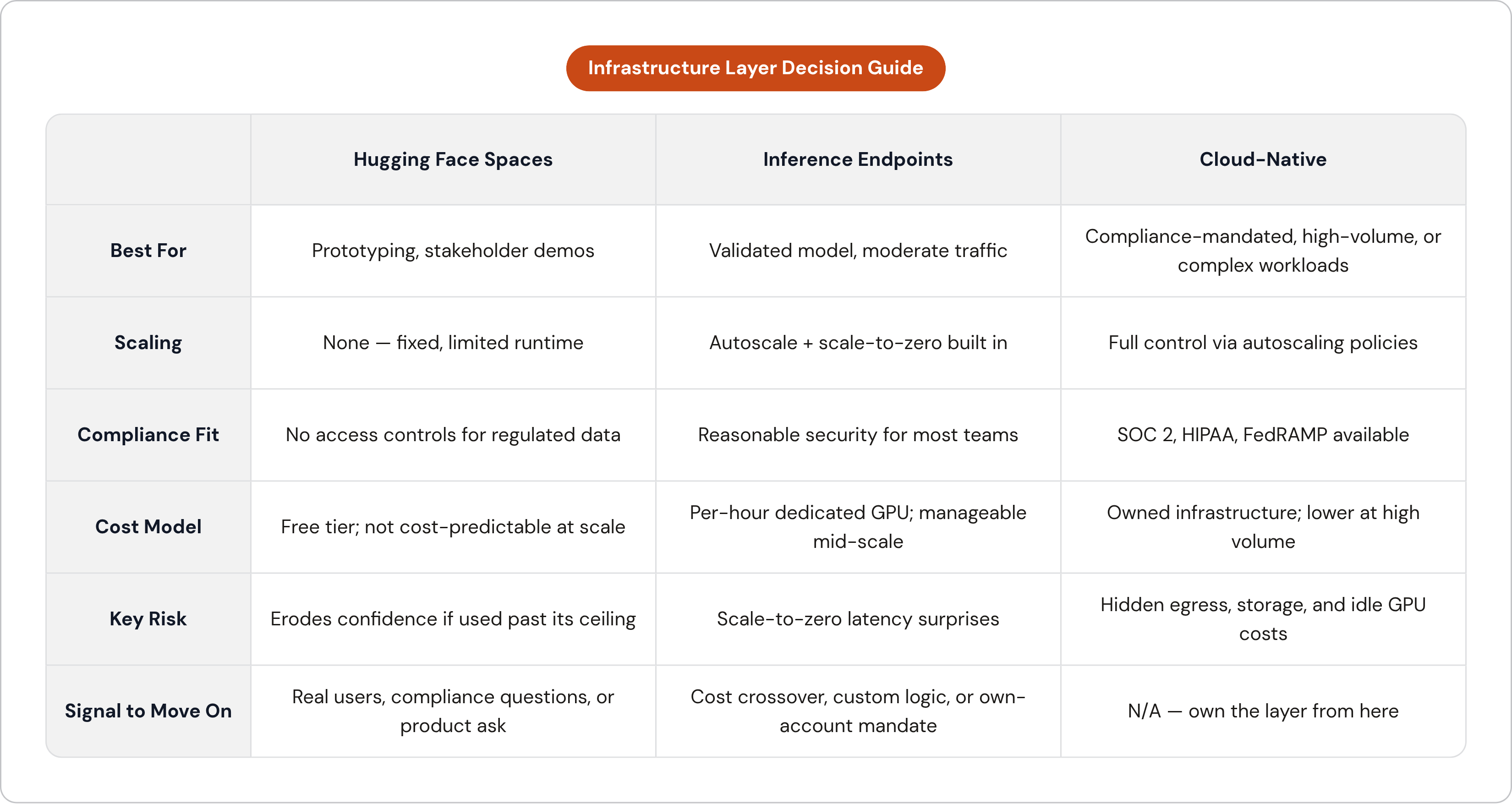
The decision is not primarily about preference or ambition. It is about where the team actually is: what is validated, what compliance requires, and what the traffic numbers look like right now.
If the model is not yet validated, use Spaces. Do not pay for infrastructure to test a hypothesis. If compliance requirements mandate infrastructure inside the team's own cloud account, skip managed endpoints entirely and go directly to cloud-native deployment. If traffic volume has crossed the point where managed per-hour pricing costs more than self-hosted, the move to cloud-native is a financial decision, not a technical one.
For a team with no MLOps hire following the default path: start on Spaces, graduate to Inference Endpoints when the prototype is validated, add vLLM as the serving backend immediately because the efficiency gains are available within the managed layer and there is no reason to leave them on the table, and move to cloud-native when compliance, cost, or control requirements actually demand it. Use a platform that handles cluster management so the team is not building that capability from scratch during an already demanding growth phase.
What this progression does not require is a dedicated MLOps hire, a platform engineering team, or months of infrastructure work before the first production request is served. Each layer covers more operational surface area than the last. The team's job is to evaluate continuously whether the infrastructure being borrowed is still cheaper in time, money, and risk than owning it directly. At some point for most teams it isn't, and recognizing that moment clearly is what makes the move to cloud-native feel like a logical next step rather than a crisis.