SOC 1 vs SOC 2: Which Report Does Your Startup Actually Need
SOC 2 protects data; SOC 1 protects financial records.

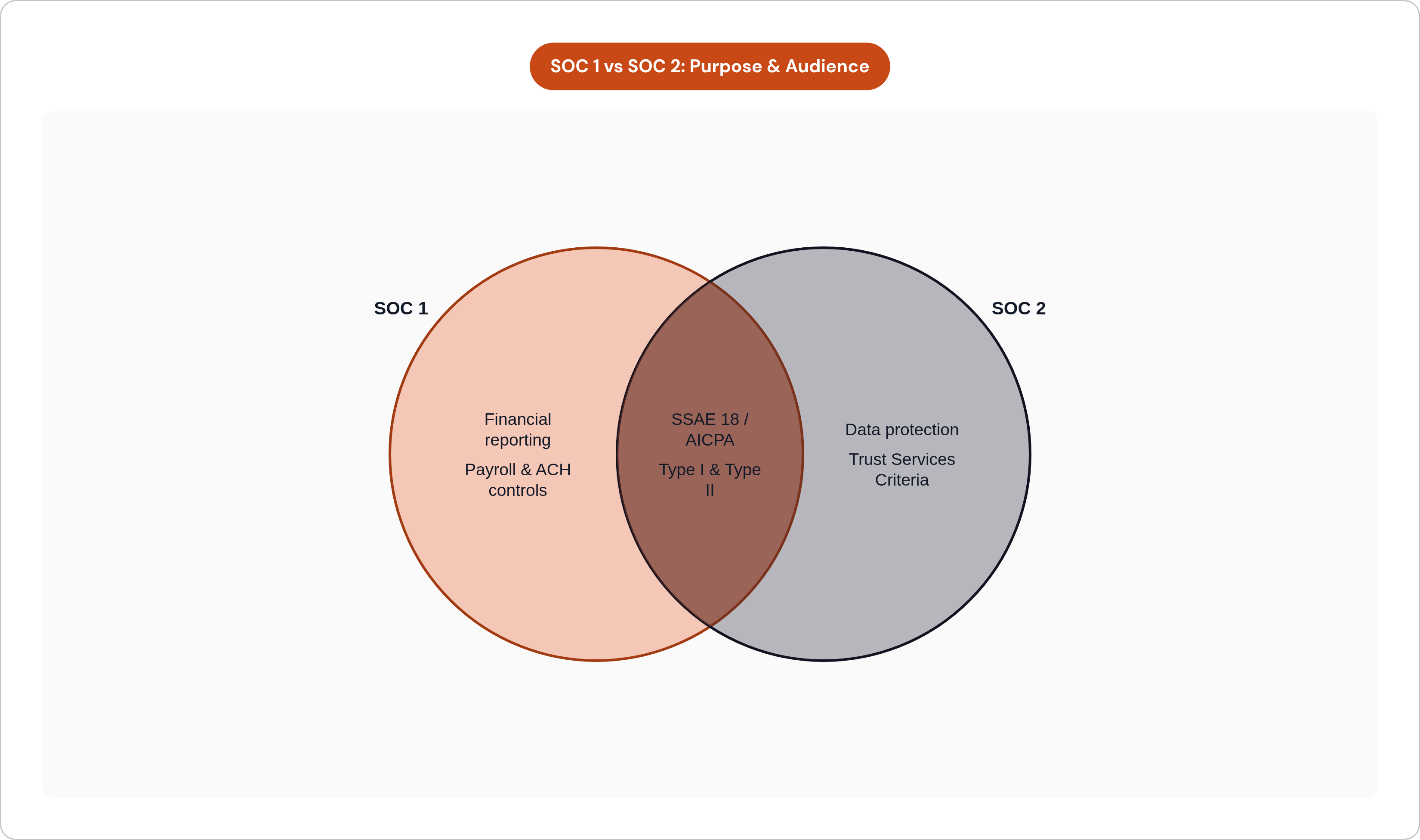
Both reports come from independent CPA firms. Both fall under the AICPA's System and Organization Controls framework, issued under the same SSAE 18 standards. The names sound like siblings. They are not.
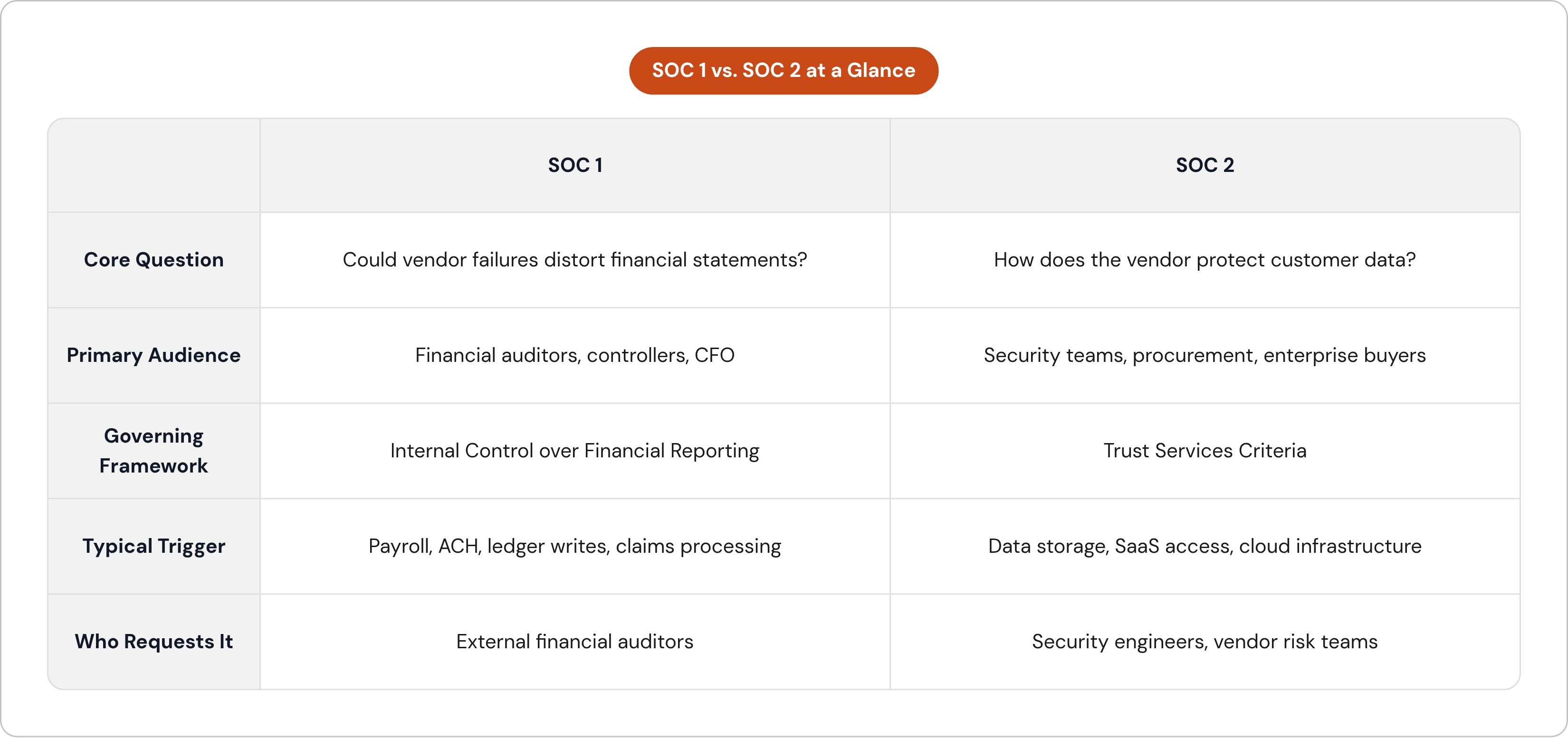
SOC 1 has one controlling question: could a failure in this vendor's systems or processes introduce errors into a client's financial statements? The full name, System and Organization Controls for Service Organizations: Internal Control over Financial Reporting, tells you exactly what it measures. The audience is not a security team. It is the customer's financial auditors, controllers, and CFO. These are people whose professional obligation is to validate that the numbers hitting a balance sheet can be trusted. A cloud storage product that holds files does not need a SOC 1. A product that runs payroll calculations, processes ACH transactions, or writes journal entries into a general ledger does.
SOC 2 asks something different: how does this vendor protect the customer data it stores, processes, or transmits? Its audience is prospective customers, security teams, and procurement organizations conducting vendor risk assessments. It is built around five Trust Services Criteria: Security, Availability, Processing Integrity, Confidentiality, and Privacy. Only Security is mandatory. The rest get scoped based on what your service promises and what your customers contractually require.
If the question is about financial statements, the answer is SOC 1. If the question is about data protection, the answer is SOC 2.
Why SOC 2 Is the Default Answer for Most Startups
The market has already made this decision for you. According to Vanta's 2025 State of Trust Report, 83% of enterprise buyers require SOC 2 from SaaS vendors before signing a contract. Among companies with more than 5,000 employees, that reaches 91%. The security questionnaires flooding your sales team's inbox, the ones asking about encryption, access controls, incident response, breach notification, those are SOC 2 scopes. Every one of them.
The cost of lacking it is concrete. Thirty-six percent of companies reported losing a deal in 2024 because they lacked a required certification, up from 29% the year before, per the same Vanta report. Drata's 2025 State of Trust report found that companies with SOC 2 Type II closed enterprise deals 35% faster than competitors without it. The security questionnaire burden, which can consume more than 20 hours per week across sales and security teams, drops sharply when a SOC 2 report is available to share instead.
There is also a less-discussed financial upside: cyber insurance underwriters factor compliance certifications into pricing. I have seen founders genuinely surprised when their first SOC 2 Type II cuts their premium enough to partially offset the audit spend. It does not always happen, but it is worth calculating before you dismiss compliance as a pure cost center.
SOC 2 is the right starting assumption. Specific conditions change the answer.
The Conditions That Make SOC 1 Necessary, Alone or Alongside SOC 2
The threshold test is blunt: does your service touch the numbers that flow into your customer's financial statements? If yes, SOC 1 is required regardless of what else you do. If no, it is almost certainly irrelevant to your situation.
The product categories that routinely trigger SOC 1 requests include payroll platforms, payment processing and ACH infrastructure, accounts payable and receivable automation, loan servicing, claims processing, and general ledger or ERP integrations where the vendor writes to or transforms financial records. The people asking for SOC 1 are not security engineers. They are external financial auditors and internal controllers, operating on a completely separate track from the IT team sending SOC 2 questionnaires.
This is where fintech founders get caught off guard. I mean genuinely caught off guard, not in an abstract theoretical way. A platform that processes payments while also storing personally identifiable information will receive simultaneous requests from two different parts of the same customer organization: financial auditors wanting SOC 1, security teams wanting SOC 2. These are separate engagements under different AICPA standards with different auditor scoping. They cannot substitute for each other. Running them simultaneously is the most efficient path when both are required.
A payroll SaaS is the clearest illustration: SOC 1 covers the controls over payroll calculations affecting the employer's financial statements; SOC 2 covers the employee data the platform holds. Same vendor, same audit cycle, two distinct reports going to two different people inside the same customer.
RFPs and contracts signal this if you know what to read. Questions about transaction handling, financial reconciliation, and controls affecting reported figures point toward SOC 1. Questions about encryption, access management, uptime commitments, and breach notification point toward SOC 2.
Sector-by-Sector Decision Map for the Most Common Startup Categories
B2B SaaS (CRM, project management, analytics, productivity tools): SOC 2 only. There is no financial statement exposure. The relevant risk is data handling; the relevant audience is the security and procurement team.
Fintech payments infrastructure (card issuing, ACH, ledgering): This is the most complex category. Depending on transaction volume and card brand designation, PCI DSS Level 1 compliance is required by card brands and banking partners, which is a separate framework from SOC entirely. SOC 2 Type II is required by downstream fintech clients building on the platform. SOC 1 is required by enterprise customers whose auditors need assurance over financial statement controls. Budget for both SOC reports from the outset and do not let anyone convince you that one satisfies the other.
Banking-as-a-Service platforms: SOC 2 Type II is the minimum expectation from fintech customers. SOC 1 Type II is often required by the sponsoring bank. Plan for both from day one; once you have a banking partner relationship, these are not optional.
Healthtech and healthcare-adjacent: If the product handles no health data, SOC 2 is the priority and HIPAA does not apply. For covered entities and business associates handling protected health information, HIPAA compliance is mandatory by law; SOC 2 is optional but commercially expected by large EHR platforms and enterprise healthcare buyers. HIPAA alone is not a substitute for the control validation a SOC 2 provides, even though some early-stage founders try to position it that way.
AI infrastructure and SaaS: If the product stores training data, model outputs, or inference logs belonging to enterprise customers, SOC 2 is the relevant report. If the product touches customer financial data as part of an AI workflow, such as AI-assisted accounts payable, apply the SOC 1 threshold test honestly.
Type I vs. Type II: The Second Decision That Determines How Quickly Compliance Pays Off
Once you have identified the right report, you still have to choose the form. Both SOC 1 and SOC 2 come in two variants. The distinction applies equally to either.
Type I assesses whether your controls are suitably designed as of a specific date. It does not test whether they actually operated effectively over time. Because it is point-in-time, it can be completed after controls have been in place for as little as 30 to 60 days. It is useful for early-stage startups that need something to advance a deal, and for bridging the gap while a Type II observation period accumulates.
Type II covers a defined observation period, typically six to twelve months, and tests both the design and operational effectiveness of controls across that window. Enterprise security teams expect it. Among Fortune 500 companies, mid-market buyers, financial services organizations, and government entities, Type II requirements are effectively the norm.
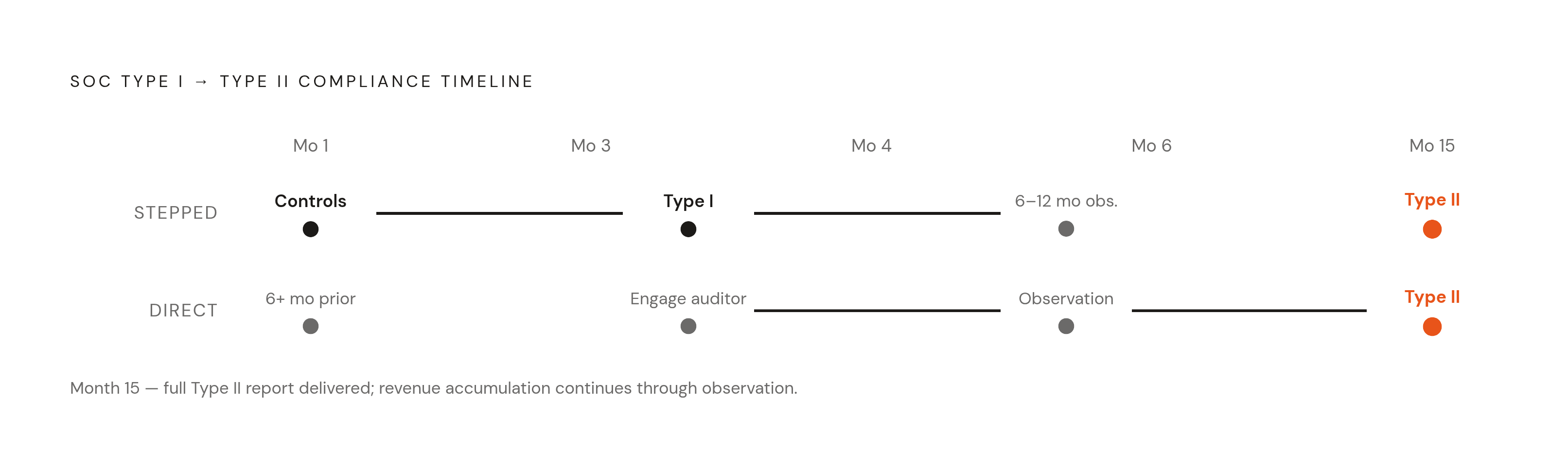
The playbook I have seen work most consistently: get Type I first to unblock the deal in front of you, then run the Type II observation period in parallel, continuing to collect revenue while accruing the evidence needed for the stronger report. Most auditors will credit a meaningful share of Type I cost if you upgrade to Type II within twelve months. That path typically delivers a full Type II report by month fifteen. One exception worth knowing: if your controls have been well-designed and running for six months or more before you engage an auditor, you can go directly to Type II. No rule requires the stepping-stone.
What SOC 2 Compliance Actually Costs, and Where Startups Underestimate
For a small startup of up to 25 employees pursuing Security-only Type I, expect an all-in range of roughly $20,000 to $40,000, covering readiness work, the audit fee, automation tooling, training, and legal costs. For a mid-size SaaS company adding the Availability criterion and running a Type II observation period over six to twelve months, the total climbs to $60,000 to $100,000 or more.
Auditor selection moves that number substantially. Boutique firms specializing in SaaS startups charge significantly less than Big Four and national firms for the same scope. The Big Four command a premium that is appropriate for enterprises whose customers require a recognizable auditor name. Most startups are not in that situation, and paying the premium without a reason to is just imprecision.
Here is where founders consistently underestimate: internal team time. A successful audit requires a dedicated project owner at roughly 50 to 100% capacity for four to six months, plus meaningful involvement from engineering, legal, HR, and operations. That labor does not appear on the auditor's invoice. It does not feel like a line item. And it is precisely why audits stall. I have watched technically well-resourced startups blow past their audit timelines simply because they assigned the project to someone who also had a full-time job doing something else.
Year two is cheaper. Annual maintenance typically runs well below year one spend when automation stays in place and controls remain deployed. Scope decisions also compound: each Trust Services Criterion added beyond Security increases audit cost by roughly 20 to 30%. The scoping conversation with your auditor has direct budget consequences and is worth treating accordingly.
When to Start, and What to Have in Place Before the Auditor Arrives
Start when any one of these is true: an enterprise deal has SOC 2 as a stated procurement requirement; you are actively pursuing mid-market or enterprise buyers and your revenue is north of a million or two; security questionnaires are arriving regularly and consuming real hours; a contract is stalled because procurement is waiting on compliance documentation. Any single one of those conditions is sufficient.
What needs to be in place before the auditor arrives is where most startups lose weeks, sometimes months.
You need documented security policies covering access control, incident response, change management, risk assessment, and vendor management. Not drafted and filed away; documented, communicated, and demonstrably in use. An auditor is looking for evidence of practice, not evidence of intent.
Your infrastructure needs to be configured in accordance with those policies: least-privilege access controls, logging and monitoring, encryption at rest and in transit, multi-factor authentication enforced across critical systems. None of this is taken on faith; auditors pull evidence.
You need a risk assessment that was actually performed, not templated and forgotten. And you need a penetration test from a qualified third party, with findings documented and remediation tracked.
The readiness gap assessment, typically conducted by your auditor or a compliance platform before the formal engagement begins, exists to surface exactly where these elements are missing. Most startups discover they have policies in someone's head but not on paper, or infrastructure configurations that were never formally recorded. That is normal. The mistake is starting too late to close the gap before the clock starts.
Start twelve to eighteen months before you expect to close your first large enterprise deal. Founders who wait until procurement asks for the report are the ones paying rush fees, losing deals to delays, and learning the hard way that a six-month observation period cannot be compressed by wanting it to be shorter.