Platform Engineering for Startups Without a DevOps Hire
Small teams need platform outcomes without hiring specialists—here's how to get them.
On a four-person engineering team, one person can spend most of the week untangling deploy scripts, rotating credentials, and chasing down why staging doesn't match production. It's a structural tax on velocity that appears long before the company can afford to fix it the obvious way. A dedicated platform engineer or a small platform team would fix this, but that hire costs more than most Series A and B companies can afford. The hire that would solve the problem isn't available to the companies that need it most.
Platform engineering, as a discipline, makes the most sense once duplication sets in: once multiple teams are independently solving the same infrastructure problems, standardizing that work pays for itself. For most startups, that tipping point is around 30 to 50 developers. Below that line, the right model is a small group of versatile generalists who can wear a DevOps hat alongside their regular work, because specializing too early carries its own cost in overhead and coordination. A small team doesn't need a platform org chart. It needs infrastructure that doesn't eat its best engineer's week.
That's the wall teams hit: the operational need for platform engineering, self-service deploys, visibility, reviewed changes, cost tracking, security checks, well before they cross the headcount or revenue threshold that would let them hire for it. The gap between needing the outcome and affording the org chart that traditionally delivers it is the entire problem this piece is built to solve.
What platform engineering outcomes look like at startup scale
Strip away the org-chart language and platform engineering comes down to six concrete, daily things an engineer either has or doesn't: self-service deploys, one surface to see infrastructure state, deployments that get reviewed before they ship, cost visibility broken down per service, automatic detection of security misconfigurations, and all of it running without a dedicated platform engineer on staff. These aren't abstractions: the platform engineering tool market stratifies into three tiers, and two of them are wrong for small teams.
Everything beyond those six, service catalogs, component scorecards, developer portals, is, as the sources put it, "enterprise furniture" that does not belong in a small team's workflow. A startup doesn't need a catalog of its own services. It already knows what they are.
There's a useful benchmark buried in the data on mature platform teams: organizations with mature platform engineering practices hit a 20:1 ratio of developers to platform engineers. That ratio isn't a staffing target for a startup, it's a signal of what good tooling should produce: one person's worth of platform capability spread across twenty developers' worth of output, achieved through automation rather than headcount.
The cleanest way to state the difference: at a large company, platform engineering is an organizational design problem, solved with internal developer platforms, standardized paths, and service catalogs. At a startup, it's a tooling problem. The question a founding engineer actually has to answer is how to manage cloud infrastructure without breaking production, not how to design an internal platform org. That reframing matters because it changes where the solution comes from. It's a tool that structurally delivers those six outcomes without requiring a specialist to run it.
How the current tool landscape splits for small teams
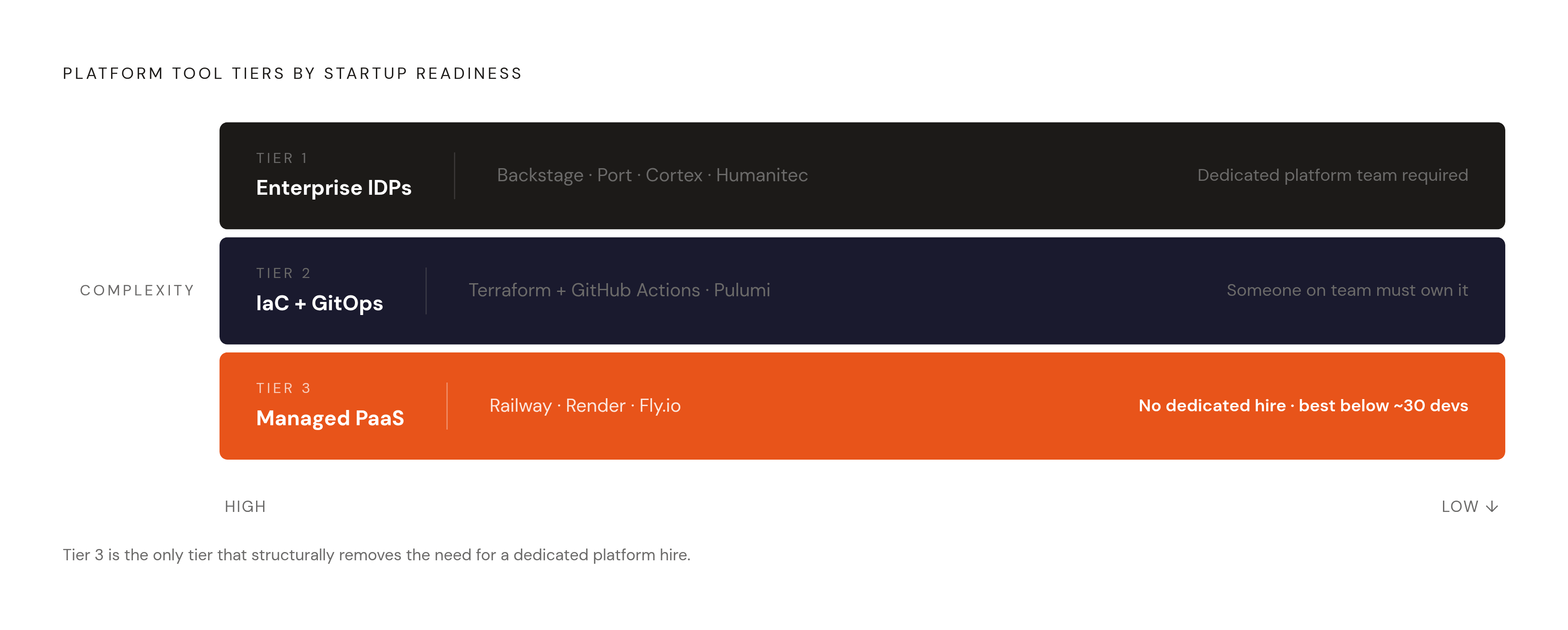
Tier one is the enterprise internal developer platform: Backstage, Port, Cortex, Humanitec. These tools are genuinely good at what they do, and the honest problem is that what they do assumes a dedicated platform team already exists to operate them. Out of the box, though, it does very little: it requires engineers to build and maintain plugins continuously, and Spotify, the company that built it, runs a full-time team to keep it running. That's not a fit for an early-stage startup. Port is the most startup-accessible tool in this tier: it offers a free tier for small teams, paid plans priced per seat each month, a no-code and low-code portal builder, and setup measured in days rather than weeks. Even so, Port is a visibility and workflow layer sitting on top of infrastructure, not an infrastructure operator itself, and it still needs someone who can configure it well. Cortex has evolved from a service catalog into a broader Engineering Operations platform, useful for measuring maturity across many services, priced custom, and it needs at least one platform engineer on staff to get value from it. If a team is Series A+ and already has DevOps tooling in place, building toward engineering maturity is where Cortex fits best. Humanitec is at the Kubernetes-heavy end of this tier, starting at $2,199 a month and assuming a platform team exists to run it, a non-starter at seed stage. A managed PaaS entry point costs a fraction of that, so you can see just how far apart these tiers really sit.
Tier two is infrastructure-as-code paired with GitOps: Terraform with GitHub Actions, or Pulumi. This tier buys maximum control, at maximum configuration cost. Terraform plus GitHub Actions is a mature, well-documented combination capable of managing any cloud resource, but someone has to own the Terraform modules, the state backend, the CI/CD pipeline, and drift detection. On a four-person team, that someone usually ends up being the same engineer buried in infrastructure plumbing instead of product work, which is the exact symptom this piece opened with. Pulumi improves on Terraform for teams that think in actual code, TypeScript, JavaScript, Python, Go,.NET, Java, alongside YAML and HCL, rather than HCL alone. Testing infrastructure feels more natural, and the abstractions compose better. The overhead of owning infrastructure-as-code doesn't go away, it just gets friendlier. Across both tools in this tier, the shared failure mode is the same: a toolchain hands a team a platform, not a platform engineer. Someone still has to own it, and on a small team, that someone is the product engineer who should be shipping features instead.
Tier three is managed platform-as-a-service, and it's the tier that actually removes the need for a dedicated hire, within real limits. Services in this category need low setup effort, offer self-service deploys, and don't need a dedicated team to keep them running. One provider in particular offers a genuinely strong developer experience: standing up a Postgres database, a Redis queue, and a Node API in a matter of minutes. The underlying infrastructure belongs to the provider, not the startup, which works fine until cloud credits, reserved instances, compliance requirements, or custom networking start to matter. This tier fits early MVPs best, when speed beats everything else and two engineers with a tight deadline just need something shipped by Friday.
Each tier does something well. The tier one tools deliver organizational maturity and visibility at scale.
The stage-based framework for choosing infrastructure approach as a team grows
The right infrastructure approach isn't a permanent decision. It changes predictably as a team scales, and if a team over-builds too early or clings to a lightweight setup for too long, the cost of staying on the wrong tier compounds.
Below the tipping point, under roughly 30 developers, managed PaaS handles the outcomes that matter: Railway is the fastest path from code to URL, Render is where you graduate when you need production-grade Postgres and predictable bills, and Fly.io is where you go when your users span continents and you're comfortable with Docker. Within that tier, the right pick shifts again depending on what the team actually needs: one provider offers the fastest path from a Git push to a live URL, a second is where teams graduate once they need production-grade Postgres and billing they can actually predict, and a third fits teams whose users span continents and who are comfortable working with Docker. Pricing details matter here too. One major PaaS provider removed its original, generous recurring free tier in August 2023, and now it offers a limited permanent Free plan, a one-time trial credit, and a low-cost Hobby plan, with autoscaling that runs automatically and needs no configuration. A second provider built its case on production-grade Postgres and predictable billing, and practitioner comparisons named it the strongest managed PaaS alternative after a widely discussed outage at a competitor in May 2026. Every, the AI-native media and software company, made exactly this move, migrating from one of these providers to the other, and described the result: "We've gone from having 3 or 4 issues every week to really not having to think about infrastructure at all".
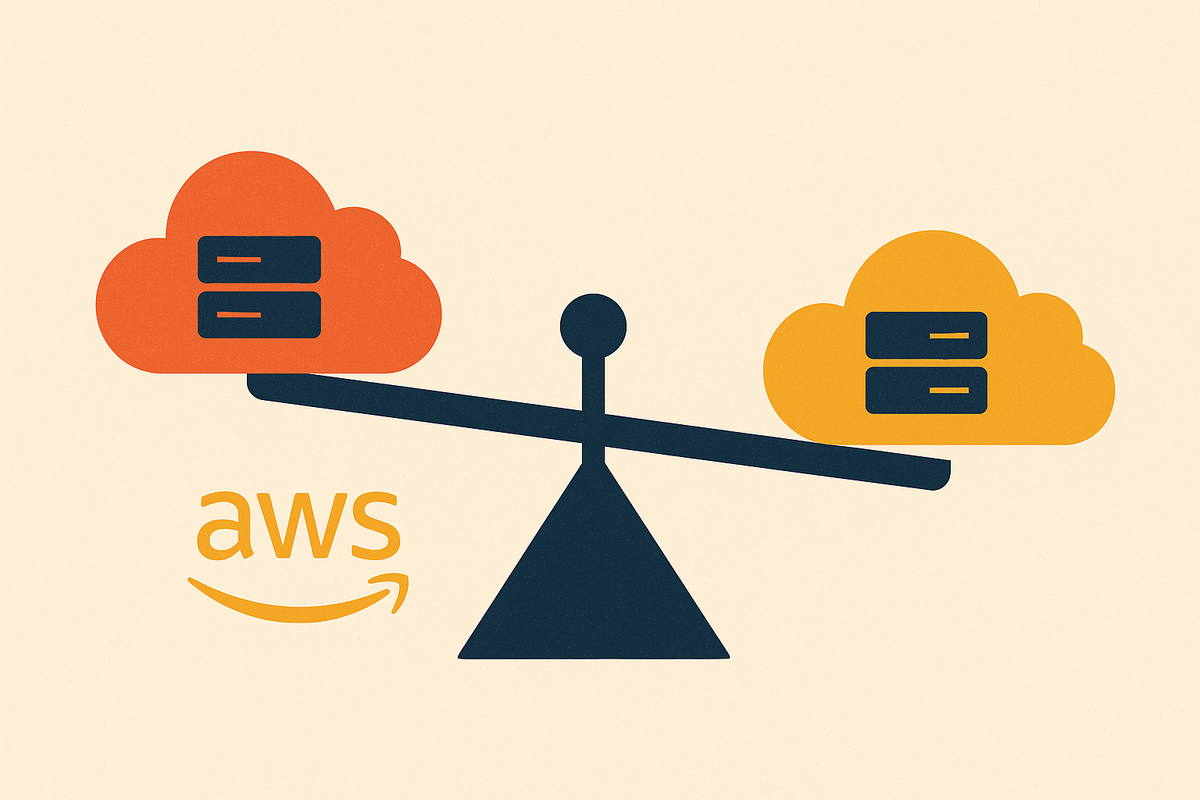
If you worry about getting locked into a provider, you probably overestimate how painful switching actually is. All three major PaaS options can deploy from either Docker images or Git repositories, so you don't need to change your application code when you move between them. What actually takes time is re-pointing environment variables, exporting and importing databases, updating DNS, and reconfiguring CI/CD pipelines, work that fits into a weekend for a small project or a sprint for something running production data across multiple services. Switching providers carries operational risk, not architectural risk: it means rebuilding deployment workflows, monitoring, and secrets management, not rewriting the product itself.
As a team crosses the 30-to-50-developer tipping point and infrastructure problems start duplicating across teams, the calculus shifts toward tier two or tier one tools, Port for teams building toward engineering maturity with existing DevOps tooling already in place, or Terraform and Pulumi for teams that need granular control over specific cloud resources. The framework is about recognizing which stage a team is in and matching the tier to that stage, then re-evaluating as the team grows past it.
Compliance requirements and the infrastructure calculus at growth stage
When compliance turns from an abstract future concern into an infrastructure decision, it can happen overnight. When an enterprise prospect asks for a SOC 2 report, or a healthcare customer requires a signed BAA, the timing of that moment decides whether compliance becomes a simple checkbox or a drawn-out remediation project.
Timing changes the cost by an order of magnitude. Building SOC 2 security controls into the pipeline from day one adds modest upfront effort and almost no ongoing drag once it's in place. Retrofitting those same controls onto a year-old codebase that ships straight to production with shared credentials turns into a multi-month remediation project.
The numbers back this up. Compliance platforms themselves split by price and depth and by their 2026 pricing: Vanta is at the upper end of the pricing range and carries the largest integration catalog, with more than 300 integrations, while Secureframe is at the lower end and offers the best price-to-feature ratio for a team going through SOC 2 for the first time. The platform fee is small next to what it replaces: manual evidence collection alone can consume hundreds of engineering hours, and at blended engineering rates, that opportunity cost dwarfs whatever the automation platform charges annually. A total first-year SOC 2 Type II run usually costs $50,000–$120,000 all-in, covering the auditor fee, a penetration test from a firm such as Cobalt, NetSPI, or Bishop Fox, the compliance platform, 0.3–0.6 FTE of engineering time over the window, and remediation findings.
For companies handling health data, the cost lever is architectural. Isolating protected health information inside a bounded set of services, and running analytics, logging, and AI features on de-identified data instead, shrinks the audit scope, the breach blast radius, and the engineering burden all at once. Practitioners generally sequence this work the same way: SOC 2 first, as early-stage proof of security, HITRUST later, once the company scales or needs to enter regulated contracts. So that phasing balances cost against benefit at each stage, and a company doesn't have to front-load every control it might eventually need.
All of this lands on infrastructure architecture, not paperwork. A platform running inside a shared-tenant provider's own infrastructure can't produce the audit trail, the access controls, or the data isolation that SOC 2 and HIPAA require once a company is operating at enterprise scale. That structural limit is what pushes compliance-driven companies toward infrastructure that runs inside their own cloud account rather than inside someone else's shared environment, and it's the decision point where the next stage of the infrastructure conversation has to begin.