Blue-Green vs Canary Deployment Strategies for Production Services
Choose based on your risk profile and infrastructure constraints, not convention.
The engineering conversation around deployments has moved past whether to do zero-downtime releases. That question is settled. The conversation now is how, and specifically, which of the two dominant mechanisms, blue-green or canary, fits the service you are actually running. The choice is not a matter of taste or convention. It follows from your service's risk profile, your team size, and your infrastructure. Pick the wrong one and you will either be paying for idle infrastructure you don't need or making rollback decisions at three in the morning with incomplete information.
How Blue-Green Deployments Work and What They Actually Guarantee
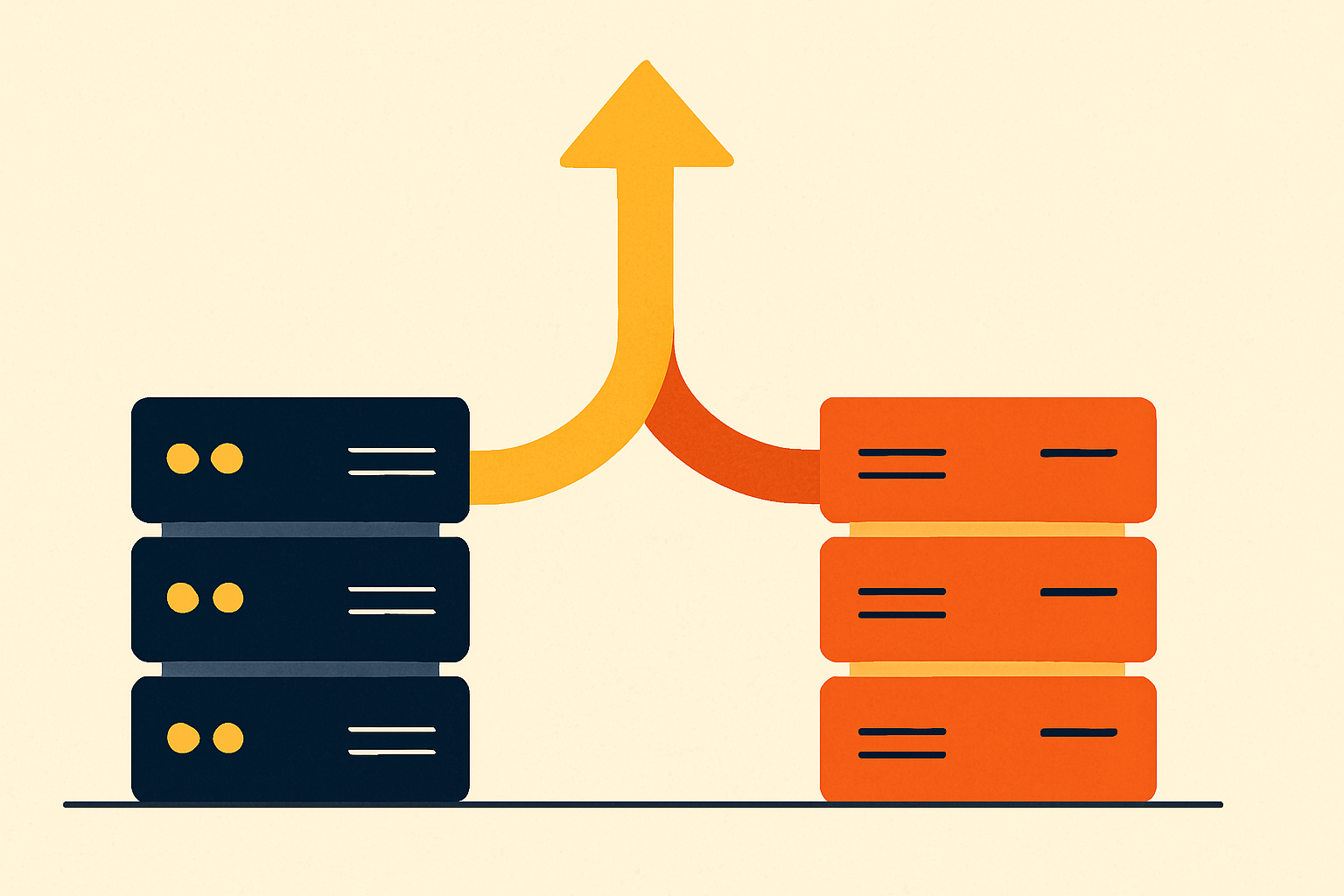
The mental model is simple: two identical environments run simultaneously. Blue holds live traffic. Green holds the new version. Everything you want to verify, integration tests, load tests, third-party integration checks, runs against green before a single real user touches it. When you're confident, you flip a load balancer rule. Traffic moves. The switch is instantaneous.
Rollback is equally clean. If something looks wrong after the flip, you reverse the load balancer change and traffic is back on blue in seconds. Green sits idle until you've confirmed stability or replaced it with the next release.
What the strategy actually guarantees is precise: zero downtime at the moment of cutover, a known-good fallback environment that remains live throughout the deployment window, and the ability to run comprehensive pre-release verification before any production user is exposed. Those are meaningful guarantees.
What it does not guarantee: safety for in-flight transactions at the exact moment of the flip, and, critically, meaningful rollback if a database schema migration has already run. That second limitation is where the "instant rollback" story gets complicated, and it deserves its own section.
How Canary Deployments Work and What Graduated Rollout Actually Means in Practice
Canary deployments do something structurally different. Instead of holding a new version in isolation and then flipping all traffic at once, you deploy it to a small subset of infrastructure and let real production traffic flow through it. A typical ramp looks like two percent, then twenty-five, then seventy-five, then one hundred. At each stage, you observe metrics before approving the next increment.
The defining property of this strategy is blast radius control. If something breaks at two percent traffic, ninety-eight percent of your users were never affected. The stable version continues serving the overwhelming majority throughout the entire rollout. Rollback is not an environment flip; it is a traffic weight reduction, which can also be fast but involves more discrete steps than a single load balancer change.
The operational complexity of canary deployments is real, but it is front-loaded. You incur it once when you build the tooling: weighted routing, real-time metric comparison, and automated analysis to promote or abort at each stage. The release moment itself becomes lower-stakes by comparison.
The Opposite Bets Each Strategy Makes
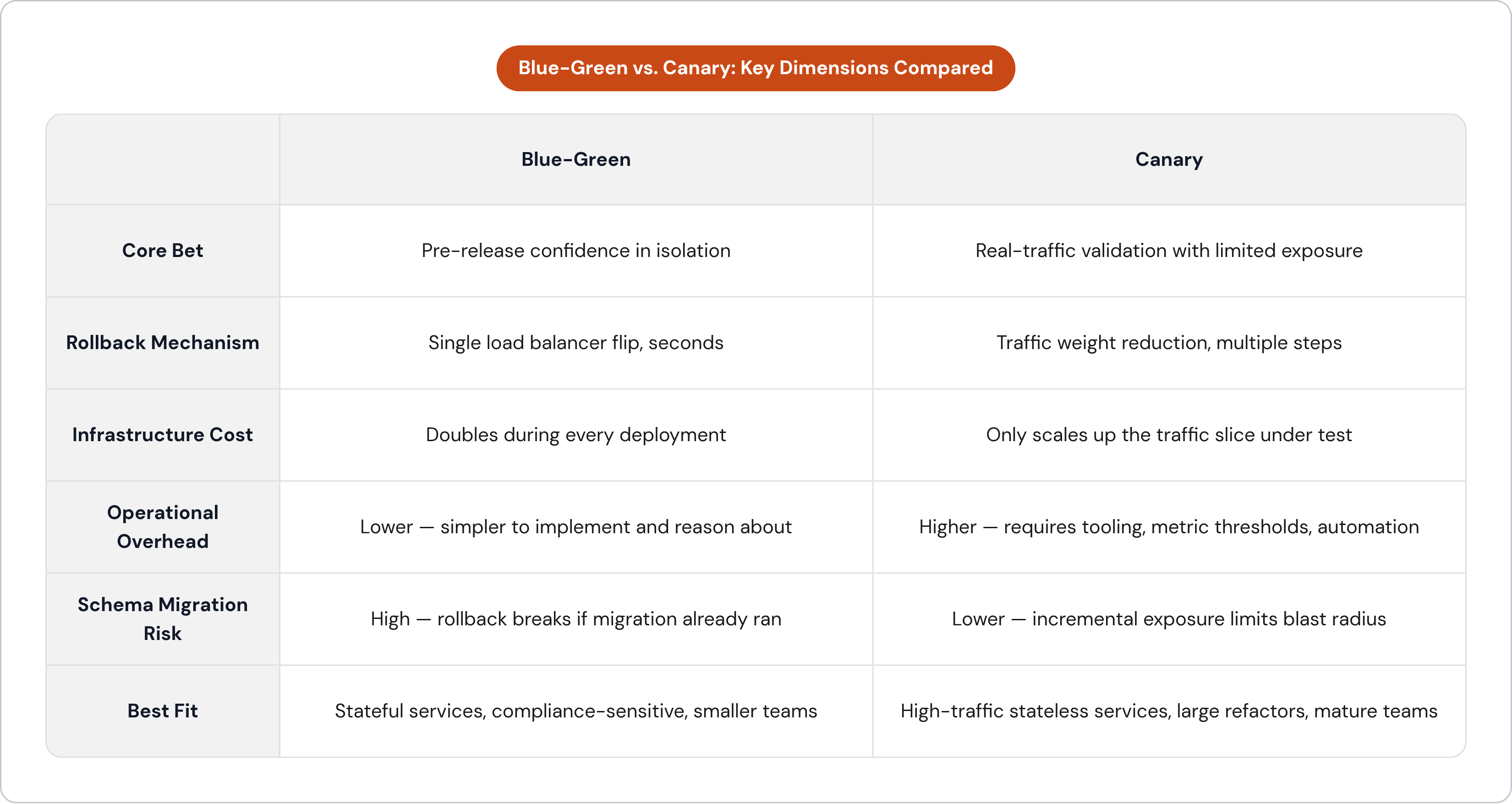
Blue-green bets on pre-release confidence. The assumption is that your new version has been sufficiently validated in isolation, that your staging environment is a faithful replica of production, and that the switch can be executed cleanly as an all-or-nothing action. If those assumptions hold, blue-green is straightforward and fast.
Canary bets on real-traffic validation. The assumption is that you cannot know with certainty whether something is broken until production load hits it, so you limit exposure while you find out. It treats production as the definitive test environment, which is a realistic position for high-traffic or architecturally complex services.
The cost dimension matters here. Blue-green doubles your infrastructure during every deployment; you are running two full environments simultaneously. Canary runs additional instances only for the traffic share under test, so the infrastructure overhead is lower. However, the operational overhead, the tooling, the metric thresholds, the automated analysis, is higher. Neither strategy is free.
Rollback speed also differs. Blue-green rollback is a single action measured in seconds. Canary rollback is fast, but reaching full rollback requires walking back through traffic weights, which adds steps. In practice, mature teams often don't choose one strategy permanently. Blue-green fits stateful or database-heavy services; canary fits stateless microservices where blast-radius risk is the binding concern. The strategies are complementary, not competing.
Where Blue-Green's Instant Rollback Promise Breaks Down
Rolling back traffic is straightforward. Rolling back data is not.
This is the condition that quietly undermines the blue-green rollback story for a significant class of services. If your new version runs a schema migration, say, adding a column, renaming a field, or restructuring a table, and that migration is incompatible with the previous version's expectations, switching traffic back to blue does not restore functionality. The database is now in a state the old code was not written to handle. You have flipped the load balancer correctly and still have an outage.
The standard mitigation is the Expand-Contract pattern. In the expand phase, you add new columns or tables without removing old ones, so both the old and new versions of the application can run against the same schema simultaneously. In the contract phase, once the new version is fully promoted and stable, you remove the obsolete columns in a separate deployment. This preserves the rollback option, but it adds planning overhead and turns a single deployment into a multi-step operation.
The implication is direct: teams must decide how to handle schema migrations before adopting blue-green, not as an afterthought discovered mid-incident. For services where every release touches the schema and the expand-contract discipline is difficult to maintain, canary's incremental approach often fits better than blue-green's all-or-nothing model.
Which Service Characteristics Should Drive the Choice
The nature of the change matters as much as the criticality of the service.
Blue-green is the stronger fit when changes are self-contained and additive, when API updates are backward-compatible with no schema migrations involved, when extensive pre-release testing is practical and staging closely mirrors production, and when compliance requirements demand a clear audit trail. Blue-green records a precise moment when traffic switched, which satisfies regulatory requirements for version separation and deployment history in a way that canary's gradual ramp does not replicate as cleanly.
Canary is the stronger fit when the service carries high traffic and a full-blast failure has immediate revenue or reputational consequences. It is also the right choice for large refactors or multi-service changes where subtle issues like cache behavior or data shape mismatches only surface under real load, not synthetic testing. The more intertwined and risky the change, the more canary's blast-radius control outweighs its added complexity.
Team size is a genuine variable here, not an excuse. Blue-green is simpler to implement and reason about. For smaller teams without dedicated platform infrastructure, it is the better starting point. Canary's operational complexity pays off once you have the tooling to automate analysis; without that tooling, you are managing a manual, multi-stage rollout under pressure. Blue-green is the default; canary is the natural progression when blast-radius risk becomes concrete and measurable and the team has the maturity to automate the decision loop.
Automating Canary Analysis So Rollback Decisions Don't Happen at 3 AM
The value of a canary deployment is largely unrealized if a human is sitting at a dashboard making promotion decisions at each traffic increment. Manual gates are a bottleneck, and they introduce exactly the kind of fatigue-driven error you were trying to avoid. Automation is not an enhancement to canary deployments; it is what makes them practical at scale.
Two tools are widely used for this on Kubernetes. Argo Rollouts replaces the standard Kubernetes Deployment resource with a custom Rollout resource, giving you fine-grained control over traffic increments and analysis steps. It is a natural fit if your team is already using ArgoCD for GitOps-style delivery. Flagger takes a less invasive approach: it adds a Canary custom resource alongside your existing Deployment manifests without replacing the workload type. Teams using Flux, or teams that want automated canary delivery with minimal changes to existing manifests, tend to prefer it.
A concrete threshold example: if the success rate on canary traffic drops below ninety-five percent, or if P99 latency exceeds five hundred milliseconds, Argo Rollouts can automatically roll back all traffic to the stable version. Kayenta, developed by Google and Netflix, offers statistical analysis for the same promote-or-abort decision, comparing canary and baseline metrics to reduce false positives from normal variance.
CircleCI uses Argo Rollouts internally across the majority of its own production services and has built a release agent that lets engineers promote, roll back, or cancel canary rollouts directly from the CI interface, keeping the deployment workflow within the tool engineers are already using.
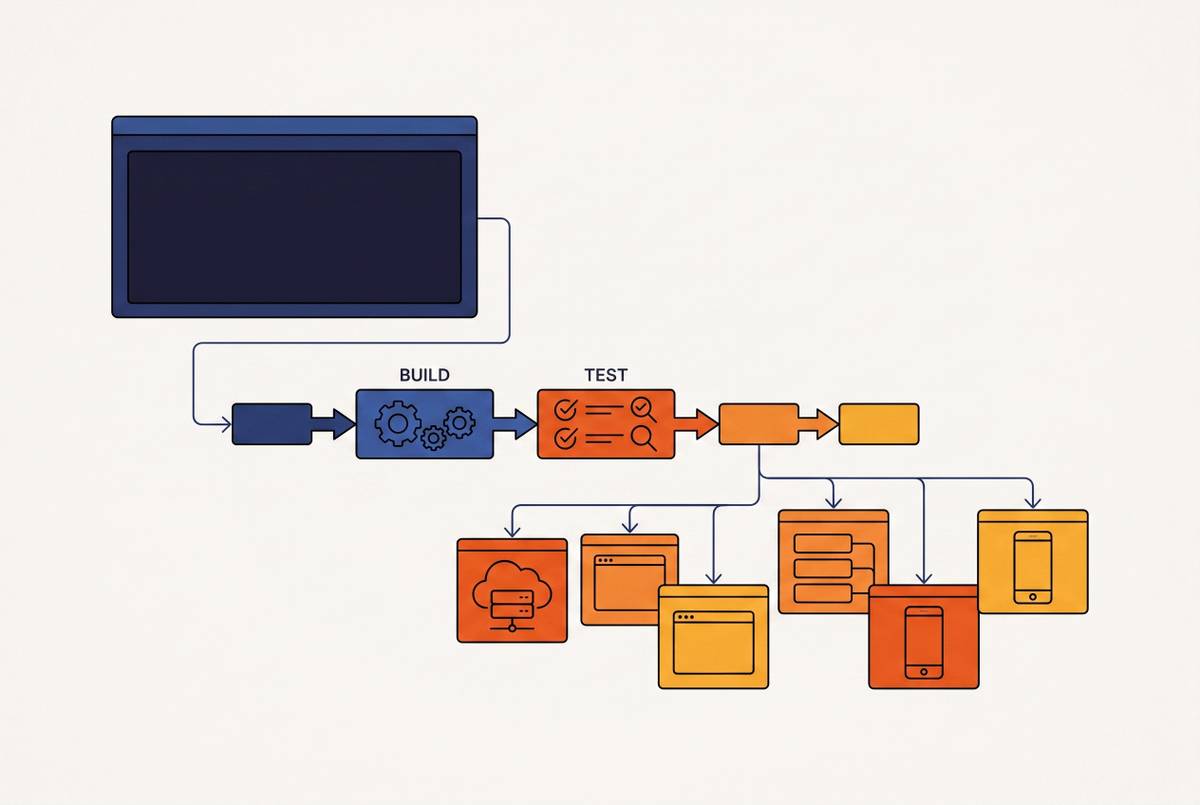
The thresholds must be defined before the rollout begins. Agreeing on what "worse" means is the actual work, and it is harder than it sounds because it requires teams to understand their own baseline behavior well enough to distinguish a regression from normal variance. The CI/CD pipeline is the right enforcement point for all of this: standardize deployment patterns as reusable pipeline templates, use branch or tag conventions to route commits appropriately, and require manual approval only for the final promotion to one hundred percent traffic or to stable.
What Canary Analysis Requires for AI Model Deployments
Traditional canary gates operate on binary signals. A request either succeeds or fails. An HTTP 200 means the service is healthy.
AI model outputs exist on a quality spectrum. A response can be grammatically fluent, factually incorrect, and still return HTTP 200. That gap is where many AI canary failures hide, and it makes standard infrastructure metrics necessary but not sufficient. Error rates, latency, and GPU out-of-memory events tell you whether the model is running. They do not tell you whether it is running well.
Additional signals are required: automated evaluation scores compared against a baseline model, toxicity and coherence metrics, and model-specific signals like VRAM pressure and concurrency saturation. Critically, rollback thresholds should be calibrated against the concurrent baseline version running in production, not against historical averages. Model quality can degrade gradually, and historical averages can mask regressions that would be more apparent in a side-by-side comparison.
At the serving layer, vLLM's model routing and Envoy work well for progressive model rollouts. Seldon Core supports canary rollouts and A/B testing for ML models on Kubernetes with Prometheus and Grafana integration, which provides a path to the metric collection the quality gates depend on.
For regulated industries, every canary stage should produce a signed audit record: model version, traffic percentage, metrics evaluated, and the decision made. MLflow's tracing and experiment tracking provides one approach to generating this without building custom logging infrastructure.
According to the Stanford 2025 AI Index, inference costs have dropped significantly in recent years, with some models now available at fractions of a cent per million tokens. At current price points, the cost of running a canary slice on GPU hardware is a less significant objection to this approach than it once was. The quality measurement problem remains a real obstacle, and it is an engineering problem, not solely an economic one.
How the Major PaaS Platforms Handle These Strategies and Where Their Limits Show
Vercel has invested in this space. Rolling Releases provide incremental rollouts natively without requiring custom routing configuration, combined with Instant Rollbacks for fast recovery. Skew Protection enables blue-green deployments with minimal configuration, and Vercel's documentation provides dedicated guides for both strategies. The constraint is architectural: serverless functions are stateless and short-lived, with timeout limits that vary by plan tier. Persistent connections and stateful workloads are not in scope. For frontend and edge-adjacent services, these patterns work well. For backend services with complex state or heavy infrastructure dependencies, the platform's model limits which deployment patterns are meaningful.
Other PaaS platforms can support blue-green and canary workflows through integrations with external tools like Cloudflare, observability platforms, and GitHub Actions, but these approaches require assembling the pieces yourself rather than using a native primitive. The integration works, but the cohesion is the responsibility of your team.
The broader truth about shared-tenant PaaS platforms is consistent: when your deployment strategy needs to be tightly coupled to infrastructure controls, custom routing rules, metric-gated promotion, or compliance-auditable traffic records, the platform's abstraction eventually becomes a ceiling. Teams typically hit that ceiling not because the platform is broken but because their deployment maturity has outpaced what the platform exposes. The migration decision, when it comes, is often driven by release cadence increasing, blast-radius risk becoming concrete, or compliance requirements demanding explicit deployment records the platform cannot produce natively.
The Deployment Strategy Decision as an Infrastructure Ownership Question
The choice between blue-green and canary is ultimately a question about where you want complexity to live. Blue-green concentrates complexity in the release moment, the all-or-nothing switch that requires pre-release confidence. Canary distributes complexity across the infrastructure layer that manages the ramp, requiring traffic-splitting, metric collection, and automated analysis. Neither strategy eliminates operational risk. Both transfer it to a different place and a different time.
What separates teams that deploy confidently from those that treat releases as risky events is not which strategy they chose. It is whether the strategy is codified, automated, and consistently applied. Burst SMS has reported reducing outage recovery time significantly after moving to blue-green with automated tooling. The improvement came not from the strategy itself but from baking it into repeatable, automated pipeline steps that removed improvisation from the process.
For teams without a dedicated DevOps function, the right infrastructure layer should handle the mechanics of whichever strategy fits, cluster routing, metric collection, automated promotion, so that engineers make the architectural decision once rather than managing the mechanics on every release. Porter, a bring-your-own-cloud PaaS that deploys production environments directly into a team's own AWS, GCP, or Azure account with CI/CD and autoscaling included, is one platform built around that handoff. That infrastructure needs to live in the same environment where the routing rules and promotion controls actually apply, which means running directly in the team's own cloud account.
The starting point for most teams is blue-green: simpler to implement, easier to reason about, and sufficient for a large range of services. Canary is the natural progression when blast-radius risk becomes the binding constraint, when the team has the tooling to automate the analysis, and when the complexity of the progressive delivery infrastructure is clearly justified by the cost of getting a release wrong.