PCI DSS vs SOC 2 for SaaS Startups Handling Payment Data
PCI DSS protects payment data; SOC 2 audits your entire security posture.

A security questionnaire lands in the inbox. It asks about both PCI DSS and SOC 2, and the team building the product has no clear answer for which one matters first, or whether finishing one lets them skip the other. That moment is common, and it's expensive, because the two frameworks answer separate questions and are frequently both mandatory at once, not one-or-the-other options a founder gets to pick between. Both frameworks market themselves around "data security," both show up on the same enterprise procurement checklists, and neither governing body has much reason to draw a clean line showing where its own authority ends and the other's begins. Sprinto's comparison cuts through this by framing the distinction as one of scope: PCI DSS protects payment card data exclusively, while SOC 2 covers the far wider operational and security control environment, spanning customer data, availability, confidentiality, processing integrity, and privacy. IS Partners adds that both frameworks require information security policies to be shared across the organization, and that shared requirement creates a surface-level resemblance that hides real differences in audit authority, the type of data each one protects, and the legal standing each carries. The cost of getting this wrong runs in both directions: a founder who treats SOC 2 as a stand-in for PCI DSS walks into enterprise deals with a gap that procurement teams catch more often now, and a founder who treats PCI DSS as sufficient proof of trustworthiness misses the broader customer-assurance case that only SOC 2 makes.
What each framework governs, and who wrote the rules
PCI DSS and SOC 2 come from entirely different kinds of institutions, and that origin explains most of what makes them behave so differently in practice. One is an industry-mandated standard with a governing council behind it; the other is a voluntary attestation framework built by an accounting standards body. PCI DSS was developed and is maintained by the PCI Security Standards Council, and it applies to any organization that stores, processes, or transmits credit card data. Its requirements sit under six objectives: build and maintain a secure network and systems, protect cardholder data, maintain a vulnerability management program, implement strong access controls, regularly monitor and test networks, and maintain an information security policy. The version in force now is PCI DSS v4.0.1, released June 11, 2024, and it refines and clarifies the existing requirements rather than introducing new obligations.
SOC 2 operates on a different axis entirely. It was developed by the American Institute of Certified Public Accountants (AICPA), and it applies to service organizations: cloud providers, SaaS companies, data hosting centers, and any third party handling customer data. It's built around five Trust Service Criteria, security, availability, processing integrity, confidentiality, and privacy, with security as the only one that's mandatory and the rest brought in based on contractual obligations or business goals. There are two report types: Type I evaluates whether controls are designed correctly at a single point in time, and Type II evaluates whether those same controls actually operate effectively over a longer observation period. The audit authority differs too: SOC 2 exams are performed by independent CPA firms licensed for the work, while PCI DSS assessments run through QSAs certified directly by the PCI Security Standards Council.
Which trigger puts a SaaS company in PCI DSS scope
The most common mistake a SaaS founder makes is assuming PCI DSS only applies if the company directly stores a card number somewhere in its database. That assumption is wrong, and it leaves real exposure unaccounted for, because a SaaS platform can fall fully into PCI DSS scope without ever seeing a single raw card number. The PCI Security Standards Council names two separate triggers, and either one alone creates a compliance obligation. The first is straightforward: handling payment account data, meaning primary account numbers (PANs), cardholder names, expiration dates, security codes, or other sensitive authentication data. The second trigger catches far more companies than founders expect, because it covers the ability to impact the security of the cardholder data environment (CDE), a category that includes SaaS companies providing payment orchestration, cloud administration, managed security, software deployment, logging, customer support tooling, or any other service with security impact on that environment. The PCI SSC's own service-provider scope guidance addresses exactly this boundary case: a service provider can affect the security of payment account data without ever handling that data directly, so a SaaS team needs to test for both data possession and security impact, since testing only for stored card numbers produces a false negative that leaves real exposure unmeasured.
Four questions settle most of the ambiguity, and a SaaS team should work through all four before choosing a framework or an assessment path. First, what is the company's actual payment role, merchant, service provider, payment facilitator, gateway, or processor, or none of the above. Second, where does account data actually travel, tracing browser fields, redirects, iframes, application servers, APIs, logs, support tools, backups, and third parties involved, and covering PANs and sensitive authentication data rather than stopping at database tables. Third, which systems can change payment security, covering code, scripts, deployment paths, identities, infrastructure, and vendors that can alter or administer the CDE even when those systems never receive a PAN directly. Fourth, who actually sets the validation requirement, and the answer needs to come in writing from the acquirer or payment brand before the company selects an SAQ or brings in a QSA. Outsourcing payment processing to a third party does not erase PCI DSS responsibility either: the merchant still has to confirm that provider is PCI DSS compliant for the specific services it supplies, keep a written agreement in which the provider acknowledges its own share of responsibility, monitor that provider's compliance status at least once a year, and understand exactly where each party's responsibility begins and ends.
Payment Architecture and PCI DSS Scope
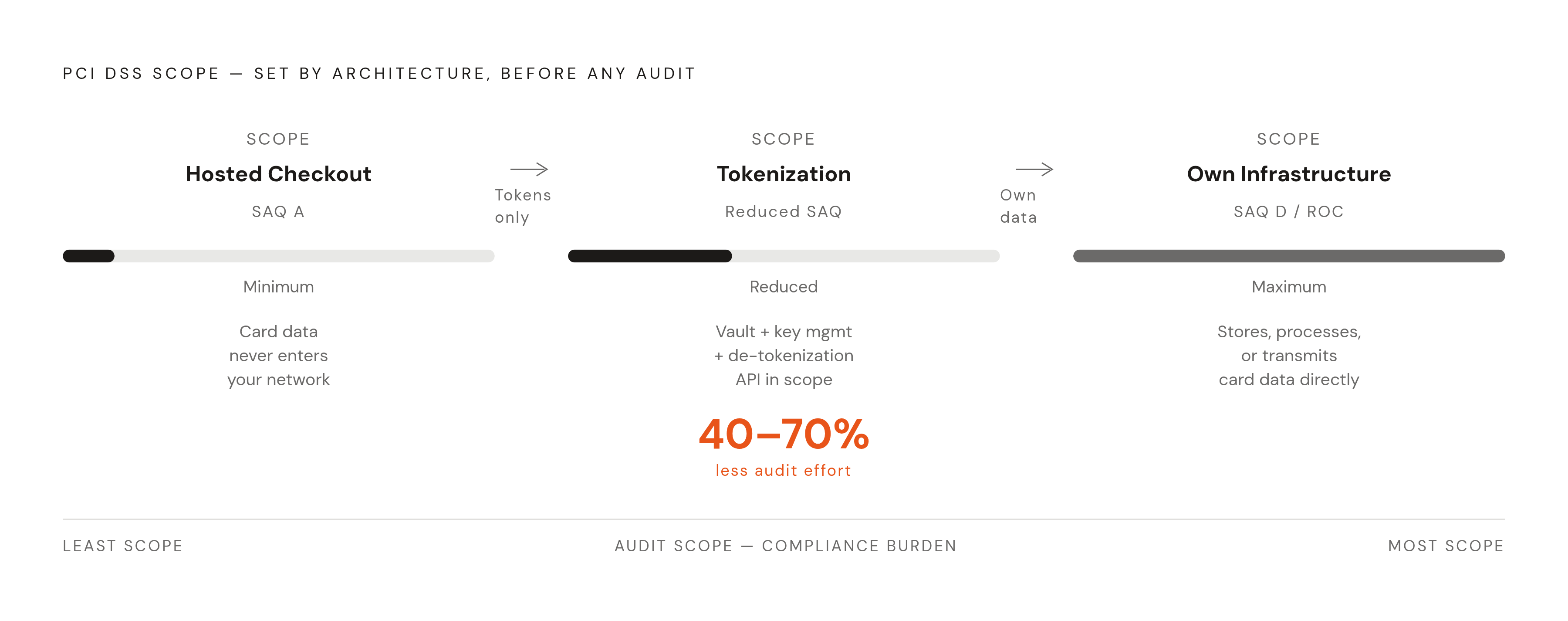
By the time a compliance team starts writing controls, the size of the job has usually already been decided, because the scope of a SaaS company's PCI DSS obligation is largely fixed by architectural choices made long before that work begins.
A SaaS using a hosted checkout, where card data never enters the SaaS network, reduces scope to its minimum, and the company can complete SAQ A, the simplest form of PCI assessment. The actual implemented data flow and the shared responsibilities between the company and its provider are what determine eligibility, so SAQ A qualification has to be confirmed against the exact integration, the payment-page controls, the scripts running on that page, and the specific instructions of the compliance program involved.
The other team builds a custom checkout form and processes cards on its own infrastructure, and that decision alone pushes it toward a much heavier compliance burden. Tokenization replaces payment information with a randomly generated token, while the actual card data sits in the payment service provider's token vault, a design particularly useful for subscription SaaS businesses running recurring payments on tokens rather than raw cardholder data. Under this design, any system that only ever touches the token, the CRM, the customer portal, the analytics pipeline, sits outside PCI scope entirely. Only the tokenization vault, the key management system, and whatever application calls the de-tokenization API remain in scope. VISTA InfoSec's engagement data shows mature fintechs cutting PCI audit effort by 40 to 70 percent through exactly this kind of architecture-first design.
Companies that store, process, or transmit payment data on their own systems, by contrast, must complete SAQ D, the most comprehensive self-assessment questionnaire. Organizations classified at merchant level 1 don't even get the option of self-assessment: they must engage a QSA to prepare a full Report on Compliance (ROC), the most resource-intensive path the standard has. None of this gets chosen at audit time. It gets chosen during product design, when a team decides how payment data will move through the system. Founding teams need to scope their PCI DSS exposure while they're still writing payment integration code, not after their first enterprise security review forces the question.
PCI DSS v4.0.1 Enforcement for Modern Deployment Stacks
Every organization inside PCI DSS scope has been assessed against v4.0.1 since March 31, 2025, and there's no grace period left to lean on. The new requirements function as mandatory controls that a team cannot defer. The transition window is closed: iTechGuides documents that 51 of the 64 new requirements introduced in PCI DSS v4.0 were originally future-dated, and all of them became fully mandatory on March 31, 2025, so none of them can be described as optional heading into 2026.
Three of these changes carry the heaviest engineering load for SaaS teams specifically. Requirement 8.4.2 expands multi-factor authentication to cover all access to the cardholder data environment, not just administrative access, which touches every engineer, support agent, and automated system that has any contact with the CDE. Requirements 6.4.1 through 6.4.3 target payment page script security, aimed directly at JavaScript injection attacks, the Magecart-style attacks that capture card data before it ever reaches the payment processor. Requirement 6.4.3 requires every script running on a payment page to be authorized, integrity-checked, and inventoried, and for SaaS teams running third-party analytics, A/B testing tools, or chat widgets on their checkout pages, meeting that requirement is a real engineering project. Requirement 11.6.1 requires a change- and tamper-detection mechanism to alert personnel to unauthorized changes to payment pages and scripts, assessed at least weekly or at a frequency defined by the entity's targeted risk analysis.
None of this needs to run as a separate compliance program bolted onto engineering. VISTA InfoSec documents a case where a DevOps team was burning six weeks a year on manual evidence collection, screenshots and logs assembled by hand for their QSA, before shifting to Policy-as-Code, building automated compliance checks directly into the CI/CD pipeline. Shifting to Policy-as-Code gave the team audit-ready status held year-round with zero configuration drift. For SaaS teams already running CI/CD pipelines, that's the practical path forward: compliance automation extends tooling the team already has, rather than standing up a new one.
SOC 2: when it becomes unavoidable, and which report type to pursue first
SOC 2 carries no legal mandate, yet enterprise buyer behavior has turned it into a practical requirement for any SaaS company chasing meaningful B2B revenue or pipeline. Vanta's 2025 State of Trust Report found that 83 percent of enterprise buyers require SOC 2 certification from SaaS vendors before they'll sign a contract, a figure that climbs higher still among the largest companies making the purchase. A founder waiting for a legal requirement to justify the investment is misreading the market: the buyers have already set the requirement themselves.
The choice between report types carries its own weight. Type I looks at whether a company's controls are designed correctly at a single point in time, a snapshot that answers whether the right policies and systems exist on paper. Type 2 goes further, evaluating whether those same controls actually operate effectively over an extended observation period. Most enterprise buyers treat Type II as the real signal of operational maturity, since it shows controls holding up under real conditions rather than existing only as documentation assembled for an auditor's visit. A SaaS company early in its compliance path often starts with Type I to establish that the control design is sound, then moves to Type II once those controls have had time to run and prove themselves in practice. That sequencing mirrors the PCI DSS lesson from earlier in this piece: framework obligations are a structure built into the product from the start, not a single gate to clear once. They're a structure that needs to be built into the product and the company's operating rhythm from the start, not retrofitted the week an enterprise buyer asks for proof.