Jenkins vs GitHub Actions for Small Engineering Teams
GitHub Actions costs small teams almost nothing; Jenkins costs them a DevOps engineer.
For a small engineering team, the Jenkins vs GitHub Actions decision comes down to one thing: who has time to babysit the infrastructure. Most comparisons start with syntax, plugins, and YAML versus Groovy. That misses the actual fork in the road: a team without dedicated DevOps staff creates a decision not between two CI tools but about who owns and patches the machine underneath one of them.
Scope matters here. This is written for teams under about 10 developers, no platform engineer on staff, probably already living on GitHub for source control. Mature CI/CD pays off in a big way. State of DevOps benchmarks from 2025 put elite performers at many multiples more frequent deployment than laggards, with recovery times several times faster when something breaks. That is the ceiling those figures describe. The question for a lean team is which tool actually gets them there without eating the whole team's week.
What each tool is, stripped of the marketing
Jenkins is an open-source automation server. It's been around since 2004, split off from a related project at a major software vendor in 2011, and has stayed self-hosted from day one. Over 1,800 plugins, pipelines defined in a Jenkinsfile written in Groovy. Someone stands up the controller. Someone runs the agents. Someone owns patching, scaling, and backups, because none of that comes bundled.
GitHub Actions is a CI/CD product built and run by Microsoft's GitHub. It's event-driven: a pull request, a push, a tagged release fires a workflow. Workflows live as YAML files right in the repo, and the marketplace carries more than 23,000 pre-built Actions to drop in instead of writing scripts from scratch.
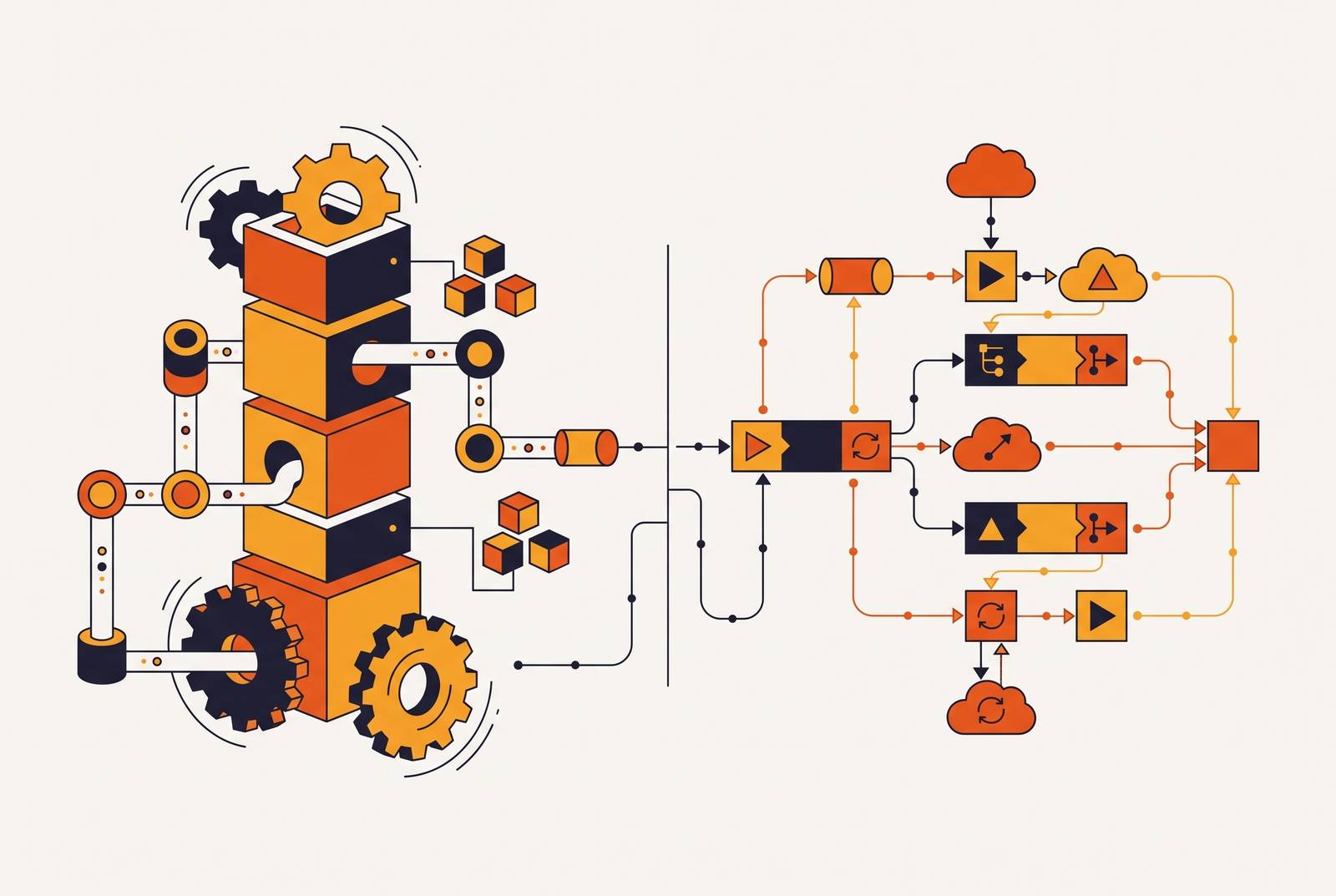
The architecture splits cleanly here. Jenkins separates job coordination (the controller) from execution (the agents), and you can scale that out horizontally, but doing so is a manual, hands-on job. Actions defaults to GitHub-hosted runners: no server to provision, no capacity planning, no controller to keep alive at 2 a.m.
Both support pipeline-as-code, version-controlled and reviewable like any other file in the repo. But Jenkinsfile syntax in Groovy has a real learning curve, steeper than Actions YAML, and that gap matters a lot for a team with no one whose job title includes the words "CI specialist." One of these tools is infrastructure a team operates. The other is a service a team consumes. Everything below follows from that split.
The real cost of running Jenkins without a DevOps team
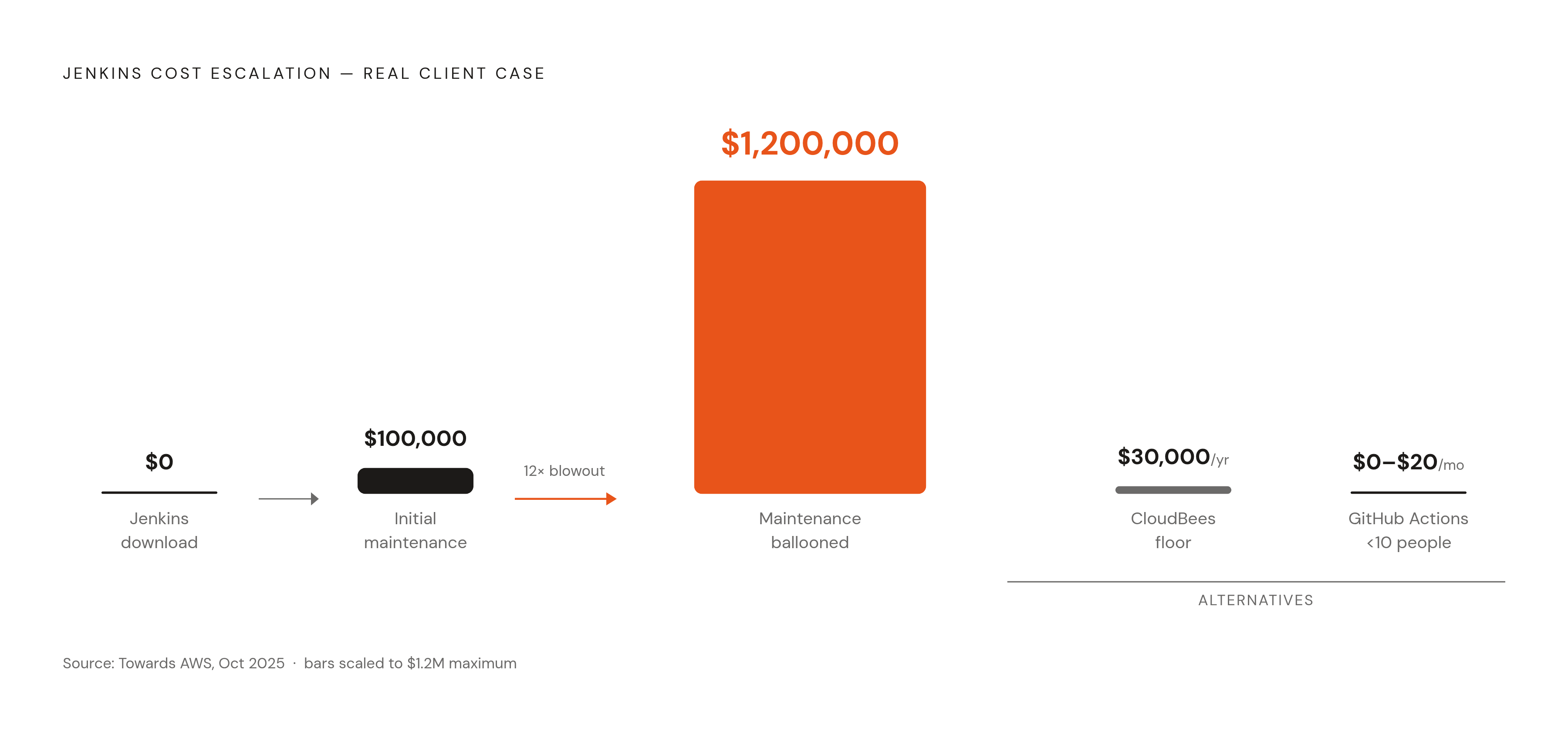
Jenkins itself costs nothing to download. Running it for a real team costs plenty: servers or VMs or cloud compute to host the controller and agents, plus the ongoing engineering hours to configure it, patch it, upgrade plugins, and debug it when a build queue backs up for no obvious reason.
The maintenance line is the expensive one. Research from eesel.ai found that the ongoing cost of running Jenkins often adds up to a full-time DevOps salary, sometimes a small team's worth of salaries, just to keep the lights on. That's not a hypothetical. Towards AWS reported in October 2025 on a client whose Jenkins maintenance costs ballooned from $100,000 to many times that amount. That gap is not a rounding error but a twelve-fold blowout, on infrastructure that was supposedly free to begin with.
Plugins are a big part of why. Having 1,800-plus plugins available is a genuine strength when a team has specialists who know which ones are safe and which ones are abandonware. For a lean team without that expertise, it's 1,800-plus potential failure points, a lot of them unmaintained. The Jenkins Security Advisory logged 47 plugin CVEs in 2025 alone, several of them credential exfiltration bugs in plugins that run with full controller permissions. Somebody has to patch each one, and that somebody is whoever happens to own the Jenkins box that week.
Jenkins still runs CI/CD at 80% of the Fortune 500, and it's not there by accident or inertia. Those companies have platform teams built specifically to absorb this overhead. A team of eight engineers does not. Jenkins is losing ground overall too, down 8% year over year in market share, even as it stays deeply embedded in large enterprises. The assumption a lot of small teams make going in is that free software equals cheap software. The numbers above say otherwise.
What GitHub Actions costs, including the 2026 pricing changes
Public repos run Actions free of charge, full stop. Private repos get a bucket of included minutes on every GitHub plan, and for a team under 10 developers, effective CI/CD spend is often somewhere between $0 and $20 a month.
Pricing shifted twice going into 2026, and both moves deserve a precise account. On January 1, 2026, GitHub cut prices on GitHub-hosted runners by up to 39%, depending on machine type, while leaving the free-minute quotas untouched. Then, on December 16, 2025, GitHub announced a new charge of $0.002 per minute for self-hosted runner usage, planned to take effect March 1, 2026. Runner usage on public repos stayed free throughout, and GitHub Enterprise Server customers were exempt from the proposal in the first place.
GitHub's own numbers on the (ultimately shelved) change are worth knowing anyway, because they show how narrow the actual impact would have been: 96% of customers would have seen no bill change at all, and of the 4% affected, 85% would have seen their bill go down, not up. The remaining 15% faced a median increase around $13. For context on scale, GitHub processes 71 million Actions jobs a day and ran 11.5 billion minutes of compute in 2025, infrastructure that GitHub had been absorbing the cost of without passing it through.
A concrete benchmark helps more than any pricing table. A fintech company in San Francisco running 14 microservices out of a Go monorepo burns roughly 18,000 Actions minutes a month. After the 3,000 included minutes, that's $128 out of pocket, and total time spent managing CI/CD runs under an hour a week. That's what low operational overhead actually looks like in practice, not in a sales deck.
Compare that to what it costs to buy back Jenkins maintenance time on the commercial side. CloudBees CI, the enterprise-support flavor of Jenkins with managed controllers, starts north of $30,000 a year. That number is basically an admission of what the Jenkins ecosystem itself thinks the maintenance burden is worth.
Where Jenkins still earns its place
Running CI/CD across 80% of the Fortune 500 isn't inertia. Those organizations have requirements GitHub Actions, as a cloud product, structurally cannot meet.
Air-gapped and on-premises environments are the clearest case. GitHub Actions is a cloud-hosted product, and teams in regulated industries that can't send code or build artifacts outside their network face significant constraints in adopting it. Jenkins can be deployed entirely on-premises within whatever compliance boundary an organization requires, none of which a cloud-hosted CI product can replicate.
Legacy toolchain integration is the second case. Those 1,800-plus plugins reach into legacy toolchains and on-prem systems that cloud-native platforms often don't support. And for genuinely complex enterprise orchestration, multi-stage approval gates, conditional deployment windows, scripted rollback logic, Jenkins still handles patterns that Actions' event-driven model wasn't built for.
None of that makes Jenkins the wrong tool. It makes it the right tool for a specific organizational profile: a team that already has the DevOps capacity to run it, or a compliance requirement that makes self-hosting non-negotiable. Neither condition describes most startups under 10 engineers.
Security and compliance trade-offs that change the calculus for some teams
Neither platform is inherently safer. Jenkins had those 47 plugin CVEs in 2025. GitHub Actions has seen supply chain incidents involving widely used reusable workflow components, where compromised dependencies exposed secrets across many repositories. Supply chain risk isn't a Jenkins problem or an Actions problem, it's a category. Verizon's 2025 Data Breach Investigations Report found third-party involvement in breaches doubled year over year, now appearing in 30% of confirmed incidents, up from 15%. The fix on both platforms is the same discipline: pin dependencies to commit SHAs, never to a mutable tag.
Where the two genuinely diverge is credential handling. GitHub Actions has supported OIDC since 2021 and can mint short-lived tokens that AWS IAM, GCP Workload Identity Federation, and Azure AD will trade for temporary cloud credentials, no long-lived secrets sitting in CI config at all. Jenkins can be configured for OIDC-based credential flows, but the setup is far more manual, and most existing Jenkins shops still haven't moved off static, long-lived credentials.
For SOC 2, any CI/CD tool that produces an auditable trail from a reviewed code change to a production deploy satisfies the requirement, Jenkins, Actions, GitLab CI, doesn't matter which, as long as it's configured right. HIPAA raises the bar further: getting a GitHub Actions pipeline HIPAA-aligned rather than just SOC 2-clean comes down to three specific decisions, the scope of OIDC trust, discipline around runner labeling, and where the boundary sits on reusable workflows. Solvable, but it takes deliberate design, not defaults. For a team building toward SOC 2 without a compliance engineer on staff, Actions' managed infrastructure and built-in secrets handling carry a noticeably lighter configuration burden than getting the same posture out of Jenkins.
How the market has split, and what that signals for tooling momentum
Jenkins still holds more than 40% of the CI/CD market by installed base. But GitHub Actions has passed it in actual developer adoption, and that gap between "installed somewhere" and "what developers reach for" is the real story. Industry data put roughly 85% of GitHub-hosted CI/CD pipelines on Actions heading into 2026, with 68% of GitHub projects using it.
Jenkins share is down 8% year over year. GitLab CI is the fastest grower in enterprise accounts, up 34% in 2025. Large organizations are migrating away from Jenkins, but slowly, the kind of shift measured in years, not quarters. That said, Jenkins isn't fading into irrelevance: it still counts more than a million active users and over 200,000 installations worldwide. What's shifting is the center of gravity in its community, from people building new things on it to people maintaining what's already there.
Practically, momentum favors Actions for a small team in a few concrete ways: more than 20,000 community-maintained Actions in the marketplace, active investment from Microsoft, and a hiring pool full of developers who already know how to write a YAML workflow without training. Jenkins expertise, meanwhile, is turning into a specialized skill rather than a default one.
There's a hybrid pattern showing up at bigger companies too: Actions for CI, Jenkins held onto for complex CD or regulated deployment stages. That's a reasonable split when there's staff to run both. For a team under 10 people, running two CI/CD systems isn't a hedge, it's just a second thing to maintain.
A decision framework for teams making this choice right now
For a team under roughly 10 developers, no dedicated DevOps hire, already living on GitHub: Actions is the practical default. Managed infrastructure and a cost floor around $0 to $20 a month together remove the hidden tax that Jenkins quietly imposes on teams too small to notice it building up.
Jenkins earns a real look under a narrower set of conditions:
- An air-gapped or on-prem deployment requirement with no path to cloud connectivity
- A legacy toolchain with no real Actions equivalent
- A platform engineer already on staff, owning the instance, with the maintenance cost already in the budget
- A regulated environment, FedRAMP or FIPS, where self-hosted and fully auditable infrastructure isn't optional
Before committing either way, three questions cut through most of the noise. Who patches Jenkins the next time a plugin CVE lands, given that 47 of them showed up in 2025 alone? What's the fully loaded cost of the engineering time this tool is going to consume, keeping that $100,000-to-$1.2-million maintenance blowout in mind as the cautionary range? And is the codebase already on GitHub, because if it is, the switching cost to Actions is close to zero?
Actions handles CI cleanly, but continuous deployment, especially across multiple environments with rollback, promotion, and secrets management, often needs another layer built on top. Choosing a CI/CD tool is the first decision. Building out deployment infrastructure is the second, and the same maintenance-bandwidth logic applies there too. The tool that keeps a lean team shipping is the one that asks the least of them operationally. For most small teams right now, that's GitHub Actions, paired with deployment tooling built on the same principle: less time spent operating infrastructure, more time spent shipping code.
Sources
- GitHub vs Jenkins: Which CI/CD tool is right for you in 2025?
- GitHub Actions vs. Jenkins: Which one
- Jenkins vs GitHub Actions: What Developers Should Know [2026]
- Jenkins vs GitHub Actions 2026: 85% Share, 25% Faster
- warpbuild.com
- devclass.com
- Jenkins vs. GitHub Actions: Which Is Right for Your Team?
- Update to GitHub Actions pricing - GitHub Changelog