Self-Hosted Lovable and V0 Substitutes Ranked by Infra Footprint and Operator Overhead
Six self-hosted app builders compared by the ops work they demand.

Self-hosted Lovable and v0 substitutes are best ranked by the infrastructure they need and the work they leave to the operator. The practical choice is the builder whose operating burden a team can sustain, after accounting for maintenance health, data control, and compliance.
Why engineers are searching for self-hosted Lovable and v0 substitutes in 2026
The search starts with ownership. A team may be happy with prompt-to-app development but unable to accept unpredictable per-message costs or a builder interface it cannot edit. Another may need control over deployment location and data residency. An agency may want to rename the builder and sell it as its own product. These constraints appear once the workflow proves useful enough to own, modify, or commercialize.
Owning a desktop tool is not the same as operating a shared service, and owning a builder interface does not necessarily mean controlling the apps it generates. The distinction has practical consequences for cost and control. The ranking must first separate these kinds of self-hosting, then compare what each can do.
How infra footprint and operator overhead define the right ranking axis
Infra footprint is the number and complexity of persistent components a team must provision, configure, and monitor. Those components include containers, databases, sandboxes, identity providers, and storage buckets. Operator overhead is the human work of updates, secret rotation, capacity planning, security patching, and incident response. The two measures are related, but not interchangeable. A small installation can demand constant attention, while a larger stack can be easier to run when its management is handled elsewhere.
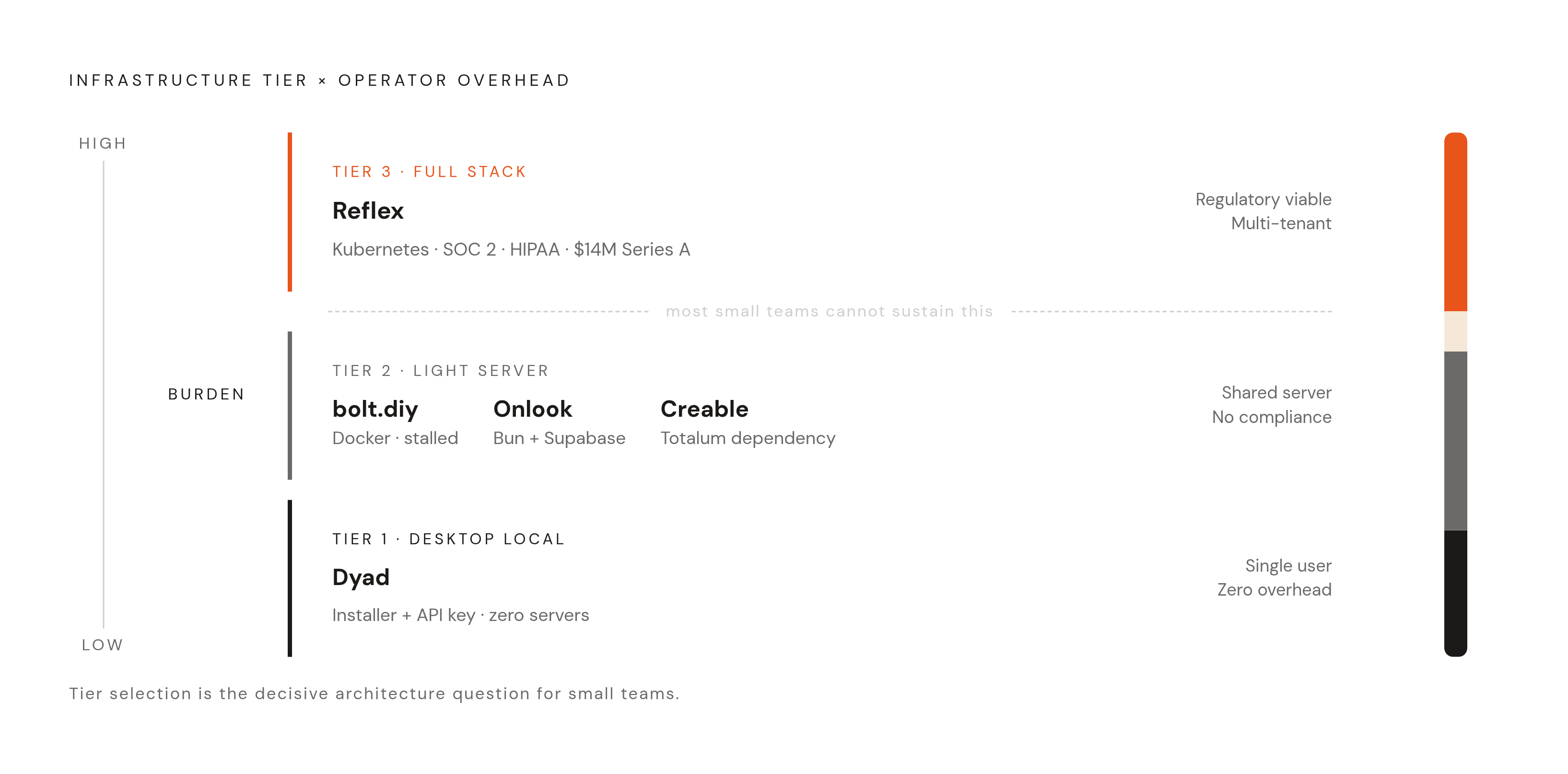
Small engineering teams need to give that recurring work plenty of weight. It consumes time every week the builder stays in production. The ranking thus has three tiers, from desktop-local tools with no servers to run, through light Docker-based deployments, to full server stacks with platforms that need ongoing care. Features and licenses still influence the decision, but neither reveals the operating burden on its own.
Tier 1 — Desktop-local tools: Dyad and the near-zero infra floor
Dyad removes the server layer by running as a desktop-installed, local-first builder. Setup is a desktop installer and an API key. There is no shared server secrets system, container orchestration, or database migration work to operate. Its license is Apache-2.0, with an FSL carve-out for the /src/pro/ directory. That makes it the clearest low-overhead baseline in this field.
Dyad accepts the operator’s own keys for major model providers and supports local models through Ollama and LM Studio. Local models have zero external API cost, but computing still costs money. The important limitation is access. Dyad cannot be served to several users across a network, so a team needing a shared builder must move up a tier. That single-user boundary is a design decision, and it is what keeps server overhead near zero.
Tier 2 — Light server footprint: bolt.diy and Onlook running on Docker
bolt.diy needs a server, but it can run without a full platform stack. It runs as a small set of containers, with installation options including a binary, a package manager, Docker, and Docker Compose. Its provider flexibility is a genuine strength. It supports a wide range of LLM providers, including local models through Ollama or LM Studio.
The underlying execution environment is StackBlitz’s WebContainer technology, which runs sandboxed Node.js in the browser. The agent controls the filesystem, npm, development servers, terminal, and browser console, letting it install dependencies, run Vite or Next.js, read errors, and attempt fixes. The license boundary needs separate attention. Although bolt.diy is MIT-licensed, StackBlitz requires a separate WebContainers API license for production use in a commercial, for-profit setting.
Maintenance also changes the economics of that small installation. bolt.diy’s main branch stalled in February 2026, while Dyad remained active through September 2026. With the main branch stalled, a small setup job could leave the team maintaining the tool for years. The initial deployment does not capture the full cost.
Onlook takes a different route within the same tier. It is an Apache-2.0 visual builder that edits a real React codebase through a design-tool-style interface. Its documented development setup requires Bun and Docker, plus Supabase configuration. It also uses OpenRouter and configurable code-edit services such as Morph or Relace. This is a larger dependency chain than a desktop installer.
Those dependencies determine where its data lives. Project code stays in the workspace or sandbox, while application metadata and assets use the configured Supabase instance. The full workflow works only after several environment variables are set. Onlook thus fits teams that want to edit the interface of an existing React or Next.js app, but falls short for teams that need a complete prompt-to-deployed-app pipeline. Its server footprint is light, but its setup is not frictionless.
Tier 2 continued — White-label and resale path: Creable as a thin-footprint builder-as-code
Creable is for an agency or SaaS business that wants to sell a branded builder to its customers. The builder is source code the operator can restyle and rename. It is designed for multiple tenants, with isolated projects that can be assigned to a user or customer.
Generated apps rely on the Totalum API for sandboxing and hosting, so the operator owns the builder interface without operating the full application runtime. Creable on its own cannot give teams complete data sovereignty over how generated apps run.
There is also an essential deployment condition. Creable has no authentication when it ships, so every route is public and uses the same API key. An operator must add an authentication layer before exposing it to end users. For the resale use case, that leaves a thin builder service to run, but it does not remove the ongoing Totalum dependency.
Tier 3 — Full server stack: Reflex and the enterprise-grade overhead ceiling
Reflex is an Apache-2.0 Python framework for building full-stack web apps without writing JavaScript. It offers a more complete control boundary than the lighter options, including control over deployment location and upgrade timing. That control costs more to operate. Its target profile is a Python-native team in healthcare, fintech, or enterprise SaaS whose requirements make a managed SaaS builder unavailable.
Running it means looking after Python infrastructure, managing Kubernetes or VM setups, and connecting it to internal identity providers. This is not an afternoon deployment for a small team. For organizations that already have a mature AWS or GCP footprint, running Reflex in their own cloud account adds less work than building on-premises container infrastructure from scratch. The existing platform changes the starting point. Unlike the lower-tier tools, Reflex requires an established platform engineering capability or a managed PaaS layer underneath it.
What the maintenance divergence between these candidates means for a production decision
Maintenance health is a separate filter from infrastructure size. A small deployment with no dependable upstream support can be riskier than a larger, actively maintained stack. Dyad shipped v1.15.0 on September 11, 2026, and its repository was last pushed on September 18, 2026. It has the strongest recent activity signal among the candidates covered here. Onlook was last active in July 2026, so its activity is less recent, though it has not stalled in the same way as bolt.diy.
The latest commit to bolt.diy’s main branch was on February 7, 2026. A substantial backlog of unanswered pull requests strengthens the signal of effective abandonment. That is a production warning. A new deployment would inherit an unmaintained dependency on the WebContainers API, with security patches unlikely to arrive through the project. Low installation effort does not offset that accumulating risk.
Reflex has a different kind of support signal. It announced a $14 million Series A on October 29, 2026, led by Standard Capital, with participation from Databricks Ventures, Y Combinator, Lux Capital, and Abstract Ventures. Funding offers no guarantee of maintenance, but it makes abandonment less likely than when a team relies only on an inactive community project.
The compliance and data-residency forcing function that overrides the footprint ranking
Regulatory requirements can eliminate a candidate before its footprint is relevant. Healthcare rules, enterprise procurement, and EU data-residency requirements can call for controls that a deployment lacks even if it is easy to run. Lovable’s Terms of Service prohibit providing protected health information unless the plan or a separate written agreement expressly permits it. Moving to self-hosting changes who must provide those controls. It does not make the obligations disappear.
For HIPAA-oriented self-hosting, the operator must configure encryption at rest and in transit, audit logging, and role-based access control with MFA. The team must also keep up with penetration testing and security patching. SOC 2 or ISO coverage for a managed cloud offering does not automatically apply to a team’s own installation.
Reflex is the only candidate in this field offering SOC 2 certification and support for HIPAA-compliant deployments, with an Enterprise plan enabling on-premises or private cloud deployment. Its security page states that on-premises deployments can meet requirements such as HIPAA. The deployment still needs the required controls. For teams already operating a mature AWS, GCP, or Azure account, using that boundary is more efficient than building a separate on-premises stack because audited infrastructure, networking controls, and guardrails already exist.
Running a self-hosted AI builder in production: the infrastructure layer the ranking assumes
Every candidate that runs on a server needs a production environment as well as the builder itself. That includes compute, networking and ingress, secrets management, persistent storage, monitoring and alerting, and security patching. The builder does not supply that whole layer. Tier 2 and Tier 3 rankings describe the application’s footprint.
On raw cloud infrastructure, the operator also takes responsibility for cluster upgrades, CVE patches, cost optimization, and autoscaling configuration. Bare EC2, unmanaged GKE, and bare Azure VMs leave that work with the team. Subscription savings can become an expensive trade. Without a dedicated platform engineer, the work can cost more than the team gains from self-hosting.
For a team in that position, the recommended alternative is a managed PaaS running inside its own AWS, GCP, or Azure account. That keeps the customer-cloud boundary in place while the platform takes over cluster management, patching, and autoscaling. Compliance automation can reduce setup work, but it does not transfer a vendor’s certification to the application. When inference infrastructure runs alongside the builder, how it is priced also affects the cost. Charging only for the compute used means the team does not pay for idle GPU capacity under that pricing model.
Matching team profile to tier: a practical decision framework
Tier 1 fits a solo developer or small team that wants to own its code without builder credit limits and has no need for a shared network service. Dyad is the practical fit. The recommended setup is the desktop app with an API key or local model. These teams gain little by taking on servers to run just to get a browser interface.
Tier 2 fits a small team that needs shared browser access, works with no regulated data, and is comfortable with Docker. The workflow determines the candidate. Onlook fits visual React editing of an existing codebase, while Creable fits white-label resale with an added authentication layer. bolt.diy’s licensing obligation needs acceptance, but its stalled maintenance should disqualify it from new production deployments as of late 2026.
A Python-native team with regulated workloads and an existing cloud footprint belongs in Tier 3, using Reflex Enterprise in its own cloud account. Compliance requirements take priority over convenience. A Tier 2 deployment with a certified cloud environment and managed compliance layer remains a possible path only where it satisfies the required controls. Teams without a dedicated platform engineer should use a managed PaaS for server-based deployments.
For most small engineering teams, the deciding question is not which builder is technically superior, but which tier’s operational burden they can actually sustain.