Cloud Provider Lock-In Risks for Startup Infrastructure
Multiple layers of cloud lock-in can transform a migration into a crisis when they compound.
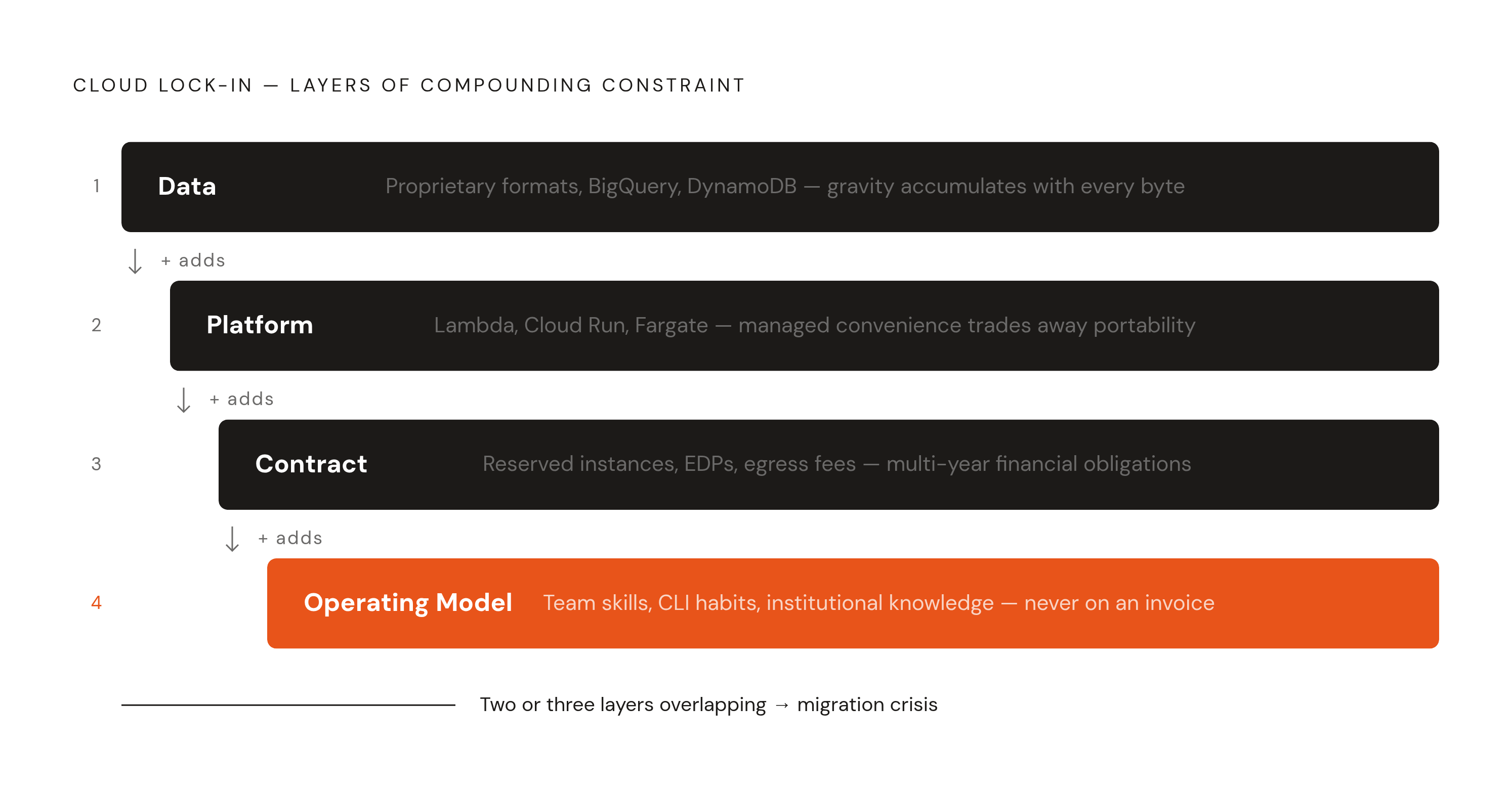
Lock-in accumulates in four distinct layers: data, platform, contract, and operating model. No single layer makes switching impossible. It's the compounding of two or three simultaneously that turns a migration into a genuine crisis.
Data lock-in is the most structural, and the subtlest. Proprietary storage formats and query engines, BigQuery and DynamoDB being the obvious examples, make export non-trivial before egress fees even enter the picture. The deeper problem is data gravity — think of it like a black hole: the more data accumulates with a single provider, the stronger its pull, and the organizational and computational cost of moving it grows faster than the data itself. Dependent services, transformation pipelines, and downstream analytics all develop implicit assumptions about where data lives. Migration stops being a lift-and-shift. It becomes a forensic exercise, and not a quick one.
Platform lock-in is the layer most teams consciously accept without framing it that way. Managed services like Lambda, Cloud Run, and Fargate trade configuration overhead for portability. That trade feels excellent early on. The deeper a team integrates native services, though, the more a prospective migration resembles a rewrite rather than a relocation. The value proposition is genuine; so is the switching cost, and it almost always arrives as a surprise.
Contract lock-in operates on a different timeline entirely. Reserved instance commitments and enterprise discount programs create multi-year financial obligations that outlast architectural preferences. You can decide to move providers and still be paying the previous one for eighteen months. Egress fees belong in this category too, though they work differently enough to warrant their own section.
Operating model lock-in is what startups notice last and find hardest to quantify. Team skills, internal tooling, and deployment workflows built around one provider's console and CLI create organizational inertia that persists even when the technical migration is otherwise feasible. The engineers who joined when you were already on AWS have never shipped to anything else. That's not a small thing to paper over. Retraining time, institutional knowledge gaps, the cognitive overhead of learning a new provider's operational model, none of it shows up on an invoice, but all of it is real.
How Egress Fees and Startup Credits Turn Convenience Into a Trap
Egress fees are not incidental pricing. They are a structural feature of every major cloud provider's model, designed to make leaving expensive. Data transfer costs accumulate invisibly during normal operations and only become legible as a switching cost when you sit down to actually price a migration. At that point, the number can be genuinely startling in a way that's hard to convey until you've seen it happen to someone's roadmap in real time.
Startup credit programs amplify this problem in a specific and underappreciated way. Credits subsidize rapid adoption of proprietary services during a window when switching costs feel hypothetical and the team has the least operational context to evaluate portability risk. Teams burn through a substantial credit allocation over a year, adopt proprietary managed services throughout the stack, and then discover the post-credit monthly bill is structurally unmanageable. The switching costs, driven by egress, data reformatting, and service-layer rewrites, make moving feel impossible. The credits did exactly what they were designed to do: generate deep adoption precisely when teams were least equipped to understand what that adoption would eventually cost.
Before accepting a credit program, three things deserve explicit modeling. First, which services the credits cover; broad credits applicable to proprietary managed services carry higher portability risk than compute-only credits. Second, what post-credit unit economics look like at projected scale, modeled before you build rather than after you've committed the architecture. Third, whether what you're building during the credit period would survive a provider change at all.
An estimated 29% of cloud spend is projected to be waste by 2026, driven primarily by overprovisioning and idle resources. That number compounds when teams lack visibility into what they're actually consuming, a visibility problem that proprietary tooling obscures rather than clarifies.
AI Workloads Introduce a Faster and Less Obvious Form of Lock-In
AI infrastructure spending reached $50 billion globally in 2024, growing at roughly 35% annually through 2027. AI-related cloud spend hit 19% of total cloud spend in 2026, up from 8% in 2023. The category is large enough that lock-in vectors here carry outsized financial consequences, and the lock-in accretes faster than it does with conventional workloads. Faster, and with less warning.
The most immediate risk is proprietary model and prompt formats. Fine-tuned models, prompt libraries, and agent workflows built inside a single vendor's ecosystem cannot be ported without meaningful rework. When the market moves to a better model, a lower-cost inference provider, or new hardware — and it does move — teams locked into one vendor's format cannot follow without paying a significant remediation tax. They're stuck between a terms-of-service agreement and a six-figure migration bill.
The January 2025 ChatGPT outage disrupted enterprises that had built AI-powered features with no fallback and no alternative provider. Those teams discovered in real time that resilience hadn't been designed in. Builder.ai's reported collapse in 2025 illustrated an adjacent risk: organizations that had built their entire development workflow on a single vendor found themselves rebuilding from scratch under the worst possible conditions, on the worst possible timeline.
Gartner's 2025 Market Guide for AI Gateways projects that a majority of organizations using generative AI will deploy an AI gateway within the next few years. The industry's response to single-provider AI dependency is already organized and underway.
Training and inference carry different portability profiles, and that distinction matters. Training runs are long, fault-sensitive, and often tied to specific hardware, whether H100s or TPUs. Moving mid-project is costly in a way that few other workloads match. GCP's TPU advantage is a genuine capability differentiator for training, but exclusive reliance on it is platform lock-in wearing the clothes of a performance decision. Inference is continuous and latency-sensitive, but more amenable to multi-provider routing if the architecture supports it from the start. Tools like SkyPilot abstract over AWS, GCP, Azure, and specialist GPU providers, handling spot instance failover automatically. Portability at the GPU layer is achievable; it just has to be designed for rather than retrofitted.
Early-stage AI startups typically spend somewhere between $2,000 and $8,000 monthly on GPU compute during prototype phases. Wrong provider choices at that stage affect runway directly, not just long-term architecture.
When PaaS Platforms Become Their Own Form of Lock-In
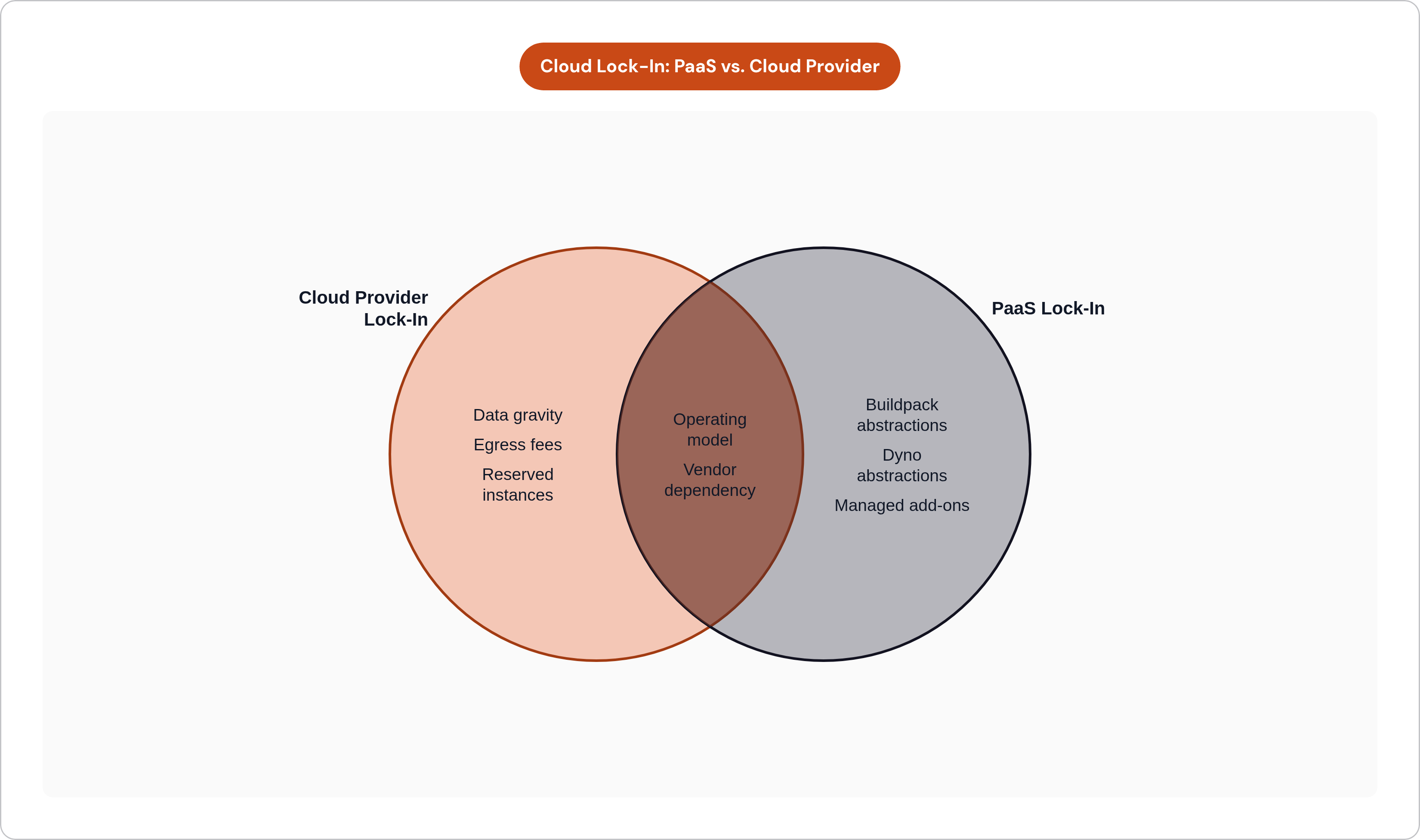
PaaS lock-in is different in character from cloud provider lock-in. The proprietary surface is the deployment model itself: buildpacks, dyno abstractions, managed add-ons. You're not locked into a cloud; you're locked into a layer of abstraction sitting on top of one, which means migration requires unpacking both simultaneously.
Heroku is the canonical example, and the timeline is worth understanding in full. In early 2026, Salesforce moved Heroku into a sustaining engineering phase. New features are no longer the roadmap; stability and support are. A June 2025 outage had already prevented platform access for hours, and trust in Heroku's reliability had been eroding well before the sustaining-engineering announcement arrived. Teams that stayed through the free-tier discontinuation, successive cost increases, and the outage cycle are now migrating under pressure rather than on their own terms. Migrating when forced versus migrating when ready is the entire difference between a controlled transition and a crisis. That's not a strategic nuance; it's an operational reality with real consequences for engineering capacity and business continuity, which is the problem Porter addresses as a bring-your-own-cloud PaaS, deploying applications into a team's own AWS, GCP, or Azure account rather than locking them into a vendor-managed infrastructure layer.
The same pattern can repeat on any PaaS. Render, Vercel, and Fly.io all carry concentration risk if a team builds deeply against their abstractions without thinking through what an exit would require. The migration compounds in difficulty the longer it's deferred: CI/CD pipelines, environment configs, database add-ons, and monitoring integrations all need to be rebuilt or re-pointed simultaneously.
ReadMe migrated its production monolith from Heroku to Render with 90 seconds of downtime. That's achievable, but only with deliberate parallel-environment testing and a real rollback plan. It didn't happen casually.
PaaS economics often create a forcing function before teams are ready. When a monthly PaaS bill exceeds roughly $5,000, moving workloads to a managed environment in your own cloud account typically saves 50 to 70 percent. The financial case for migration frequently arrives before the organizational readiness does, which is precisely why teams end up migrating reactively instead of strategically.
What Multi-Cloud Adoption Actually Looks Like in Practice, and Where It Falls Short
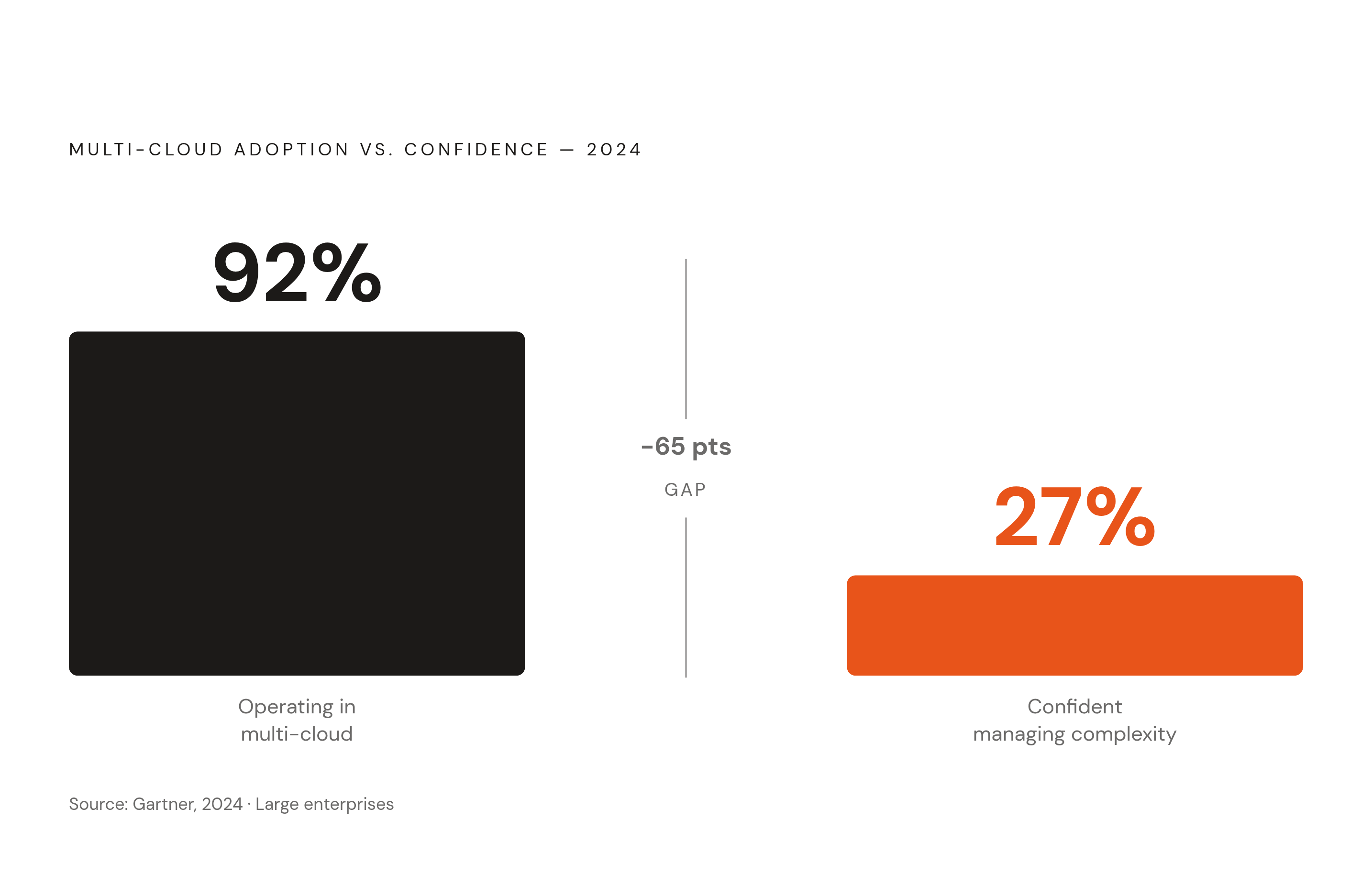
Over 92% of large enterprises operate in a multi-cloud environment, per a 2024 Gartner report. Only 27% of businesses feel confident managing the complexity of those environments. Those two numbers, sitting adjacent to each other, describe an industry that has moved faster than its operational capability to manage the outcome.
True active-active multi-cloud requires consistent identity and access management across providers, unified observability and cost visibility across environments where most native monitoring tools are provider-specific, and networking and security policies that work across the full surface without duplication. For small engineering teams, that overhead is typically not justified. For most startups, the goal is portability and optionality, not simultaneous operation across three providers.
21% of workloads were repatriated in 2025. Some teams find the multi-cloud operating cost exceeds the lock-in cost they were originally trying to avoid. That's a real outcome, and it argues for calibration rather than ideology.
The practical version of multi-cloud for startups is architectural neutrality: build so that migration is possible, not so that you're actively running on three providers simultaneously. 89% of IT leaders say companies shouldn't rely on a single cloud provider. The consensus is against concentration even when active multi-cloud is operationally out of reach. Those positions are compatible; they just require distinguishing between strategic intent and current operating reality.
The Technical Choices That Preserve Portability Without Adding Operational Burden
Portability doesn't have to be a tax. Most choices that preserve architectural freedom also improve operational quality independently, which means they get made for entirely other reasons, and portability arrives as a byproduct.
Containerization is the baseline. Container images are provider-agnostic by default. The portability work is done once, at build time. Managed Kubernetes, whether EKS, GKE, or AKS, runs on all three major clouds and represents the lowest-lock-in option for orchestration that doesn't require running your own control plane.
Infrastructure as Code is the other foundational choice. Terraform or Pulumi definitions represent your infrastructure independently of any provider's console. The primary benefit for most teams is operational: consistent environment standardization, policy-driven guardrails for cost and compliance, reproducible deploys. Portability is secondary, which is exactly why this work gets prioritized and sustained rather than deferred.
Where the real discipline lives is in the deliberate evaluation of proprietary services. Compute, EC2, Cloud Run, standard VMs, sits at the lower end of the lock-in spectrum. Managed data services, BigQuery, DynamoDB, Firestore, sit at the higher end. Every proprietary managed service deserves a specific question: what is the open-source or portable equivalent, and what would migration cost? Not every proprietary service is worth avoiding; some offer genuine capability advantages that justify the switching cost. The goal is conscious adoption, not blanket avoidance.
CI/CD portability is frequently overlooked until it creates friction. 62% of developers used GitHub Actions for personal projects in 2025, with 41% in organizational contexts. Its provider-neutrality makes it a lower-lock-in default than cloud-native pipeline tools. Pipeline definitions that reference provider-specific CLI tools or deployment APIs create coupling that is easy to avoid with a small amount of abstraction applied early. Skip that abstraction and it comes back later at an inconvenient moment.
For AI workloads specifically: keep model weights in portable formats, route inference through an abstraction layer or AI gateway, and avoid building agent workflows directly against a single provider's SDK. The portability investment at the AI layer is modest when made proactively. Retrospectively, it is expensive in ways that are difficult to predict in advance.
Compliance Entanglement as a Hidden Switching Cost
Compliance is not provider-neutral, and most startups don't internalize this until they're mid-migration and the realization has teeth. Audit evidence, control mappings, and Business Associate Agreements are all scoped to a specific infrastructure configuration. When you migrate providers, you're not just moving compute. You're rebuilding the evidentiary basis for your compliance posture from the ground up.
A SOC 2 Type II audit covers a defined environment over an audit period typically running six to twelve months. A mid-cycle migration can invalidate controls and delay certification in ways that ripple downstream into enterprise sales, partnership agreements, and fundraising timelines. HIPAA BAAs must be renegotiated with the new provider; coverage scope varies materially across providers. Teams that have achieved compliance on one provider sometimes defer necessary migrations specifically because they don't want to restart the process. That's lock-in even when the technical and economic case for moving is clear, and it's the kind of lock-in that doesn't appear in any architecture diagram.
The mitigation is treating compliance infrastructure the same way you treat application infrastructure: defined as code, auditable independently of which provider runs it, and portable across environments. Platforms that deploy into a customer's own cloud account and include automated control mapping, audit logging, and CVE patching address this directly. The compliance posture travels with the architecture rather than being rebuilt for each provider, which is a meaningful structural difference from the alternative.
How to Assess Your Current Exposure Before It Becomes a Migration Crisis
Lock-in exposure is a spectrum, not a binary. The goal of an internal audit is to understand where you sit before a forcing event, a funding crunch, a provider outage, a cost spike, makes the question urgent rather than prudent.
Start with the data layer. Which data stores use proprietary formats or query engines? What would egress cost at current data volume, modeled at the provider's standard rates? What dependent services would need to be re-integrated if the data moved? Answering these questions now costs an afternoon. Answering them during a migration crisis costs multiples of that, under conditions where you have less time and fewer options.
For the platform layer, list every managed service in production. For each one, identify the open-source or cloud-agnostic equivalent and estimate what a migration would require. The goal is to know the number, even if you have no immediate plans to migrate. Unknown switching costs are more dangerous than known ones because they can't be managed.
On the contract side, pull your current reserved instance commitments and any enterprise discount agreement. Map the expiration dates. Understand which periods represent financial obligations that constrain architectural decisions and which represent genuine flexibility. The goal is to know when your next natural decision point arrives and to be positioned for it.
The operating model layer is where most audits go soft, because it's uncomfortable to quantify. Ask your engineering team honestly: how many people have shipped production infrastructure on another major cloud provider? What would a 90-day transition require in terms of retraining and tooling change? Skip this question and it will surface during the migration at the worst possible time, when the answer has consequences you can no longer absorb cleanly.
For AI workloads, document which components are tied to a specific provider's SDK or model format. For compliance, identify which controls are documented against your current environment and what evidence would need to be regenerated under a provider change.
45% of organizations say vendor lock-in has slowed their ability to adopt more flexible cloud solutions. The cost is velocity, not just dollars. For a startup, velocity is the asset. Lock-in is one of the quieter ways it erodes — like a slow leak in a tire you don't notice until you're already on the side of the road.