Vercel Alternatives for Full-Stack Applications
Vercel's bandwidth pricing and lack of managed databases push full-stack teams toward alternatives.

Start with the bill, because that is usually what starts the conversation.
The Pro plan runs $20 per user per month, so a three-person team is already at $60 before a single request is served. Bandwidth is billed separately at $40 per 100 GB over the included allocation. For a marketing site or documentation page, those numbers hold. For an application generating real traffic through API responses, server-side rendered pages, and image delivery, you are chasing a number that moves every month — like trying to budget for a taxi where the meter runs on three different clocks simultaneously.
An API-heavy app with meaningful traffic can land anywhere from $200 to $400 monthly. The problem is not the price itself; it is that bandwidth consumption on Vercel is genuinely difficult to predict, because API responses, SSR payloads, and optimized images all count against the same meter. Teams coming from frontend-only deployments never anticipate this. There is no usage cap by default, which means surprises arrive in the invoice, not before it.
The model is not irrational. It is calibrated for a specific type of workload. Full-stack applications fall outside that workload.
The four gaps that send full-stack teams looking elsewhere
Vercel's constraints are deliberate scope decisions. No Docker, no persistent processes, no containers. Native database support does not exist; Vercel integrates with Neon, PlanetScale, Upstash, and similar services, each adding a separate vendor, a separate billing relationship, and a separate failure point. Background workers and long-running tasks collide with serverless execution windows. Vendor-specific APIs like Edge Config and Image Optimization create meaningful friction when teams want to extend or eventually leave the stack.
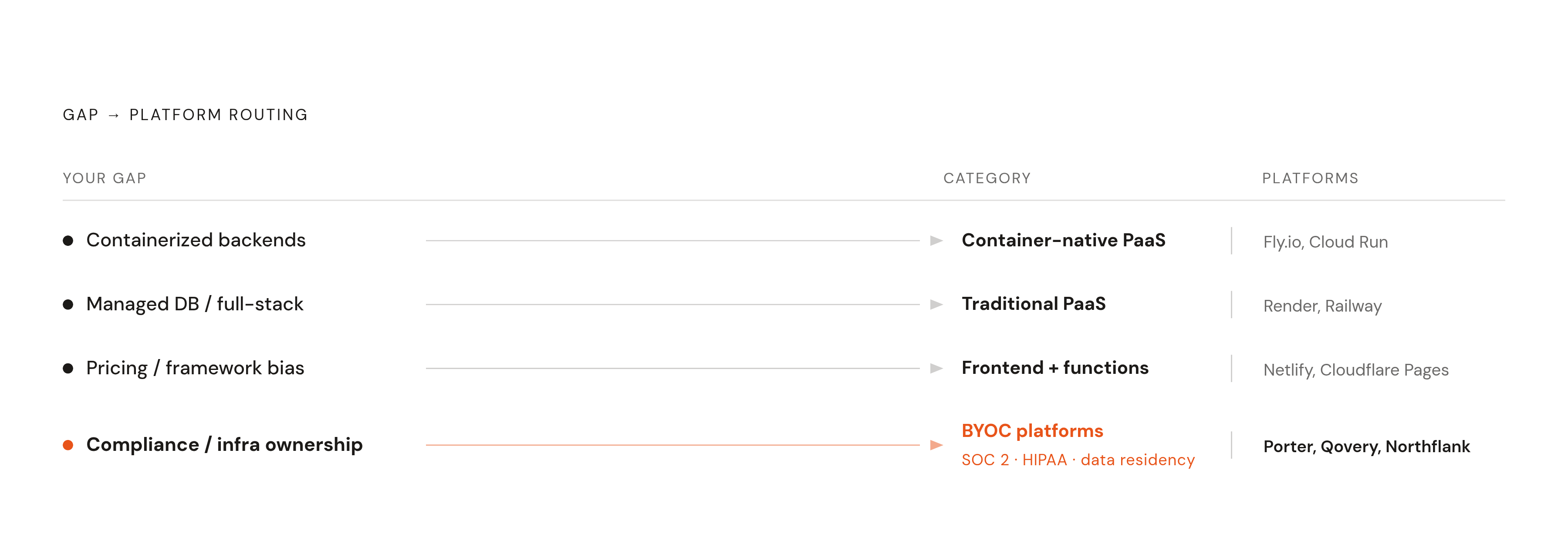
These constraints produce four specific gaps that keep recurring across teams that outgrow the platform.
Containerized backends: any service running as a persistent process, from a Dockerfile, or on a custom runtime cannot run on Vercel. Managed databases: production Postgres, Redis, or other stateful stores living alongside the application rather than in a third-party account simply do not exist natively here. Background work: cron jobs, queues, workers, and long-running tasks that exceed serverless execution windows have no home. Infrastructure ownership: teams under SOC 2 or HIPAA requirements, or teams with serious cost-predictability needs, cannot satisfy those requirements on a shared-tenant PaaS with opaque billing.
These four gaps map onto four categories of alternative: traditional PaaS, container-native platforms, hyperscaler managed services, and bring-your-own-cloud platforms. Which category is right depends entirely on which gaps actually apply to you.
Render and Railway for teams that want the simplest full-stack swap
For teams whose complaint with Vercel is structural rather than philosophical, Render and Railway are the fastest path to a coherent full-stack environment. Both offer Git-push deploys, managed Postgres and Redis, and web services, workers, and cron jobs within a single account. That last point is more consequential than it sounds. Eliminating the third-party database vendor removes an entire layer of operational surface area, the kind you only fully appreciate after debugging an incident spanning three different support portals at two in the morning — the DevOps equivalent of realizing your plumber, electrician, and landlord all have different phone numbers and none of them are picking up.
Render is the closest structural match to Heroku that currently exists, and for a large cohort of teams that is a meaningful recommendation. Native managed PostgreSQL is the single most important capability Vercel lacks, and Render provides it. Built-in load balancing, free SSL, and private networking between services handle the vast majority of full-stack application requirements without demanding that teams manage infrastructure directly. The free tier as of 2025 is among the most generous in this category: 750 free instance hours per month, free static sites, and a 90-day free PostgreSQL trial. Deploy times run roughly one to three minutes, which is acceptable for most workflows.
Railway's distinguishing characteristic is its billing model and deployment speed. Usage is billed per minute, which rewards spiky or intermittent workloads and punishes always-on services with high memory requirements. Deploys via Nixpacks complete in 30 to 90 seconds, the fastest in this tier. The visual service canvas renders the topology of a multi-service application as an actual diagram, which genuinely reduces the cognitive overhead of managing interconnected services. Persistent volumes at $0.15 per GB per month directly solve the ephemeral filesystem problem that made Heroku painful for stateful workloads.
The decision between them is straightforward. Consistent always-on services favor Render's flat-rate pricing because the bill is predictable. Variable or spiky workloads favor Railway's per-minute model because efficiency is rewarded.
Netlify and Cloudflare Pages for teams staying in the frontend-plus-functions model
These two platforms are Vercel's closest competitors, not its replacements. Teams routinely collapse that distinction after reading a comparison article that mistakes "similar" for "equivalent," and it costs them a migration that doesn't actually solve their problem.
Netlify has one of the broadest feature sets in this tier: Git and API deploys, preview environments, serverless Functions, Background Functions, Netlify Database, Blob storage, an AI Gateway, and Agent Runners. Its primary advantage over Vercel is framework agnosticism. Teams feeling the gravitational pull of Next.js lock-in, or teams that simply want a deployment platform without strong opinions about their JavaScript framework, will find Netlify more accommodating.
Cloudflare Pages is the most cost-effective option for static workloads, full stop. The free tier includes unlimited sites, unlimited bandwidth, and unlimited requests, which represents a genuinely different cost floor from any other platform in this space. The Workers ecosystem extends it toward light backend logic, and edge network performance is a baseline characteristic rather than a premium feature.
Neither platform solves the persistent-backend gap or the managed-database gap. The appropriate fit is a team whose real grievance with Vercel is pricing or framework bias, not the absence of containers.
Fly.io and Google Cloud Run for container-first workloads
When the constraint is containers, these two platforms are the most direct answers available.
Fly.io runs on its own bare-metal edge infrastructure rather than a hyperscaler, which produces a different cost and latency profile from most competitors. Teams choose their regions, machine sizes, persistent volumes, and scaling behavior explicitly. Multi-region deployment is not automatic; it must be designed. That makes Fly.io appropriate for teams that want control over geographic distribution, not for teams seeking abstraction. The strongest fit is latency-sensitive workloads: real-time applications, gaming infrastructure, WebSocket-heavy services that benefit materially from regional proximity to users.
Google Cloud Run deploys any Docker image as a managed serverless runtime, scaling to zero when idle and scaling up automatically under traffic. Native integrations with Cloud SQL, Cloud Build, and IAM make it coherent for teams already operating inside GCP, or for teams willing to absorb the learning surface of a hyperscaler in exchange for its depth of managed services.
The distinction from Render and Railway is the level of configuration exposed. Fly.io and Cloud Run hand teams more control and more configuration surface. That is an advantage when the workload demands it, and an operational burden when it does not.
AWS Amplify for teams already inside the AWS ecosystem
Amplify provisions AWS primitives, specifically Lambda, DynamoDB, S3, Cognito, and AppSync, under a higher-level abstraction layer. The Git-based deploy workflow is familiar to teams coming from Vercel, and preview environment support is included. Deep IAM integration and existing compliance posture make it valuable for organizations that need their deployment tooling to remain inside an existing AWS organizational structure.
The tradeoff is a leaky abstraction. As applications grow in complexity, teams frequently find themselves managing the underlying AWS primitives directly, which negates the developer experience benefit the abstraction was supposed to provide. Amplify is not the right answer for teams that want simplicity. It is the right answer for teams already committed to AWS, carrying real familiarity with its service landscape, who want a lighter deployment layer over infrastructure they already use.
BYOC platforms for teams that need compliance, cost control, and full-stack DX together
Bring-your-own-cloud platforms deliver a Vercel-like Git-push developer experience with one material difference: the infrastructure runs inside the team's own AWS, GCP, or Azure account. That single architectural decision resolves several problems at once.
Vendor lock-in at the platform layer is eliminated, because the cloud provider becomes the only dependency. Billing becomes the cloud provider's resource rates rather than a PaaS markup, which is more predictable and typically cheaper at scale. Compliance scope is contained because data never leaves the team's own cloud account, making SOC 2 and HIPAA audits substantially less complicated.
Porter is a self-hosted PaaS for AWS, GCP, or Azure that deploys production-ready environments directly into the customer's own cloud account and covers the full lifecycle: VPC provisioning, one-click SOC 2 and HIPAA compliance configurations, GPU workload support, and automatic CVE patching. The design intent is that teams get infrastructure ownership without needing a dedicated DevOps hire, which addresses the staffing constraint that makes BYOC feel out of reach for smaller organizations in the first place.
This category is for teams that have hit Vercel's structural limits and are simultaneously starting to worry about compliance, cost at scale, or the risk of shared-tenant platform dependency. That profile describes Series A companies and beyond, or earlier-stage AI startups handling sensitive data or running GPU-intensive workloads.
How to read the alternatives against your actual stack
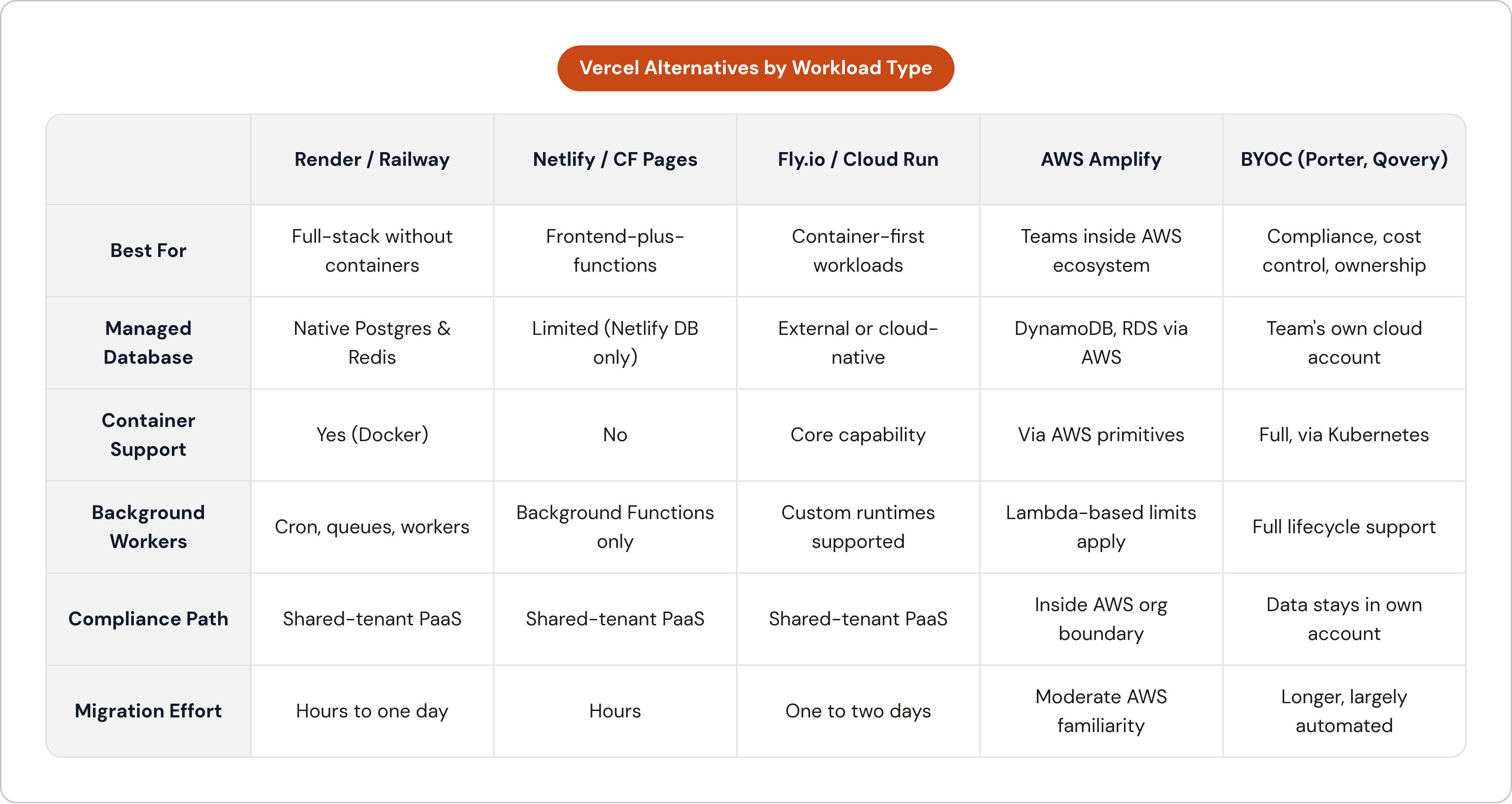
Three questions determine the right answer, and asking them in order matters.
First, backend complexity. Stateless serverless only points toward Netlify or Cloudflare Pages. Persistent services and a managed database without container requirements point toward Render or Railway. Containerized custom runtimes point toward Fly.io or Cloud Run. Full-stack applications with compliance or ownership requirements point toward BYOC platforms.
Second, team infrastructure maturity. No DevOps capacity resolves toward managed PaaS options like Render and Railway, or toward managed BYOC platforms that abstract infrastructure without removing ownership. Some infrastructure comfort with a preference for explicit control resolves toward Fly.io, Cloud Run, or AWS Amplify inside an existing AWS organization.
Third, compliance and data residency. If shared-tenant PaaS is acceptable, any of the above platforms can serve. If SOC 2, HIPAA, or data-residency requirements apply, the infrastructure must run inside the team's own cloud account, and BYOC is the only clean answer.
Render and Railway are the fastest migrations from a Heroku or Vercel setup, often completable within a day for most applications. BYOC platforms require more provisioning time, but that investment returns control and cost predictability that compounds in value as the application scales.
What a migration from Vercel to a full-stack platform actually involves
The frontend is not the hard part. Build commands, environment variables, and CDN behavior are equivalent across Render, Railway, Fly.io, and BYOC platforms. Teams moving from Vercel rarely need to change application code. The migration is infrastructure configuration, not a rewrite.
The real work lives in the backend, and it clusters into a few distinct categories.
Containerizing any service that was running as a serverless function but requires persistence or a longer execution window is typically the most technically demanding step, particularly for teams that built deeply around Vercel's function model. Migrating or provisioning a managed database comes next. For Postgres, pgdump and pgrestore handle the data movement; the discipline is in validating read and write parity before cutting DNS, at a low-traffic hour. Replacing Vercel-specific APIs like Edge Config and Image Optimization is straightforward but requires auditing every place those APIs are called; standard equivalents exist on every platform covered here. Environment variable migration is the least of your concerns; Railway's CLI and Render's dashboard both handle it without drama.
A frontend-only or light API application migrates in hours. A full-stack application with a database and background workers typically takes one to two days including testing. A BYOC setup involving VPC provisioning, Kubernetes cluster configuration, and CI/CD wiring takes longer, but cloud deployment platforms that run inside the team's own cloud account automate the majority of that work.
The mistake teams consistently make is cutting over before the validation window is complete. Run old and new environments in parallel, confirm database behavior before any DNS change, and keep the rollback path open until the first production deploy on the new platform is stable. DNS propagation under pressure always takes longer than anyone remembers.