Fastest Path to SOC 2 on AWS When Investor Due Diligence Is Already Knocking
Compress SOC 2 Type I and Type II audits in parallel to unblock investor deals fast.
A SOC 2 request that arrives mid-due diligence is a sequencing problem, not a compliance problem. The fix is a sprint that runs a Type I report and the Type II observation window in parallel, on infrastructure you already control. This article maps that sequence week by week, and shows where the time actually goes.
Why SOC 2 requests arrive during due diligence, not before it
SOC 2 has become a binary procurement gate for B2B SaaS. Enterprise buyers treat the absence of a report as disqualifying. That means the request is not a future milestone. It arrives the moment a serious buyer or investor starts evaluating the company.
Investor due diligence and an enterprise sales pipeline often become active at the same growth inflection point. The SOC 2 ask therefore arrives from both directions at once, with no runway to spare. A startup that deferred the audit until it "felt necessary" now has a hard external deadline it did not set and cannot move. Vanta's guide for startups is direct on this point: waiting until an enterprise deal depends on the report means compressing months of preparation into weeks, which drives up both cost and operational burden.
What the audit actually requires, scoped for a first report under time pressure
The fastest credible first report for most B2B startups is a SOC 2 Type I on Security alone, possibly adding Availability and Confidentiality. Security is mandatory in every SOC 2 report and covers access controls, system monitoring, change management, and risk management. The second overlaps with GDPR concerns and matters when you process significant personal data volumes.
The report type matters as much as the scope. A Type I report is a point-in-time assessment. The auditor confirms your controls are designed appropriately on a specific date, and it takes two to three months to obtain. Sophisticated buyers find it less credible, but it works as a bridge to unblock a deal. A Type II report is a period-of-time assessment. The auditor confirms your controls operated effectively over an observation window of at least three months, typically six to twelve. This is the standard enterprise buyers require. The sequencing move that collapses the timeline is to pursue Type I immediately to unblock the deal in front of you, and begin the Type II observation window at the same time so evidence accumulates in the background. ComplyJet's 2026 guide describes exactly this pattern: complete Type I fast, start the Type II observation window simultaneously, and by the time the Type II report is ready you are not starting from zero. Porter locks compliance controls into the deployment layer from the start, so the observation window runs cleanly without infrastructure churn interrupting the audit trail.
An auditor inspects policies, processes, and technical controls. A licensed CPA firm reviews systems, interviews the team, and tests controls before issuing a report. Every startup must have documented policies: Acceptable Use, Access Control, Change Management, Data Classification, Data Retention and Disposal, Incident Response, Business Continuity, Vendor Management, and Security Awareness Training.
The shared responsibility line that determines what AWS hands you and what you still have to build
The most costly misunderstanding in AWS SOC 2 projects is the belief that AWS's own certification does much of the work. AWS holds its own SOC 2 Type II certification covering physical data centers, hypervisors, global network infrastructure, and managed service platforms under the Security, Availability, and Confidentiality Trust Services Criteria. Processing Integrity is not in scope. But that certification does not extend to anything a customer configures above the hypervisor.
The shared responsibility model draws a clear line. AWS is responsible for physical security, hardware availability, hypervisor security, and managed service platform security, including RDS engine patching and S3 infrastructure. The startup is responsible for IAM configuration, OS hardening on EC2, encryption decisions, network controls, application security, logging configuration, backup procedures, incident response, and all operational processes audited under SOC 2. The work is in configuring them correctly, documenting the controls, and collecting evidence that proves they operated throughout the observation window.
How AWS native services map to each required control, and what still needs configuration
Most of the technical controls required for SOC 2 Security, Availability, and Confidentiality can be satisfied with AWS native services. The gap is not missing tooling. Access control under CC6 maps to IAM Identity Center and MFA. That means least-privilege IAM policies per service and per engineer, no shared credentials, no long-lived access keys for humans, SSO with MFA enforced, defined IAM roles for all applications, and no root account use for daily operations.
Threat detection maps to GuardDuty, which you enable in all regions with one click and no agents. Its machine learning detection covers account compromise, crypto-mining, exfiltration, and unusual API activity, and its findings serve as evidence of an operational threat detection capability during the observation period. Availability under A1 maps to multi-AZ deployment. Production services should run across at least two Availability Zones, with RDS Multi-AZ and an ALB with multi-AZ targets. One procedural update affects evidence collection: AWS Audit Manager closed to new customers on 30 April 2026. Teams starting fresh must rely on Config conformance packs and Security Hub exports for automated evidence collection.
The week-by-week sprint sequence that compresses the timeline to its practical minimum
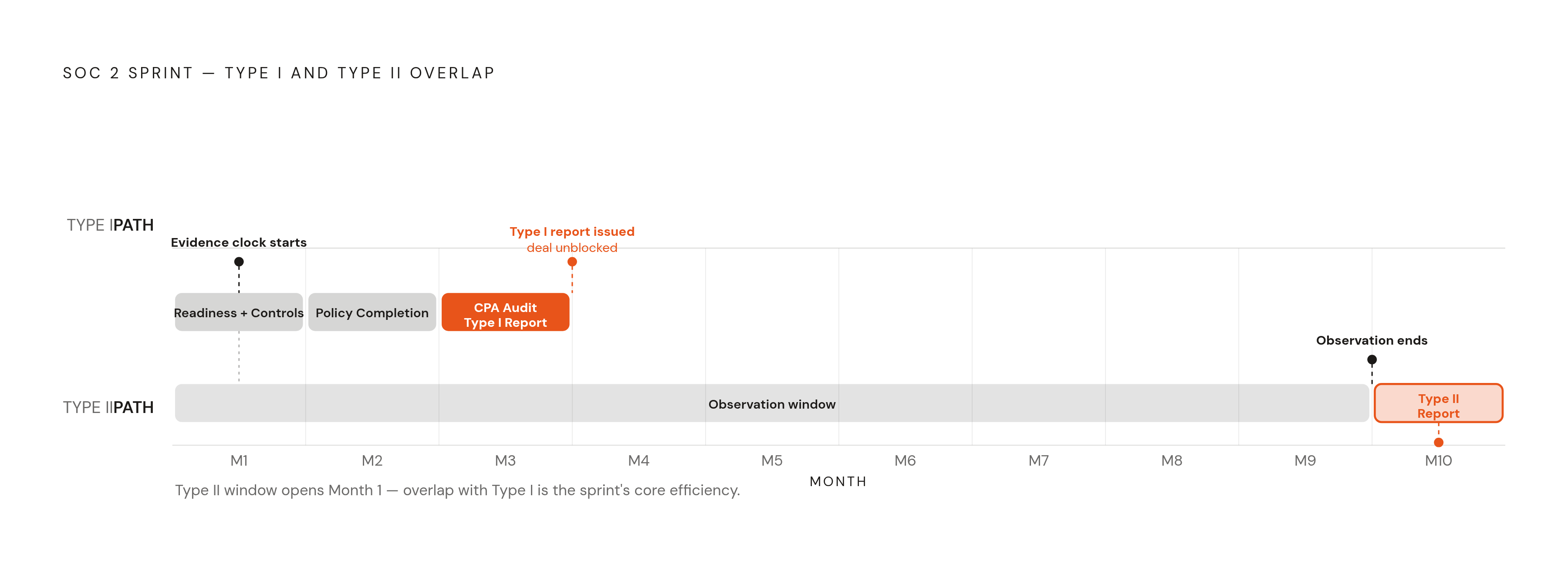
The fastest credible path from zero to a usable SOC 2 report follows a fixed sequence: gap assessment, control implementation, Type I audit, and Type II observation running simultaneously. In the first month, run a readiness assessment to identify which controls exist, which are partial, and which are missing. Then immediately activate the controls that start the evidence clock: CloudTrail multi-region trail, GuardDuty in all regions, Config conformance packs, and Security Hub. Assign an internal owner, the CTO or a senior engineer, who makes decisions on policies. SOC 2 does not require a dedicated security team, but it does require someone who owns the process through audit. Begin drafting the required written policies at the same time.
The second month is for implementing missing controls and completing the policy set. Implement SSO via IAM Identity Center, enforce MFA for all employees, and enforce RBAC across application and cloud infrastructure. Enable encryption at rest on all RDS instances, and if existing instances are unencrypted, do the snapshot-and-restore now because it cannot be deferred. Finalize and version-control all policies and obtain employee acknowledgments. The third month is when you engage a licensed CPA firm. The auditor reviews control design as of a specific date and issues the Type I report, which lets the deal or due diligence conversation proceed. The Type II observation window has already been running since month one, so three months of evidence are accumulating in the background.
Months four through nine are the Type II observation period. Atlant Security's 2026 guide describes this pattern as one conditional option for startups that need a fast report without sacrificing Type II credibility, while recommending that startups with sufficient time skip Type I and go straight to Type II. By month ten, the Type II report is complete. Gaps in the observation window cannot be filled retroactively, and auditors flag missing evidence periods as control failures.
Why infrastructure that runs in your own AWS account shortens the audit scope compared to shared PaaS
Startups running production on shared-tenant PaaS platforms face a structural audit disadvantage. The infrastructure is not theirs to inspect, so CloudTrail, VPC flow logs, and RDS encryption configurations, the primary artifacts auditors inspect, either do not exist in the startup's account or are inaccessible. SOC 2, HIPAA, and other audits require auditors to inspect networking controls, access logs, and encryption configurations directly. Those auditable artifacts exist in your account only when you own the underlying infrastructure.
Shared PaaS platforms manage infrastructure on the customer's behalf, which adds a third-party scope layer to the audit. The startup must demonstrate controls over infrastructure it cannot directly configure or evidence. The hybrid intermediate state is durable for many startups: running a marketing site on a shared CDN while keeping the API and data plane on AWS ECS or App Runner keeps the compliance scope clean without forcing a full migration of every property.
Platform options that remove the infrastructure configuration bottleneck inside the sprint window
The biggest time sink in the sprint is not writing policies. It is configuring AWS infrastructure correctly from scratch. VPC design, multi-AZ deployment, encryption settings, IAM roles, CloudTrail, GuardDuty, and Security Hub all have to be standing before the observation window opens. The question is which platform does it while keeping the infrastructure in the startup's own AWS account, a requirement for audit evidence ownership.
Porter deploys production-ready environments directly into the customer's own AWS account, so CloudTrail, VPC flow logs, IAM policies, and encryption configurations exist as first-party evidence from day one. It covers the full deployment lifecycle relevant to SOC 2: VPC provisioning, multi-AZ container deployments via EKS, automatic CVE patching, cluster management, and CI/CD. A one-click SOC 2 and HIPAA compliance posture absorbs the infrastructure configuration work that consumes most of month one and month two, leaving the engineering team's time for policy writing and control verification rather than AWS service configuration. GPU workload support serves AI startups that need inference infrastructure and SOC 2 scope managed in the same account. This option fits startups without a dedicated DevOps team that need configuration work absorbed before the observation window opens, with audit evidence living in their own AWS account.
The AWS Marketplace SOC 2 Accelerator from A-LIGN and Eden Data is available via Private Offer. The offering claims to have helped over 1,600 startup organizations achieve SOC 2 compliance, and it positions itself as an audit-to-report package rather than a deployment platform. It reduces the manual evidence collection burden, a meaningful time saving during the Type II window, but it does not configure the underlying AWS infrastructure. The distinction that matters for sprint timing is this: compliance automation platforms such as Vanta accelerate evidence collection during the observation period, while a deployment platform like Porter removes the infrastructure configuration work that must happen before the observation period can start. These are different bottlenecks at different points in the timeline, and the fastest sprints address both.
The infrastructure checklist an auditor will test on day one of the observation period
An auditor testing SOC 2 Security, Availability, and Confidentiality on AWS looks for evidence that controls were in place and operating from the first day of the observation period. Gaps discovered during the audit cannot be remediated retroactively. For access and identity, IAM Identity Center must be configured and enforced for all human access, MFA enforced for all employees with no exceptions, no shared credentials and no long-lived access keys for humans, IAM roles defined for all applications, and the root account unused for daily operations. A quarterly access review process must be documented and scheduled.
For audit logging and monitoring, CloudTrail must be enabled across all regions with a multi-region trail, logged to S3 with integrity validation, and retention set to at least one year. GuardDuty must be enabled in all regions, and Config conformance packs and Security Hub control exports must be active from day one, not from audit start. For encryption, encryption at rest must be enabled on all RDS and Aurora instances, which means snapshot-and-restore for any existing unencrypted instance before the window opens. SSL enforcement must be enabled for all database connections, S3 encryption enabled across all buckets holding customer data, and TLS enforced for all data in transit. For availability, all production services must be deployed across at least two Availability Zones, RDS Multi-AZ configured, and an ALB with multi-AZ targets in place. Policies must be written, versioned, and employee-acknowledged, with an incident response plan documented and tested. Engineering controls require code review for all production changes, a CI/CD pipeline with automated testing and security scanning, separate staging and production environments, and endpoint management with disk encryption and screen locks on all company devices.
What ongoing compliance costs and annual re-audit cycles look like once the first report is in hand
SOC 2 is not a one-time certification. Manual evidence collection consumes engineering hours every year, not just in year one, while automation platforms that felt expensive at the first audit reduce the recurring burden significantly over subsequent cycles. The infrastructure ownership choice made during the sprint has a compounding effect on annual audit costs. Running in your own AWS account means each year's evidence, CloudTrail logs, GuardDuty findings, and Config conformance pack results, is already in your account and accessible to your auditor without negotiating access through a third party. They determine the cost and friction of every subsequent annual cycle.