Monorepo CI/CD Architecture for Multi-Service Startups
Architectural decisions about change detection and deployment scope matter more than tool choice.
A monorepo puts every service, library, and pipeline config in one Git repo with one commit history. The real work is answering three questions before any tool touches that repo: how change detection works, what counts as affected, and how deployment gets scoped. Get that wrong, and the fanciest CI setup just runs the wrong jobs faster. Most teams skip straight to picking a tool, which is backwards: picking Turborepo over Nx has never once fixed a broken dependency graph.
Startups reach for a monorepo because it solves real coordination problems. A single pull request can change a shared library and update every service that depends on it, atomically, with one review. Dependency versions, lint rules, and CI config live in one place instead of drifting across a dozen repos. Onboarding gets simpler too, since there's just one thing to clone and one pipeline to learn.
Wire up CI without thinking it through, though, and a single push starts triggering everything. Without a filter, every commit rebuilds and retests every service in the repo, no matter what changed, so editing a README in service A can somehow get service B redeployed. That's a false positive with a real cost: wasted compute, slower feedback, and a growing sense that CI punishes people for shipping.
At three or four services, this is annoying but survivable. Past ten, it becomes the team's biggest source of friction. Build times balloon, pipeline logs turn into noise nobody reads, and CI starts feeling less like a safety net and more like a tax on every commit. Swapping tools won't fix that; the architecture underneath the tools needs fixing.
The three architectural decisions that everything else depends on
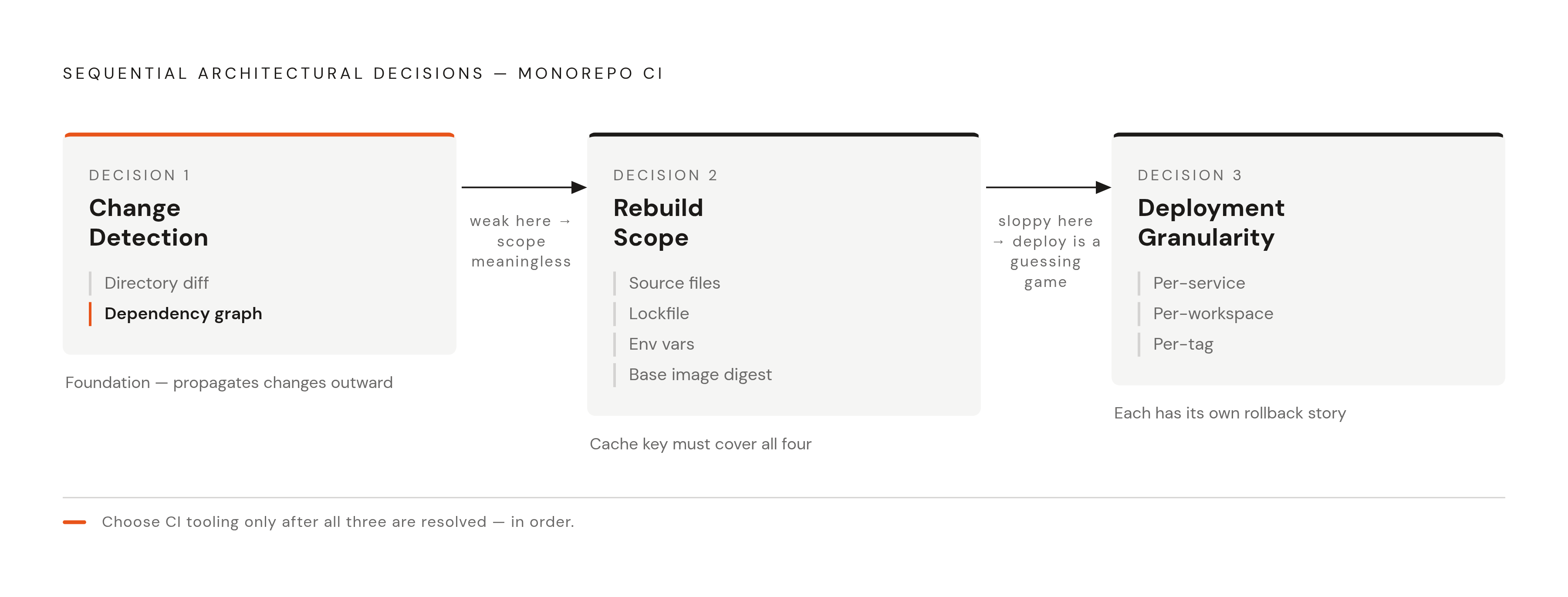
Decision 1: change detection. How does CI know which services got touched by a given commit? The naive version compares top-level directories in the diff. It's fast to set up, but it misses transitive dependencies entirely. If service-b imports a shared utility package and someone edits that package, a directory-diff approach has no way to know service-b needs to rebuild.
The fix is a real dependency graph, where a change to a shared library propagates outward to every service that imports it, directly or indirectly. Before picking a tool, figure out whether that graph is static, locked via a lockfile and resolved once, or dynamic, built through workspace hoisting at install time. That answer decides which tools will even work correctly.
Decision 2: rebuild scope. Once you know what changed, what counts as affected? A utility package used by three services means three pipelines run, not one, and skipping any of them is worse than running one extra job. A false negative, where a service that should've rebuilt gets skipped, causes silent breakage in production. A false positive just wastes time and money. Early on, define blast radius wide; tighten it later once the signal has earned trust.
This decision is tangled up with caching. A cache hit is only safe if the cache key covers every real input: source files, environment variables, base image version. Miss one and a "successful" build ships stale code without telling anyone.
Decision 3: deployment granularity. What's the actual unit that gets deployed, and how independent is it? Per-service deploys, per-workspace deploys, and per-tag deploys each carry different rollback stories. Shared infrastructure, databases, message queues, needs its own versioning separate from service code. Zero-downtime deploys demand the service contract, the API shape, the schema, stay put at the exact moment of deploy, or a consumer that deployed a beat too early breaks.
These three decisions don't sit in isolation. Weak change detection makes rebuild scope meaningless, since "affected" gets computed from bad data, and sloppy rebuild scope makes deployment granularity a guessing game, since nobody can trust which services actually need a new deploy. Fix them in order, and each one gets easier, because the last one becomes solid ground to build on.
How to implement change detection that actually tracks the dependency graph
Start with the baseline everyone can build without extra tooling: git diff against the merge base, not the previous commit. Comparing HEAD to the branch point catches everything that happened across the whole PR, not just whatever landed in the last push, and the setup cost is zero. Its limit: it only sees file paths, with no idea what imports what.
Graph-aware tools close that gap, and this is where the naive approach should just get retired. Turborepo, Nx, and Bazel all build an explicit dependency graph and push change signals through it on their own. Turborepo's --filter='...[origin/main]' syntax selects a package plus everything that transitively depends on it. Edit a shared auth package, and every service that imports it gets flagged, no manually maintained change map required.
For that signal to be trustworthy, it has to capture more than source files. Lockfile and manifest changes count too, since a dependency bump should invalidate every downstream cache that relied on the old version. Environment variables that affect build output count. Base Docker image bumps count, since a new base image can change behavior without a single line of application code changing.
The repo layout has to support this. One package per service directory, shared code living in an explicit /packages layer, no cross-service imports sneaking outside that layer: that structure gives the dependency graph clean edges. The anti-pattern is treating the whole /packages layer as one giant node, where a change anywhere inside triggers every consumer of anything inside it. That's directory-diff thinking wearing a graph-based costume, and it's worth calling out because teams adopt Nx or Turborepo and still land in this failure mode if the layout underneath doesn't cooperate.
Caching strategies that make selective rebuilds actually fast
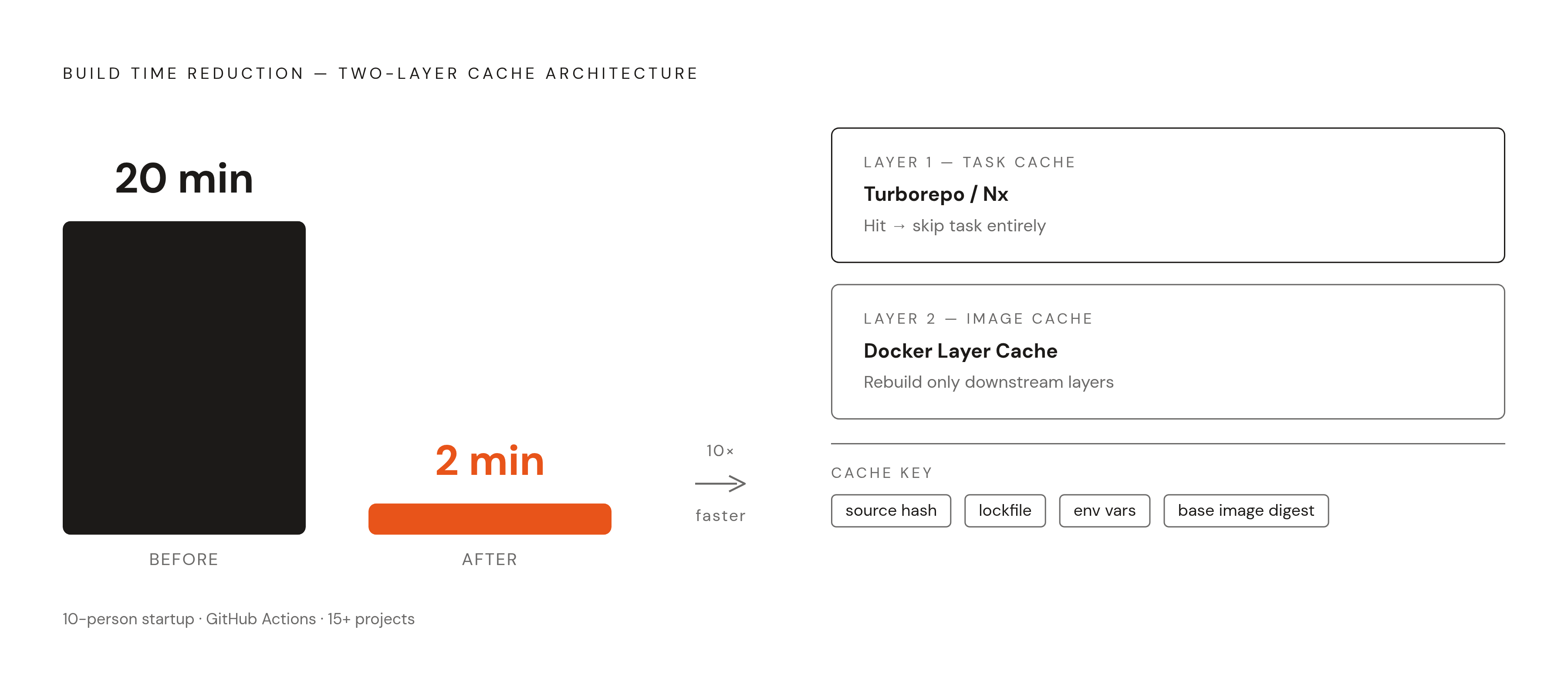
A 10-person startup running Turborepo on GitHub Actions across more than 15 projects cut build times from 20 minutes down to 2 using caching. The architecture decision, skipping unchanged packages in the first place, did most of that work. Caching is what made the win hold up across runs instead of landing as a one-time fluke.
Two layers stack on top of each other well. Task-level caching, through Turborepo or Nx, caches the output of a specific build or test task keyed on its inputs; a cache hit skips running the task entirely. Layer-level Docker caching works underneath that, caching intermediate image layers so only the layers downstream of an actual change get rebuilt.
Cache key design is where teams trip up, and it's worth picking a side here: too narrow beats too broad, every time. Too narrow a key misses a relevant input and ships a stale artifact that looks fine until it doesn't. Too broad, and the cache almost never hits, so the team paid for the caching setup and got nothing back for it. A workable recipe: hash the source files, the lockfile, the relevant environment variables, and the base image digest together into one key.
A local cache only helps whoever's laptop it lives on, which isn't much. Remote cache, whether that's Turborepo's Remote Cache, Nx Cloud, or a self-hosted S3 bucket, shares hits across the whole team and every CI runner. For a small team on GitHub Actions, remote cache is usually the single highest-return piece of the whole setup, because every developer and every CI run benefits from work someone else already did.
Platform choice matters less than people expect once the cache runs warm. In a 12-package Node.js monorepo, GitHub Actions with a warm cache finished in 1 minute 21 seconds versus Jenkins at 1 minute 38, a narrow gap either way. What matters more when picking a runner strategy is cold-cache behavior: what happens on the first run after a weekend, or after a base image bump.
Some things should never be cached, full stop: integration tests that depend on external state, database migrations, and anything reading from a live database. Cache those and the result is a green build that lied.
Structuring the pipeline so each service deploys independently
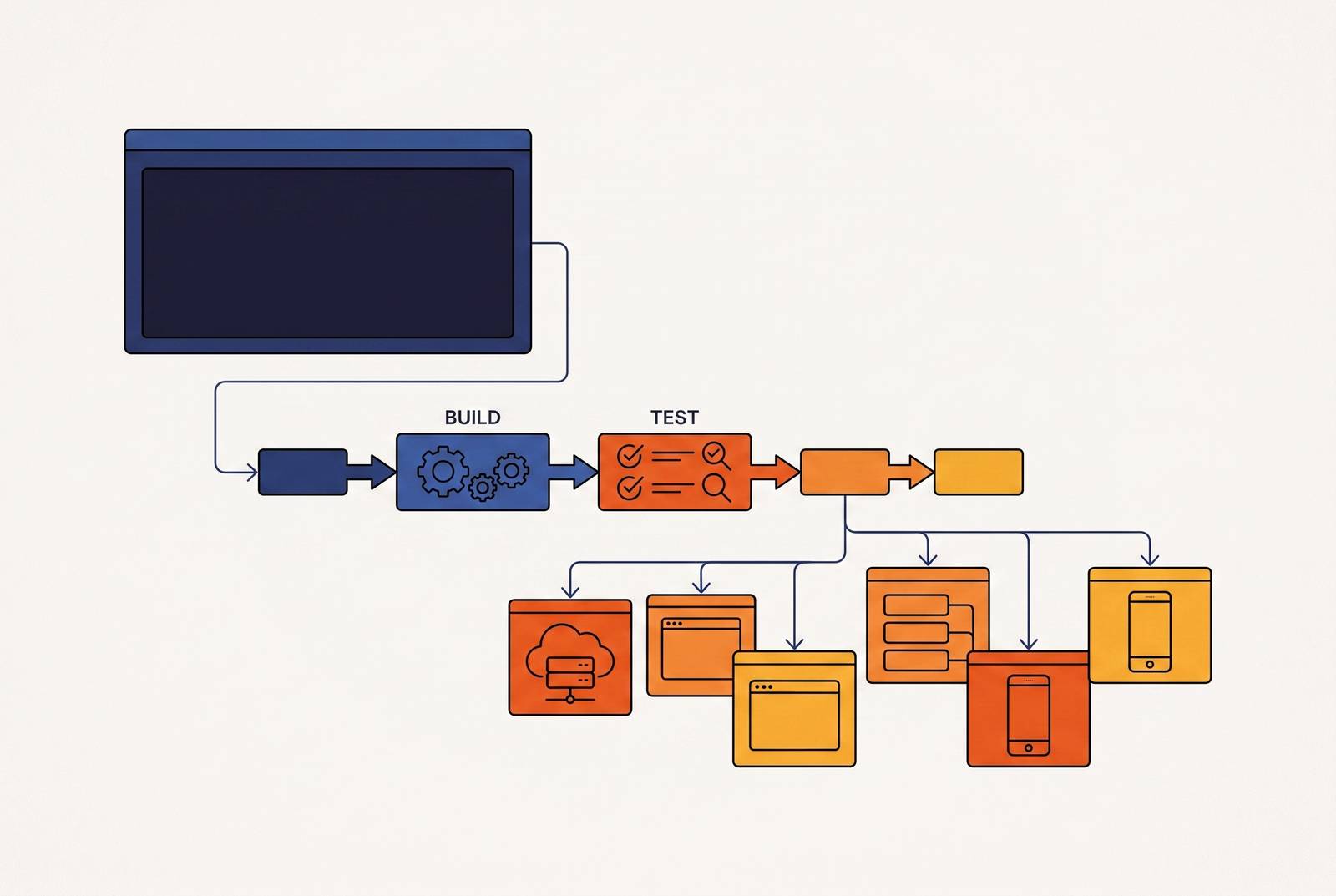
The target: a merge to main deploys only the services whose dependency subgraph actually changed, with nobody manually gatekeeping which jobs run.
That shape breaks into three stages. Change detection outputs a list of affected service names, usually as a JSON matrix. Build and test fan out in parallel across that matrix, with each service building and testing on its own. Deployment happens independently per service, with no artificial serialization forcing services to wait on each other when there's no real dependency between them.
In GitHub Actions, strategy.matrix fed by the output of the change-detection step lets the pipeline definition stay static while its execution adapts to whatever changed. The YAML doesn't need to know in advance which services will run; it just reacts to the matrix it's handed.
Ordering still matters when contracts are involved. Schema migrations run before the service depending on the new schema goes live, and backward-compatible API changes deploy before the service that consumes them, never after. Encode that ordering explicitly, as a dependency between deploy jobs, rather than hoping the timing works itself out. Timing-based ordering is exactly the kind of thing that works fine in staging and fails at 2am in production.
Keep the promotion path, build, then staging deploy, then production deploy, consistent across every service. Whoever's debugging a failed deploy should be working from the same mental model no matter which service broke. One giant sequential pipeline that builds and deploys every service in a fixed order is the failure mode to avoid: it's slow, fully serialized, and it makes it genuinely hard to tell which service caused the failure once something breaks partway through.
What shared infrastructure means for a monorepo pipeline and how to handle it
Databases, message brokers, secrets managers, and API gateways are not services. Treating them like one in the change-detection matrix is a mistake, because they change on a different clock than application code. Fold them into the same matrix and schema migrations start firing on every unrelated PR that happens to touch a neighboring file.
The fix is separation. Manage shared infrastructure with infrastructure-as-code, Terraform or Pulumi, living in its own dedicated path inside the repo with its own change-detection gate. Application code and infrastructure code should almost never trigger the same pipeline run.
Schema migrations deserve their own convention. Keep them in a dedicated /migrations directory, or alongside the service that owns the schema, and have the pipeline check specifically whether migration files changed. If so, migrations run during the deploy stage, before the application deploy happens. Default to backward-compatible migrations: additive changes only, no destructive column drops until nothing still reads the old column.
Secrets need scoping too. Each service should read only the secrets it actually needs. A shared env file that hands every service access to every credential is a liability waiting to be found the hard way, usually by someone who shouldn't have found it. Scope secrets per environment and inject them at deploy time; never bake them into the build artifact.
The underlying principle: shared infrastructure changes should be rare and reviewed carefully, while application service changes should be fast and frequent. The pipeline needs to make that split visible, rather than flattening everything into one undifferentiated stream of changes.
Flaky tests and pipeline hygiene that small teams usually defer and shouldn't
Flaky tests do more damage in a monorepo than in separate repos, and the reason is structural. One intermittently failing test in a shared package can block merges across every service that depends on that package. The blast radius of one unreliable test scales with how widely its package gets imported, which in a monorepo is often everywhere.
Quarantine handles this without letting it fester. Move tests that fail intermittently into a nightly suite that doesn't block PRs, and set an alert the moment a test enters quarantine so someone actually looks at it. A 48-hour fix target keeps the list short enough to manage. Skip the deadline, and quarantine quietly turns into a graveyard nobody visits again.
Run tests per-service in parallel, rather than pooling them into one runner working through every package one at a time. Parallelism here is close to free, since the change-detection matrix already exists and does the hard part.
A few habits compound badly if left unchecked. The "kitchen sink" repo, where unrelated projects get bundled in because it was convenient at the time, creates spurious change signals and bloats every run. Reaching for Bazel or Pants at three services is over-engineering, full stop; those tools earn their complexity at dozens of services and hundreds of packages, not before. Optimizing only for the warm-cache case means the first run after a weekend, or after a base image bump, arrives unexpectedly slow, and nobody remembers why.
Basic hygiene pays for itself. Delete stale branches, keep package naming consistent, and require a CODEOWNERS file per service directory so ownership is something machines can read, not tribal knowledge passed around at standup. That ownership data can feed straight into the change-detection layer.
Choosing a CI platform and deployment target that fits the monorepo shape
GitHub Actions is the default starting point for most startups, and for good reason. As of May 2026 it was processing 3 billion CI minutes a month, with 68% of GitHub projects already using it. The ecosystem of reusable actions and the tight pull-request integration make it the path of least resistance for a monorepo pipeline, especially early on.
It's enough for JavaScript and TypeScript monorepos running on standard compute, with teams fine writing YAML by hand. It falls short on its own for GPU workloads on ML services, builds that need private VPC access, or teams bumping against hosted-runner minute limits at real scale.
Self-hosted runners grew sharply through 2025 as more teams needed private network access or specialized hardware hosted runners don't offer. That's the right move once builds need to reach internal services directly, or once GPU compute becomes part of the pipeline.
Then there's the deployment target: whatever actually receives the built artifact. Each service should land in an isolated environment that can roll back on its own, independent of every other service. Shared-tenant PaaS platforms make this harder than it should be, and it's worth naming that plainly rather than hedging around it. Per-service isolation tends to be coarse there, and compliance boundaries get fuzzy when infrastructure is pooled across tenants. A platform that deploys into the team's own cloud account, AWS, GCP, or Azure, keeps the per-service isolation the pipeline was built to produce, and keeps compliance scope clean instead of muddy.
When sizing up a deployment platform for this setup, look for per-service deploy triggers rather than one deploy-all button covering the whole repo. Preview environments per PR matter a lot once a single PR touches multiple services at once. Rollback should be scoped to the service level, not the whole repo, and native GPU support matters if any service does inference or training, rather than a workaround bolted on after the fact.
The tradeoffs that should inform whether a monorepo is right for your team right now
A monorepo is an operational bet, not a style preference. It pays off when a team has enough shared code that atomic cross-service changes happen often, and it costs the most when change detection, caching, and deployment granularity get treated as afterthoughts instead of the foundation they actually are.
Team size is the honest filter, and below three or four services the answer is usually no. The coordination benefits rarely outweigh the tooling work needed to keep CI fast. A couple of well-organized separate repos often serve a small team just fine, and pretending otherwise wastes engineering time on infrastructure nobody needed yet. Past ten services with real shared libraries between them, the atomic-commit advantage starts pulling its weight, but only if the change-detection graph and cache keys got built right from the start, not patched in after build times already ballooned into the double digits.
The honest question is whether the team will invest in dependency-graph-aware tooling, cache key discipline, and per-service deploy pipelines before the pain shows up, rather than after. Skip that investment and jump straight to picking a tool, and the monorepo turns into exactly what critics warn about: slow, opaque, a tax on every commit. Do the architecture work first, and the same repo structure becomes real leverage: atomic changes across services, one source of truth, a pipeline that scales with the team instead of against it.