What the CIS Benchmarks Actually Require From Your Cloud Config
CIS Benchmarks translate vague security mandates into exact configuration requirements.
"Harden your environment" is the least useful sentence in cloud security. It appears in vendor whitepapers, board decks, and audit findings, and it tells an engineer almost nothing. Which setting? What value? Pass or fail based on what?
CIS Benchmarks exist to answer those questions with numbers, not adjectives. They're built through a consensus process involving practitioners across industry, and each one names the exact configuration item, the value it should be set to, why that value matters, and how to fix it if it's wrong. Instead of "encrypt your data," a CIS Benchmark says: turn on CMK encryption on this resource type, here's the API call, here's what happens if you don't.
Two layers get confused constantly, and separating them is worth doing up front. CIS Controls are 18 prioritized cybersecurity practices, the governance layer, the stuff a security executive presents to a board. CIS Benchmarks are the technical layer that puts the Controls into practice at the setting level: configuration guides for specific platforms, AWS, Azure, GCP, Kubernetes, various databases and operating systems. An auditor understands this distinction cold. Plenty of engineers don't, and that gap is exactly where compliance programs quietly fall apart: teams think they've addressed a Control because a Benchmark scan came back clean, when the two documents were never solving the same problem in the first place.
Which benchmark version your cloud needs to be measured against
Version currency isn't paperwork. It's the difference between passing an audit and passing an audit against a standard nobody uses anymore.
Take AWS. Security Hub's CSPM module supports CIS AWS Foundations Benchmark versions 5.0.0, 3.0.0, 1.4.0, and 1.2.0. A team running automated checks today can still be measured against v1.2.0 without realizing it, because nobody went back and repointed the configuration. The check keeps running. It keeps passing. And it almost certainly isn't testing what anyone on that team thinks it's testing.
Here's where things stand as of the most recent releases:
AWS: CIS AWS Foundations Benchmark is up to v6.0.0. Security Hub added support for v5.0 in October 2025, with 40 automated controls included in that benchmark. AWS also publishes service-specific benchmarks: Compute Services (v2.0.0), Database Services (v2.0.0), End User Compute Services (v1.2.0), and Storage Services (v1.0.0). Azure: CIS Microsoft Azure Foundations Benchmark is v6.0.0, but Microsoft Defender for Cloud, the native tool most teams rely on, supports v3.0.0 as a regulatory compliance standard. That gap between what a scanning tool like Prowler tracks and what Defender natively checks means teams relying on Defender's native checks can pass compliance status while still being unmeasured against two full major versions of the benchmark. GCP: CIS Google Cloud Platform Foundation Benchmark v4.0.0 published in May 2025 under NIST Checklist ID 1282, since superseded by v5.0.0 under that same ID. Google Cloud Security Command Center's certified detector mappings only go up to v2.0.0, meaning teams on the current benchmark version need something else, the official GCP CIS InSpec Profile or a third-party tool, to get real coverage. Kubernetes: CIS Kubernetes Benchmark v1.12.0, with a separate CIS EKS Benchmark at v2.0.0. Oracle Cloud: CIS Oracle Cloud Infrastructure Foundations Benchmark recently updated to v3.1.0.
The pattern across every one of these: the benchmark moves faster than the native tooling built to check it.
Level 1 vs. Level 2: what each profile requires you to do
Every CIS Benchmark splits its recommendations into two profiles, and reading any individual control without knowing which profile it belongs to is a waste of time.
Level 1 is the floor. These are essential controls meant to apply to basically any environment, chosen specifically because they cause minimal operational friction. On AWS, Level 1 looks like: require MFA on the root account, restrict public access to S3 buckets, rotate access keys at least every 90 days, and enable foundational logging and monitoring controls. None of that should surprise anyone who's spent time in an AWS console. Most auditors treat full Level 1 compliance as evidence of reasonable security due diligence, full stop.
Level 2 is where things get heavier. It's built for environments with elevated security requirements, and some of its controls will cost you something, either in functionality or in operational overhead. AWS Level 2 examples: require customer-managed key (CMK) encryption on all EBS volumes, enforce stricter MFA requirements beyond just the root account, and apply additional network and data protection controls. Some of these benchmark documents run past 1,000 pages, and a handful of Level 2 controls impose configurations that carry real operational overhead. CIS itself recommends testing Level 2 changes in a non-production environment before anyone touches production with them.
The practical order of operations is simple: get every Level 1 control implemented first, then work through Level 2 against actual risk tolerance and what the business can absorb operationally.
What CIS Benchmarks check: IAM, logging, networking, and storage across AWS, Azure, and GCP
The Foundations Benchmarks for AWS, Azure, and GCP all organize around the same four categories. The exact settings differ by platform, but the shape of the work doesn't.
Scale first: the Azure benchmark spans 9 sections and is the heaviest lift by recommendation count, with GCP and AWS covering fewer recommendations. Azure is the heaviest lift by sheer recommendation count.
Identity and Access Management. A few requirements show up almost identically across all three clouds: no root or admin access keys sitting active anywhere, MFA enforced on the root or administrator account and on every console user, least-privilege role design (no *:* wildcard policies anywhere in a policy document), and regular service account key rotation. AWS v5.0.0 specifically requires IAM password policies to set a 14-character minimum and block password reuse. GCP focuses heavily on service account key rotation and avoiding user-managed keys for service accounts wherever that's possible. Azure's IAM section is just one of the 9 sections making up its Foundations Benchmark v3.0.0, which gives a sense of how much ground that benchmark covers relative to the other two.
Logging and monitoring. On AWS, this means CloudTrail enabled with at least one multi-region trail capturing both read and write management events, encryption at rest on that trail, log file validation turned on, and S3 access logging enabled on the bucket storing the CloudTrail logs. Teams enable CloudTrail and stop there, skipping S3 object-level data events, which specific CIS logging controls explicitly require. CloudWatch alarms need to be watching for unauthorized API calls, console logins without MFA, configuration changes, and any root account activity. Azure's version of this is Activity Log configuration and retention, plus Microsoft Defender for Cloud enabled and actively scanning subscriptions once the benchmark is turned on as a compliance standard. GCP requires audit logging across services and active VPC Flow Logs.
Why the misconfiguration problem these benchmarks address is getting worse, not better
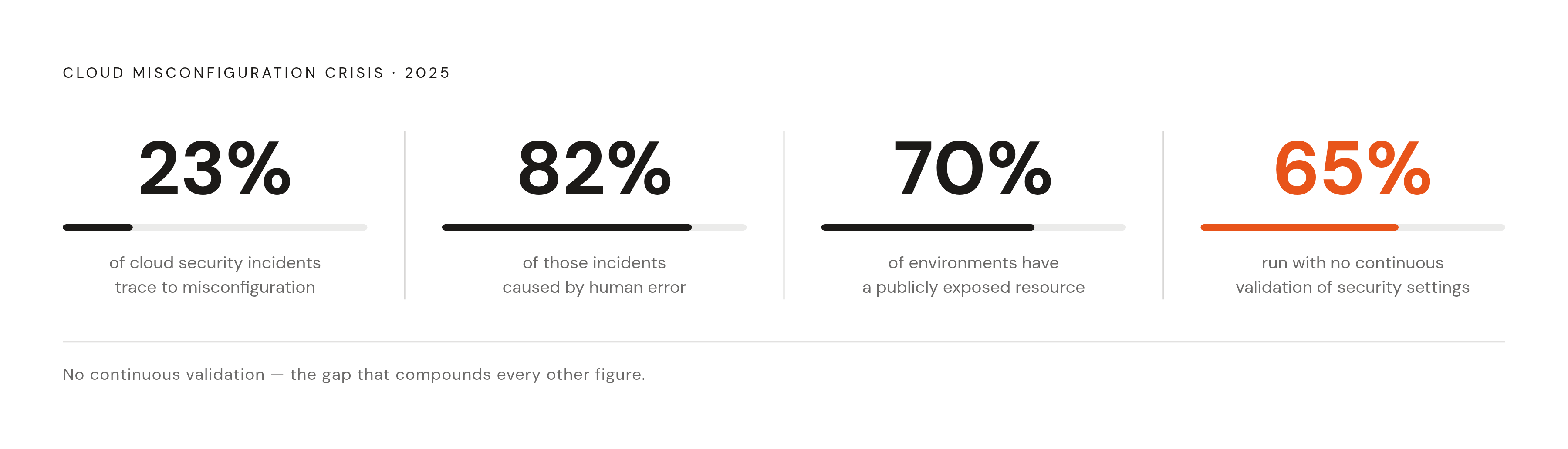
Start with the failure rate, because it's the whole argument in one number: 23% of all cloud security incidents in 2025 trace back to misconfiguration, and 82% of those are human error, not a provider-side flaw. 23% of all cloud security incidents in 2025 trace back to misconfiguration, and 82% of those are human error, not a provider-side flaw. This is a story about the people configuring that infrastructure making avoidable mistakes at scale, not about AWS, Azure, or GCP shipping broken infrastructure. It's a story about the people configuring that infrastructure making avoidable mistakes at scale.
Roughly 70% of cloud environments currently contain at least one resource that's publicly exposed. And 65% of companies say outright that they have no continuous validation running against their security settings, so any drift between the last audit and today goes undetected until something breaks or someone finds it.
The trend line is bad, too. In 2024, 27% of organizations running public cloud workloads reported a security incident, up from the year before, and the average environment carried 43 misconfigurations at any given time. Cloud environments aren't getting simpler. Multi-account setups, more services per account, more infrastructure defined and redefined through code: every one of those trends adds surface area, and none of them is reversing.
How CIS Benchmark compliance maps to SOC 2, HIPAA, PCI DSS, and ISO 27001
Here's the efficiency case for doing this work through CIS Benchmarks specifically: harden a system once against a CIS Benchmark, and that work counts as evidence toward several compliance frameworks at once, rather than running a separate hardening project for each one.
CIS publishes mapping documents tying its Benchmarks and Controls to major frameworks including NIST, ISO/IEC 27001, PCI DSS, and HIPAA. That's not marketing language; it's a direct crosswalk between specific CIS controls and the specific requirements in each framework.
For SOC 2, CIS scan results routinely get submitted as audit evidence for infrastructure hardening. Trust service criteria CC6 and CC7 overlap heavily with what CIS already checks around logging, encryption, and access control. But SOC 2 also demands policy documentation, HR controls, and vendor management practices that sit entirely outside what any CIS Benchmark touches. CIS compliance gets a SOC 2 audit most of the way there. It doesn't finish the job.
For HIPAA, CIS Controls v8.1 maps directly onto the HHS Healthcare and Public Health Cybersecurity Performance Goals. Implementing the Controls goes a long way toward satisfying the technical safeguards HIPAA requires for protected health information, even though HIPAA, like SOC 2, layers in requirements CIS was never built to cover.
Where version drift and native tooling gaps create false confidence in benchmark compliance
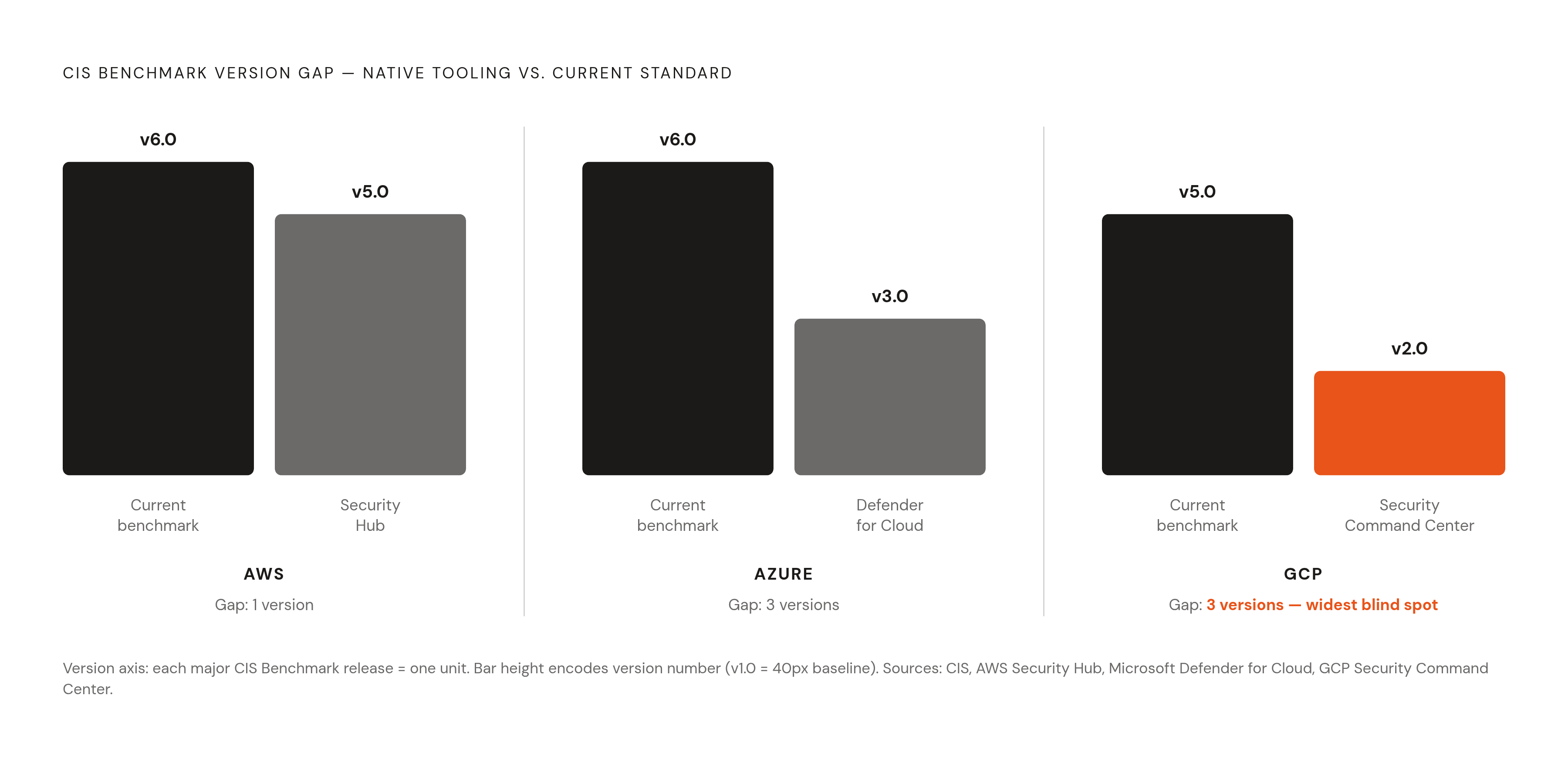
The version problem from earlier isn't abstract. AWS Security Hub supports v5.0.0, 3.0.0, 1.4.0, and 1.2.0 simultaneously, and without someone actively going in and pointing automated checks at the current standard, those checks default to whatever version they were originally configured against, potentially one that predates a meaningful batch of new controls.
GCP has the same problem from a different angle. Google Cloud Security Command Center's certified detector mappings stop at v2.0.0, while the actual current benchmark is v4.0.0. Any organization relying purely on native cloud-provider scanning is not getting coverage against the standard it thinks it's being measured on. Closing that gap means bringing in a third-party scanning tool; there's no way around it with native tooling alone.
Then there's the deeper structural issue: infrastructure that doesn't sit still long enough to be scanned on a schedule. Auto-scaling groups, ephemeral containers, infrastructure-as-code deployments that tear down and rebuild resources by the hour, all of it changes configuration state faster than a weekly or monthly compliance scan can track. Kubernetes environments push this to the extreme. Pods spin up and disappear within minutes. Cluster configuration shifts through GitOps pipelines, sometimes multiple times a day. Whatever CIS Kubernetes Benchmark score got recorded last Tuesday tells you very little about what's actually running today, because the gap between scans is exactly where drift accumulates, unnoticed, until the next audit forces someone to look.