Database Migration Safety in Continuous Deployment Pipelines
Backward compatibility and staged migrations make schema changes safe for automated deployment.
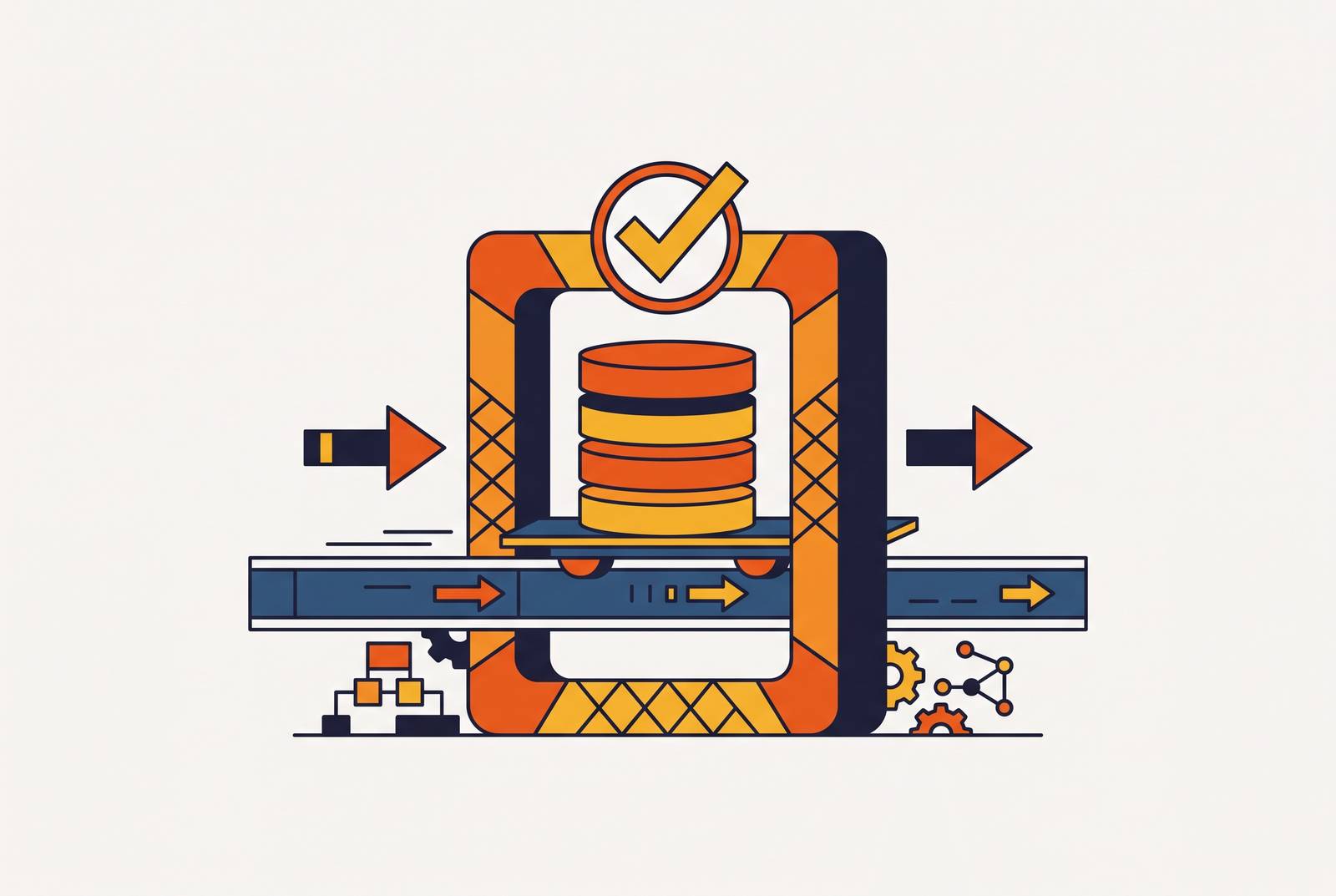
Database migrations break continuous deployment pipelines for a reason that has nothing to do with tooling. Application code is stateless from the pipeline's point of view: a bad deploy rolls back, and the slate is clean. Schema changes are different. They mutate data that has to keep existing, and a half-applied migration can leave that data in a shape no rollback script fully repairs.
Most teams still treat schema changes as the exception to their automation. App deploys ship dozens of times a day, untouched by human hands. Migrations get scheduled, gated behind a DBA sign-off, or run manually at 2am on a Sunday. That gap doesn't stay static, either. Manual migrations add coordination overhead, which pushes teams toward batching changes less often, and batched changes carry more surface area per release than small continuous ones do. Skip version control on top of that, and the schema accumulates history nobody can reconstruct.
Faster migrations alone don't close this gap. The fix has to make migrations safe enough to run automatically, with no human standing by to catch the failure. That's a different problem than the one most migration tooling solves, because it's not really a tooling problem. It's a safety model problem, and the rest of this piece walks through what that model actually requires.
The backward compatibility requirement that most migration advice skips
Here's the thing nobody puts on the slide deck: in a CD pipeline, the old version of your app and the new version overlap in time. Always. Both versions read and write the same database during that window, whether it lasts ten seconds or ten minutes. If a schema change breaks the old version during that overlap, the deploy causes an outage, full stop, regardless of whether the migration itself ran perfectly.
Backward compatibility functions as the floor for any migration, not an optional layer added on top of a good one. Concretely, that means:
- New columns need to be nullable or carry a default the old code can safely ignore.
- Renamed columns aren't renames at all, not really. They're additions. The old column name stays live until every instance running the old code is gone.
- Deleted columns get dropped only after the application has completely stopped referencing them, not after the team thinks it has.
- Constraint changes, like NOT NULL or unique constraints, are especially dangerous, because old code can still write rows that violate the new rule.
A migration that isn't backward compatible needs a coordinated cutover window: freeze deploys, migrate, unfreeze. That kind of manual gate is exactly what CD pipelines exist to eliminate. Skip backward compatibility, and every other safety pattern downstream becomes irrelevant.
The expand-and-contract pattern as the practical implementation of backward compatibility
Expand-and-contract is how backward compatibility gets implemented in practice. Instead of trying to change a schema in one deploy, the change gets staged across several, each one safe and independently reversible on its own.
Stage one: expand. Add the new column, table, or index without touching anything that exists already. Old application code keeps running exactly as it was. New code, once deployed, can start using the new structure. No data moves yet. No constraints get enforced yet. This stage is boring, and boring is the point.
Stage two: migrate. Now the old and new structures need to stay in sync. The application dual-writes, sending data to both the old column and the new one at the same time. A backfill job runs against the existing rows, populating the new column for data that predates the change. Then comes a validation step, confirming the new structure holds complete, consistent data before anyone moves on.
Stage three: contract. Only now does the old column or table get dropped, and only in its own separate deploy, after confirming that no application version still in service references it. This is where the most common mistake happens: teams treat "the migration ran" as the same thing as "the old schema is safe to remove." Those are separate facts, one about data and one about which code is still running in production.
Each of these three stages is its own deployable unit. That means each one gets tested, validated, and rolled back on its own, without dragging the other two down with it. And the pattern isn't specific to adding columns; it holds for renames, table restructuring, type changes, and new constraints alike. Nearly every non-trivial schema change decomposes into these same three moves.
Locking, index operations, and the migrations that silently stall production
A migration can satisfy every backward-compatibility rule and still take production down, if it grabs an exclusive lock on a busy table. This is the part of migration safety that has nothing to do with data correctness and everything to do with how the database physically executes the change.
A few operations are locking traps that look completely harmless in a code review:
- A standard
CREATE INDEXholds a lock for the entire duration of the index build, which on a large table can mean minutes of blocked writes. - Adding a
NOT NULLconstraint to an existing column forces a full table scan, and that scan takes a lock while it runs. - Changing a column's type often means rewriting the entire table under the hood, locking it the whole time.
PostgreSQL gives specific ways around this. CREATE INDEX CONCURRENTLY builds the index without taking a table lock; it takes longer and it can't run inside a transaction block, but it keeps the table available. For mass updates, batch processing, updating rows in small chunks with a brief sleep between batches, avoids holding row locks for long stretches at once.
What makes lock-related failures nasty in a CD context is that they don't announce themselves as migration errors. They show up as latency spikes and timeouts on completely unrelated endpoints, which means standard monitoring might not flag the migration as the cause until users start complaining. The fix at the pipeline level is to set an explicit timeout and lock-wait threshold on the migration step, rather than trusting database defaults. A stalled migration should fail fast and get out of the way, not sit there holding a table hostage. And query linting plus execution plan review belong in CI, before any of this reaches production. Catch the locking operation at review time. Don't discover it at deploy time.
Treating schema history as code: versioning, idempotency, and migration tooling
Migrations that live outside version control are invisible to CI and impossible to audit later. That's the baseline problem, and it's why schema history belongs in the same repository as application code, subject to the same review process as everything else.
A real migration framework earns its place by handling three things hand-rolled SQL scripts almost never get right:
- Ordered execution. Migrations run in a defined sequence, every time, with no ambiguity about what applies when.
- Applied-state tracking. The framework keeps a record of what's already run, so re-triggering the pipeline doesn't reapply a change that already happened.
- Idempotency. A migration that's run once does nothing the second time it's invoked, which matters enormously for pipelines that retry automatically on failure.
On tooling: Flyway is SQL-native and common in Java shops, with a strong model for ordering. Liquibase works off changesets in XML, YAML, or SQL, and supports paired rollback definitions alongside the forward migration. Alembic sits in the Python and SQLAlchemy world, and can autogenerate migrations from model diffs.
There's a real fork in philosophy here: forward-only migrations versus reversible ones. Forward-only treats every migration as a one-way door; undoing it means writing a new compensating migration, not reversing the old one. Reversible migrations ship a paired down-script with every up-script, so rollback is automated, but only if that down-script was actually written and actually tested, which is where reversible setups tend to rot over time. In practice, most teams moving fast land on forward-only with compensating scripts, because down-scripts are genuinely hard to keep correct as the schema evolves underneath them.
One more rule that's easy to skip: once a migration file has run in any environment, it's immutable. Editing a migration after the fact is exactly how staging and production schema histories quietly diverge from each other.
Where migrations live in a CD pipeline and how to sequence them safely
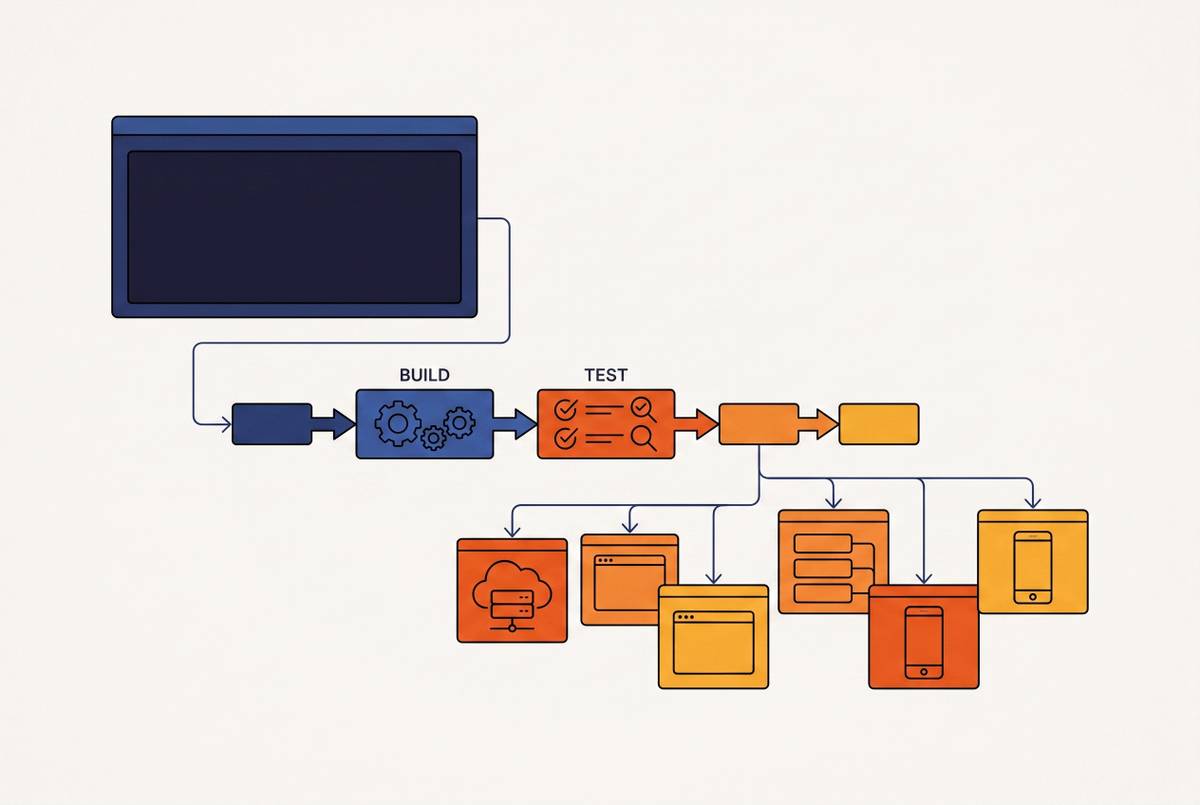
The sequencing question actually has a clean answer. Migrations run after the new application code has been deployed somewhere it can be validated, but before traffic gets switched over to that new version.
This is the pre-deploy hook pattern, and it works the same way across most platforms that support it properly, such as Porter, a bring-your-own-cloud PaaS, or Render. The migration runs as its own pipeline stage before traffic promotion happens. If it fails, the pipeline stops there, the old version keeps serving traffic, and nothing partial gets exposed to a single user. Render's preDeployCommand is a direct implementation of this: it runs once per deploy, blocks the traffic switch on failure, and keeps the previous version alive the whole time. That same pre-deploy gate pattern is one of the few things worth deliberately preserving when a team migrates off any platform onto something else.
Worker services complicate this, because they don't participate in the pre-deploy phase the same way web services do. A worker needs its own gate: a small read-only startup check that polls for migration completion and holds off consuming the queue until the schema is ready.
Blue-green deployments add another layer for bigger migrations. A new environment stands up next to the old one, the migration runs against the database while the old environment keeps serving live traffic, and the cutover only happens once both the migration and the new app version have been validated independently. Notice that this only works if the migration is backward compatible with the old app; blue-green doesn't remove that requirement, it just gives you a safer stage to discover whether you met it.
Before anything promotes to production, a few checks are worth treating as non-negotiable gates: the migration applied cleanly in staging against data volume that actually resembles production, replication lag stayed within bounds, a smoke test passed against the migrated schema, and a rollback path is confirmed and written down somewhere a human can find it at 2am.
Rollback guarantees and what "safe to roll back" actually requires
Rollback has to be designed before the migration ever runs, because by the time it fails, it's too late to start thinking about it.
There are two real models here. Transactional rollback wraps the migration in a database transaction, so a failure at any point rolls back atomically, no partial state, no manual cleanup. This works for DDL on databases with transactional DDL support, and PostgreSQL is a well-documented example of a database that handles this well. It also doesn't work for anything that has to run outside a transaction, like CREATE INDEX CONCURRENTLY.
Compensating migration rollback is the other model: a separate migration written specifically to reverse the original, adding back a column that got dropped, removing one that got added. This has to be written and tested before the original migration ever reaches production, not improvised afterward. And it isn't instant. Applying a compensating migration takes real time, during which the application may need to degrade gracefully rather than assume the rollback already landed.
Some operations have no clean rollback path at all. Dropping a column with data in it, truncating a table, deleting rows: none of that comes back through a compensating script. The only real protection is a pre-migration snapshot or logical backup that can actually be restored. Which means any migration that destroys data should trigger an automated backup step in the pipeline before it runs, not after someone notices the data is gone.
A rollback script that has never been run in staging is a guess dressed up as a plan. And feature flags are worth pairing with all of this: if a schema change unlocks new application behavior, wrapping that behavior in a flag means it can be switched off instantly, with zero database involvement, while the actual rollback plays out underneath it.
Monitoring what happens to the database during and after a migration deploys
A migration can clear every pre-deploy gate and still degrade under real traffic. Index choices behave differently at production scale than they do in staging, and query planners sometimes pick a different plan entirely once a schema changes, in ways no staging environment will reproduce.
A handful of signals deserve dedicated instrumentation around every migration deploy:
- Query latency on the affected tables. A new index should bring it down; a missing one will spike it immediately.
- Replication lag, since heavy-write migrations can cause replicas to fall behind, which then hits any read traffic routed to those replicas.
- Lock wait events, which show up as latency well before they show up as outright errors.
- Connection pool utilization, since long-running migrations hold connections open, and pool exhaustion is the downstream failure that actually pages someone.
Tagging the exact moment a migration ran on a monitoring dashboard turns a mystery latency spike into an obvious correlation. Some teams go further and wire alerts directly to a compensating migration: if the error rate crosses a threshold within a defined window after deploy, the rollback fires without anyone touching a keyboard. Canary deployments extend the same logic to the data layer: run the migrated schema against a small slice of traffic, watch the metrics, then promote to everyone, the same discipline already standard for application canaries.
How the platform a team deploys on shapes what migration safety patterns are practical
All of the patterns above are platform-agnostic in theory. In practice, the platform decides how much friction stands between a team and actually implementing them.
A handful of concrete things separate a platform that makes this easy from one that turns it into a workaround-laden mess. Look for a genuine pre-deploy hook, one that natively blocks traffic promotion on failure rather than something bolted on with custom scripting. Look for the ability to run the migration in the same pipeline as the application deploy, sharing the same environment variables and secrets, rather than a separate process that has to be kept in sync by hand. Look for migration logs kept visibly separate from application logs, so a failure is diagnosable in seconds rather than buried in noise. And look for the ability to run a migration as a one-off job, not a persistent service, because a migration that behaves like a long-running process is a migration nobody sized correctly.
None of these are exotic asks. But they separate a migration step that fails safely on a Tuesday afternoon with nobody watching from one that needs a human standing by just in case.