PaaS Cost Comparison at Scale for Growing Startups
Heroku's cost spiral shows why startups migrate toward usage-based billing.
Heroku is the case study that keeps giving because it has the longest paper trail, the most documented pricing shifts, and the most visible migration waves of any platform in this category. If you want to understand where shared-tenant economics eventually land, watch what happened to Heroku. It ran the playbook before anyone else had a name for it.
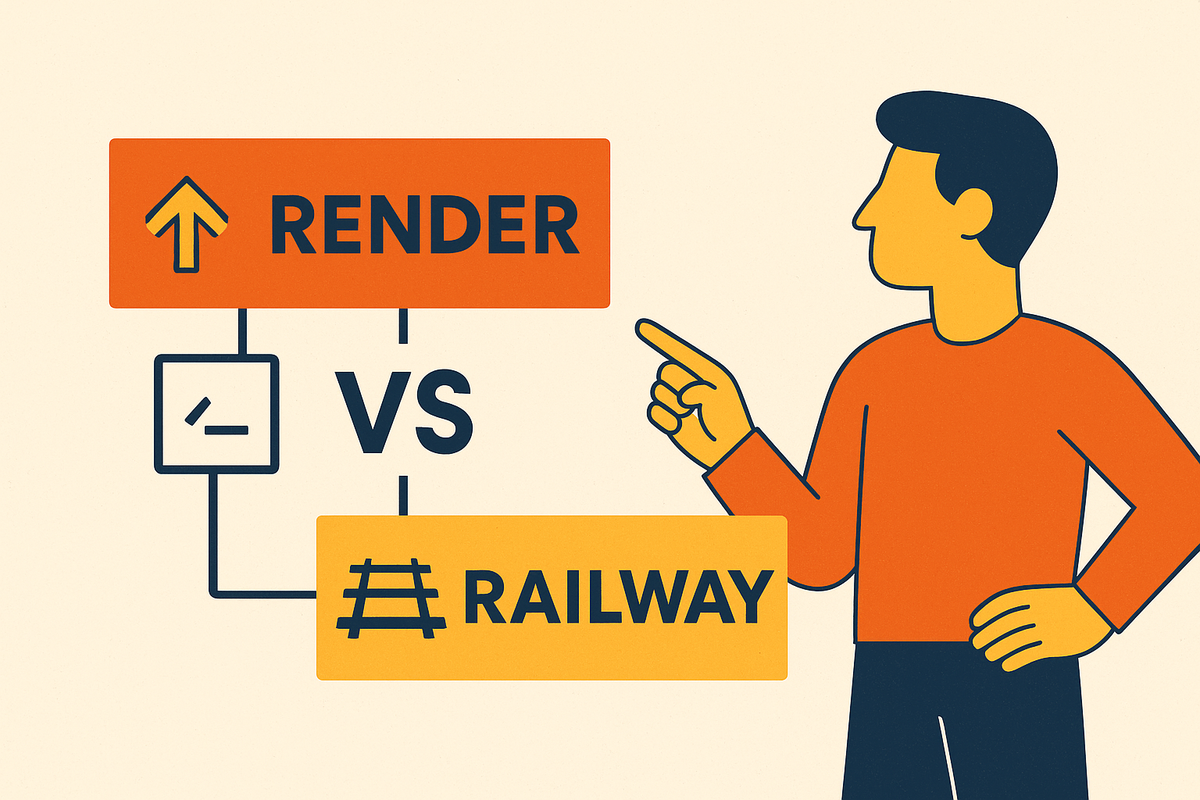
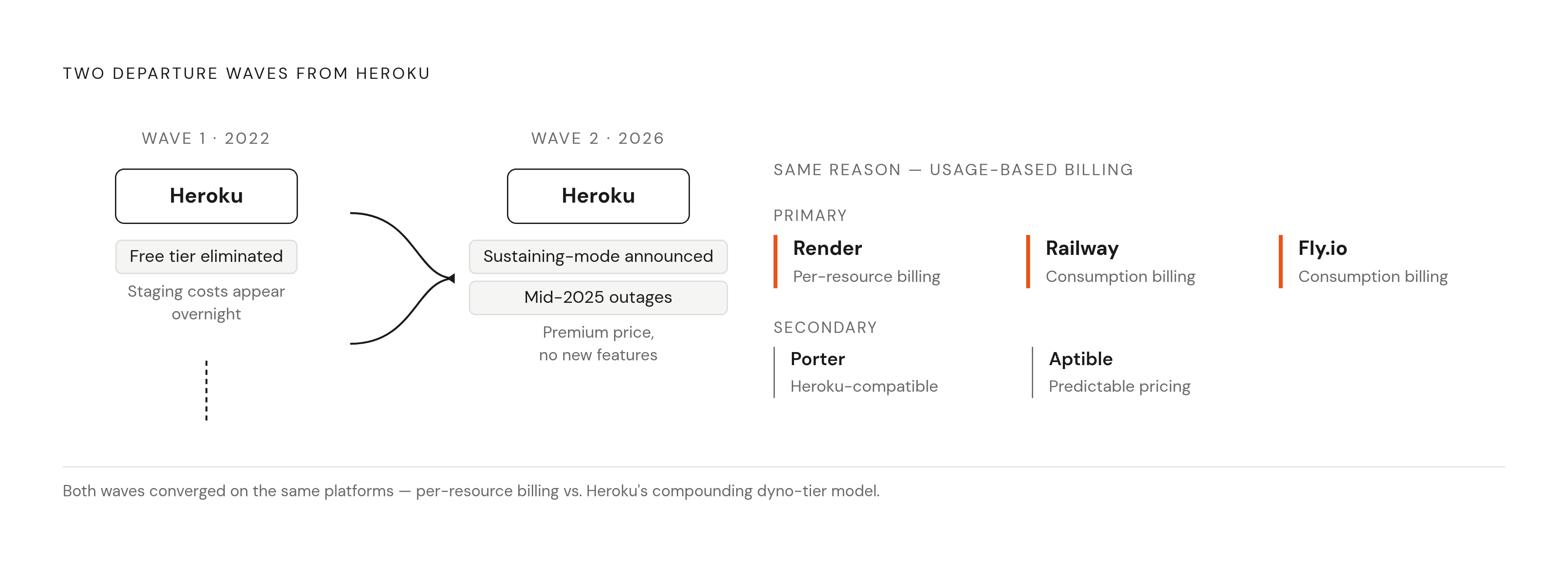
Among the platforms that absorbed migrants from Heroku, the consistent draw was usage-based billing or transparent per-resource pricing rather than compounding dyno and add-on fees. The providers that attracted both documented migration waves are Render, Railway, and Fly.io, each of which charges by actual compute and resource consumption rather than bundled dyno tiers. Porter and Aptible also received traffic from teams that needed Heroku-adjacent workflows but wanted predictable, per-resource invoices. For teams specifically escaping the Heroku Connect line item, moving the Salesforce-Postgres sync to any of these platforms and rebuilding the integration eliminates what had become, in some budget reviews, the single most expensive item on the monthly bill.
The arc is not subtle. Free tier, gone practically overnight, forcing teams that had treated staging environments as zero-cost infrastructure to suddenly pay for them. Entry-level dyno pricing climbed, and while each individual increase felt proportionate in isolation, the compounding across multiple production dynos was not. Genuine production deployments started producing monthly bills in the tens of thousands. Enterprise scale meant six figures annually without much drama. Heroku Connect, the Salesforce-Postgres synchronization add-on, cost as much as a competitor's entire monthly bill on its own. I have sat in budget reviews where that single line item was the uncomfortable centerpiece.
Then, early 2026, Heroku announced sustaining engineering mode. No new features. No new enterprise customers. Teams are now paying premium prices for a platform that has openly stopped investing in their future. Extended outages in mid-2025 added downtime costs on top of elevated monthly invoices, and that particular combination compresses migration timelines that would otherwise drift for another two or three quarters.
The departure data is not ambiguous. Two large waves: one after the free-tier elimination, one after the sustaining-engineering announcement. Both moved toward usage-based billing or transparent per-resource pricing. These teams were not fleeing because they hated Heroku's developer experience. The developer experience was fine, genuinely fine. They were leaving because the economics had inverted, and staying was costing more than the switching pain.
Which PaaS providers actually received those migrants? Render, Railway, and Fly.io led both waves, each offering per-resource or consumption-based billing in direct contrast to Heroku's dyno-tier structure. Porter and Aptible also drew teams that needed Heroku-compatible workflows without the compounding cost model. Heroku Connect defectors in particular found that rebuilding the Salesforce-Postgres sync on any of these platforms brought the overall monthly bill closer to the cost that Heroku Connect alone had previously carried.
What that sequence illustrates is not a Heroku-specific malfunction. It is what happens structurally when a shared-tenant platform exhausts its early-adopter subsidy and starts extracting margin from production workloads that are now expensive to move. Attractive entry pricing, incremental increases that each clear the internal-justification bar, and then a total bill that has long since stopped being proportional to value. Heroku ran that sequence first and most visibly, and the platforms currently in growth mode are not exempt from the same trajectory.
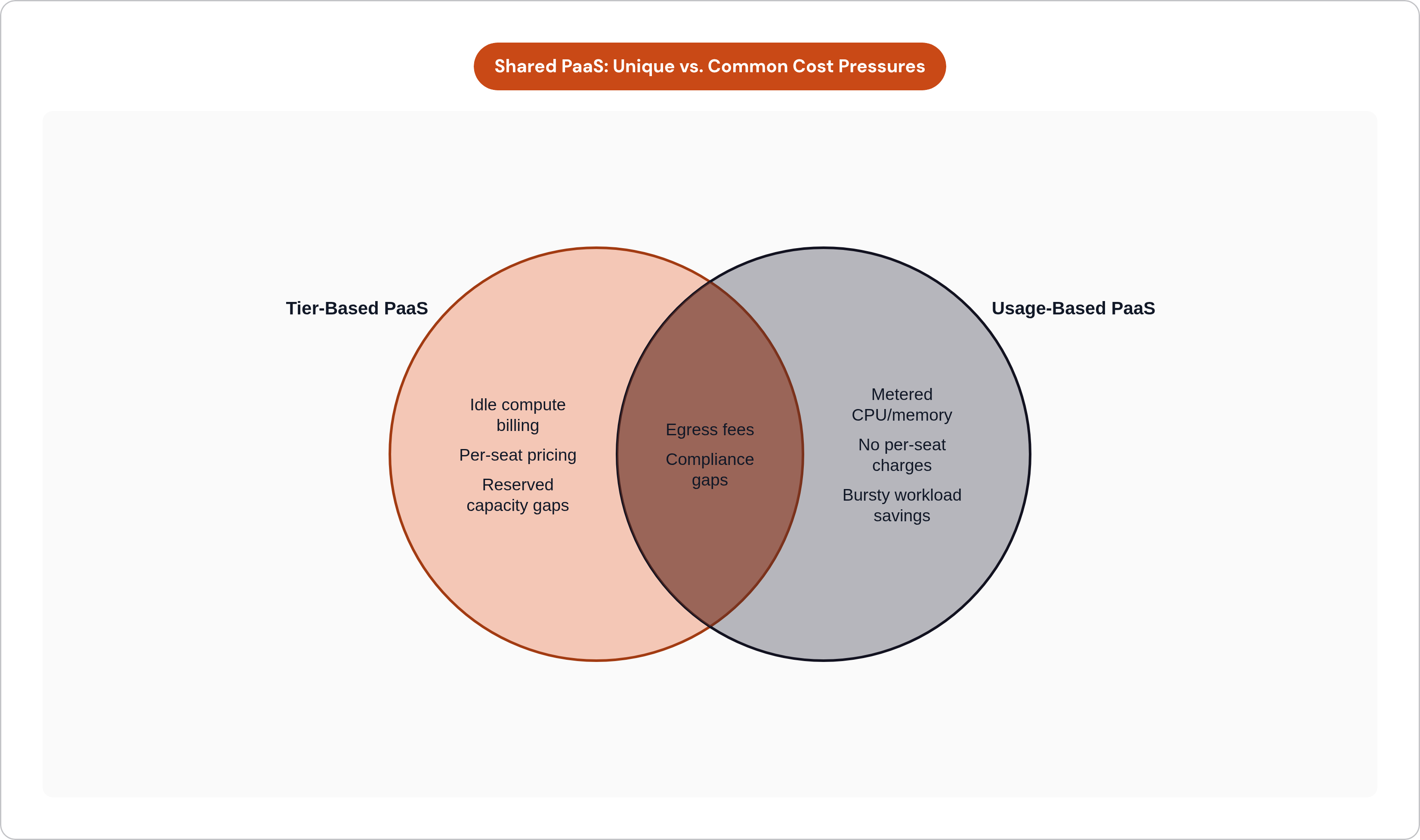
The Four Billing Mechanisms That Inflate PaaS Costs as Workloads Grow
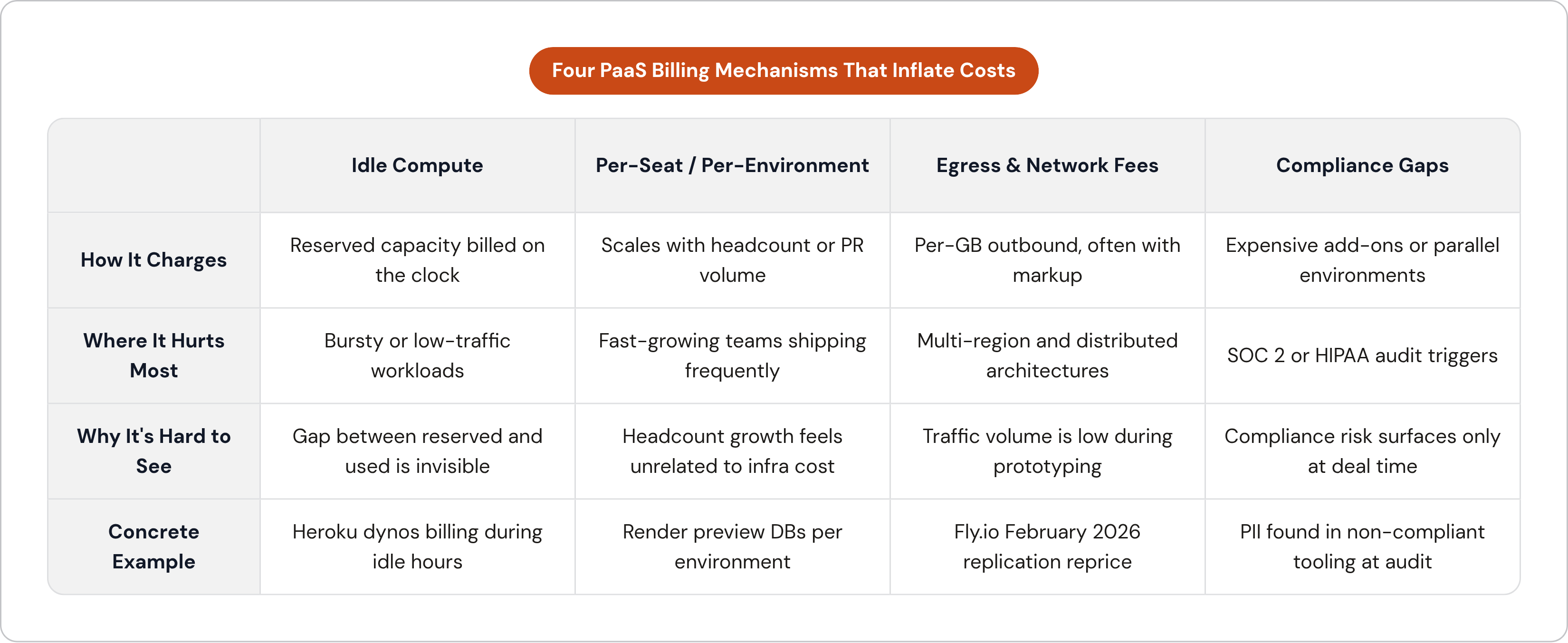
The bill inflation is not random. It comes from specific mechanisms that compound on each other in ways that are genuinely hard to see before you are inside them. Once you have watched enough teams get surprised by the same invoice, the pattern becomes predictable.
Idle Compute Billing
Tier-based platforms charge for reserved capacity whether or not that capacity is doing anything. A dyno runs on the clock, not on the request. For startups with bursty workloads, which is most startups, you are paying for peak capacity during the long stretches when nothing is peaking. The platform captures margin on the gap between what you reserve and what you actually burn. Usage-based models close that gap by design. Tier-based models depend on it, and that dependency is not incidental to the business model.
Per-Seat and Per-Environment Pricing
Some platforms price per developer or per preview environment, which means the cost line scales with team growth rather than traffic volume. Double the headcount, double that cost, regardless of whether you shipped a single additional byte. Preview environments are particularly punishing when each one instantiates a full database copy at tier pricing. The behavior being penalized is exactly the behavior a healthy startup should be optimizing for.
Egress and Inter-Service Network Fees
Platforms running on third-party cloud infrastructure pass through egress costs, occasionally with a markup. Architectures that look economical during prototyping, multi-region setups, distributed read replicas, produce network charges that scale sharply when the platform adjusts inter-region pricing. Porter, a deployment platform that runs inside a team's own AWS, GCP, or Azure account, sidesteps this by letting teams pay cloud-provider egress rates directly rather than a PaaS markup. Fly.io's February 2026 repricing of inter-region Postgres replication is the concrete illustration: setups that were genuinely affordable in 2025 became significantly more expensive without any change in the underlying architecture. The code did not change; the cost did.
Compliance Gaps That Require Expensive Remediation
Shared-tenant platforms, by construction, cannot offer the network isolation, audit logging depth, or data residency controls that SOC 2 Type 2 or HIPAA audits require. Teams discover this at the worst possible moment: when a customer contract demands a compliance report. At that point, the options are expensive add-ons, a parallel compliant environment, or a platform migration under deadline pressure. Any of those paths costs more than getting the architecture right earlier, and that cost rarely appears as a forecast on anyone's spreadsheet.
Where Railway's Usage-Based Model Wins and Where Its Limits Appear
Railway's structural advantage is real: fully metered billing with no charge for idle CPU or memory. You pay for what you consume. No per-seat pricing means adding developers does not inflate the bill. For bursty or unpredictable traffic patterns, and for microservices architectures where most services handle low volume most of the time, that model produces savings that are not marginal. Compared to tier-based alternatives, the delta is often dramatic.
The limits surface at the database layer, which is, not coincidentally, where production reliability actually lives. Railway's standard database offering lacks point-in-time recovery, read replicas, and automated failover. Railway launched experimental high-availability Postgres in early 2026 but flagged it as not yet production-ready. For teams that need those features today, that flag is a hard stop. The cost of those limitations does not show up as a line item; it shows up as an incident at 2 a.m. on a Tuesday, and the invoice for that incident is paid in engineering hours and customer trust.
A platform-wide outage in mid-2026, triggered by a cloud provider account suspension, took Railway's API, control plane, and databases offline for an extended period. The downtime cost, measured in lost revenue, incident engineering hours, and customer-trust erosion, does not appear on the PaaS invoice. It belongs in the calculation anyway.
Railway is the most cost-transparent shared-PaaS option I am aware of. That transparency is not nothing. But transparency about compute costs does not resolve reliability gaps, and those gaps become load-bearing concerns as workloads mature.
How Render's Per-Environment Pricing Affects Teams Shipping at High Velocity
Render's pull request preview environments with full database copies are a genuinely useful workflow feature for teams that live in that review-and-QA cycle. Render moved from per-seat to a flat workspace fee in April 2026, which was a meaningful improvement for growing teams that had been penalized for headcount growth. That change was worth making and worth acknowledging.
What the flat fee did not change is the per-environment cost structure. Each preview environment with a database copy consumes compute and storage at tier pricing. For teams with high PR volume, which is a reliable signal of healthy shipping velocity, those costs accumulate in ways that are easy to underestimate when you are setting up the workflow and much harder to unwind once the process is embedded in how the team operates.
Environments that are not actively garbage-collected continue billing while idle. That is not a gotcha; it is a default behavior that requires deliberate operational attention. Teams that are shipping fast tend to have less operational attention available. That is exactly when idle environment billing compounds most aggressively, quietly, over weeks.
Render fits cleanly for teams with moderate PR volume and workloads that map onto its managed tiers without significant friction. As PR volume increases, as compute requirements move outside standard tiers, or as compliance requirements arrive, the economics shift.
Fly.io's Egress Pricing and What Multi-Region Architecture Actually Costs in 2026
Fly.io has real technical differentiation worth naming directly. Bare metal rather than cloud-provider resale, horizontal autoscaling that is genuinely capable, simultaneous multi-region deployment with automatic request routing. For latency-sensitive and globally distributed workloads, and for technical founders who want Docker-native workflows without function timeout constraints, those are meaningful advantages. Agent loops and long-running processes work on Fly without the architectural contortions that serverless platforms require.
The cost structure that demands careful modeling before committing is egress. Outbound bandwidth carries per-GB charges that vary by region, with rates higher outside North America and Europe. The February 2026 repricing of inter-region Postgres replication changed the economics of setups that had looked cost-effective during prototyping. Bandwidth costs are essentially invisible during development, when traffic volumes are low, and visible only after the architecture is committed and traffic is real.
The honest frustration with that dynamic: egress volume is genuinely hard to estimate before you have production traffic, and by the time the costs are visible, rearchitecting around them requires engineering time that is never cheaply available. I have watched teams absorb that realization mid-sprint and make the arithmetic work badly.
Fly's bare-metal infrastructure does eliminate cloud-provider account-suspension risk, which became a meaningful distinction after mid-2026. It concentrates reliability in Fly's own operations instead, which is a different risk profile rather than the absence of one. Fly serves well at scale for teams whose workloads suit the platform's specific strengths. That is a narrower set of production workloads than the marketing implies.
Where Vercel's Serverless Model Breaks for AI and Long-Running Workloads
Vercel's fit is specific: static sites, frontend-heavy applications, Next.js workflows where the build and preview tooling is deeply embedded in the development process. Within that fit, the developer experience is difficult to beat. Outside it, the constraints arrive fast and the costs compound faster.
The serverless cost model charges per invocation and per compute-second. For short, frequent requests, that structure is genuinely efficient. As request duration grows, efficiency degrades. For long-running workloads, the model is not merely inefficient; it is structurally incompatible.
Function timeout limits make this concrete. The Pro tier allows a fixed maximum execution time. Enterprise allows longer durations, at enterprise pricing. LLM streaming responses mostly fit inside the Pro ceiling. Agentic workflows with tool-calling loops do not. Teams building AI features on Vercel hit the timeout wall, pay for Enterprise to clear it, or accept architectural compromises that constrain the product. None of those outcomes are surfaced in the entry pricing, and all of them arrive when engineering capacity is already stretched.
Bandwidth pricing compounds further: static asset delivery and image optimization carry per-GB charges that CDN-native alternatives avoid. Vercel's pricing has tightened multiple times since 2024. Teams that built cost models on 2023 pricing have been recalibrating repeatedly, which is its own kind of tax on planning time.
The serverless execution environment constrains the architecture, and the architecture constrains what the platform can economically serve. For AI-forward startups, those constraints arrive earlier than expected, at a point in the company's trajectory when redirecting engineering toward infrastructure migration is an expensive distraction no one budgeted for.
Why Compliance Requirements Change the Cost Calculation Entirely
One enterprise prospect asking for a SOC 2 Type 2 report, or one healthcare deal requiring a signed Business Associate Agreement, is enough to make a shared-tenant platform's compliance posture an immediate, first-order cost problem. This is not a future consideration to schedule for later. It is a trigger event that happens at a specific moment in a sales motion, typically when the largest deal in the pipeline is contingent on it, and typically when no one has the runway to absorb a multi-quarter remediation project.
Shared-tenant platforms cannot, by design, provide the network-level isolation between tenants that compliance frameworks require. They cannot provide deep audit logging tied to a customer's own cloud account, or the data residency guarantees that enterprise procurement increasingly demands. These are structural limitations of the shared-tenancy model. A software update does not close them.
The cost structure for SOC 2 on shared infrastructure compounds across several dimensions: audit fees are substantial, the observation period for Type 2 is months-long, and maintaining ongoing evidence without automation tooling consumes engineering hours that have better uses. Automation tools reduce that burden but carry their own annual cost. The most common audit finding, customer PII appearing in non-compliant systems like Slack or Jira, or AI tooling processing customer data without controls, creates remediation work that exists entirely outside the PaaS bill and is entirely a consequence of earlier architectural decisions.
HIPAA raises the ceiling further. Proposed 2025 regulatory changes would make all security specifications mandatory and require AI tools to be included in formal risk analysis. For health AI startups, that is a compounding burden arriving at exactly the moment the product is becoming commercially relevant, when the last thing anyone wants to spend cycles on is infrastructure archaeology.
A single enterprise deal typically justifies the full cost of SOC 2 Type 2 certification. The question is not whether to invest in compliance. The question is which infrastructure model makes compliance a manageable checkbox rather than a multi-quarter excavation.
What AI Inference Workloads Reveal About the Limits of Standard PaaS GPU Pricing
Training costs are large but bounded. Inference costs grow with every user and can become the single largest budget line for an AI company past early traction. That inversion is not theoretical; it is the financial reality most AI teams reach faster than they planned for, and standard shared-PaaS GPU pricing is not designed for it.
The idle GPU problem is structurally more punishing than the idle CPU problem, because GPU compute is so much more expensive. Static GPU deployments run at well below full utilization for most hours of the day. Tier-based GPU pricing applies the same idle-billing mechanism to the most expensive resource in the stack, and the math on that combination is unforgiving.
Spot instances can reduce GPU costs, but spot availability is not guaranteed, and inference behind interactive user experiences cannot typically absorb the interruption risk. Low-latency requirements push toward reserved, proximate compute, which is the expensive end of every pricing model. There is no clever optimization that fully escapes that constraint; latency requirements and the economics of reserved capacity pull in opposite directions, and something has to give.
The inference economics that work are the ones that autoscale GPU capacity down to zero between requests and route traffic across a shared pool rather than billing for dedicated reserved instances. That model exists at the infrastructure layer. Most shared-PaaS platforms have not built the GPU orchestration to deliver it. Teams whose inference bill is growing faster than revenue have hit the ceiling of what tier-based pricing can serve efficiently, and the path forward leads toward infrastructure with more granular billing control or toward owning the GPU layer directly.
Shared-tenant platforms were designed for the workloads that existed when they were designed. AI inference, agentic loops, compliance-gated enterprise deals, and globally distributed architectures at real data volume are straining those original design assumptions in ways that show up, with some regularity, as a surprise on the monthly invoice.