PaaS Solutions for Production Kubernetes Workloads
Deploy production Kubernetes without managing infrastructure overhead yourself.
The appeal of a shared-tenant PaaS is immediate and genuine. Developers push code, services run, nobody writes a manifest. For early-stage products with simple, stateless workloads, that trade makes sense. The problem surfaces later, and it surfaces in the same places every time.
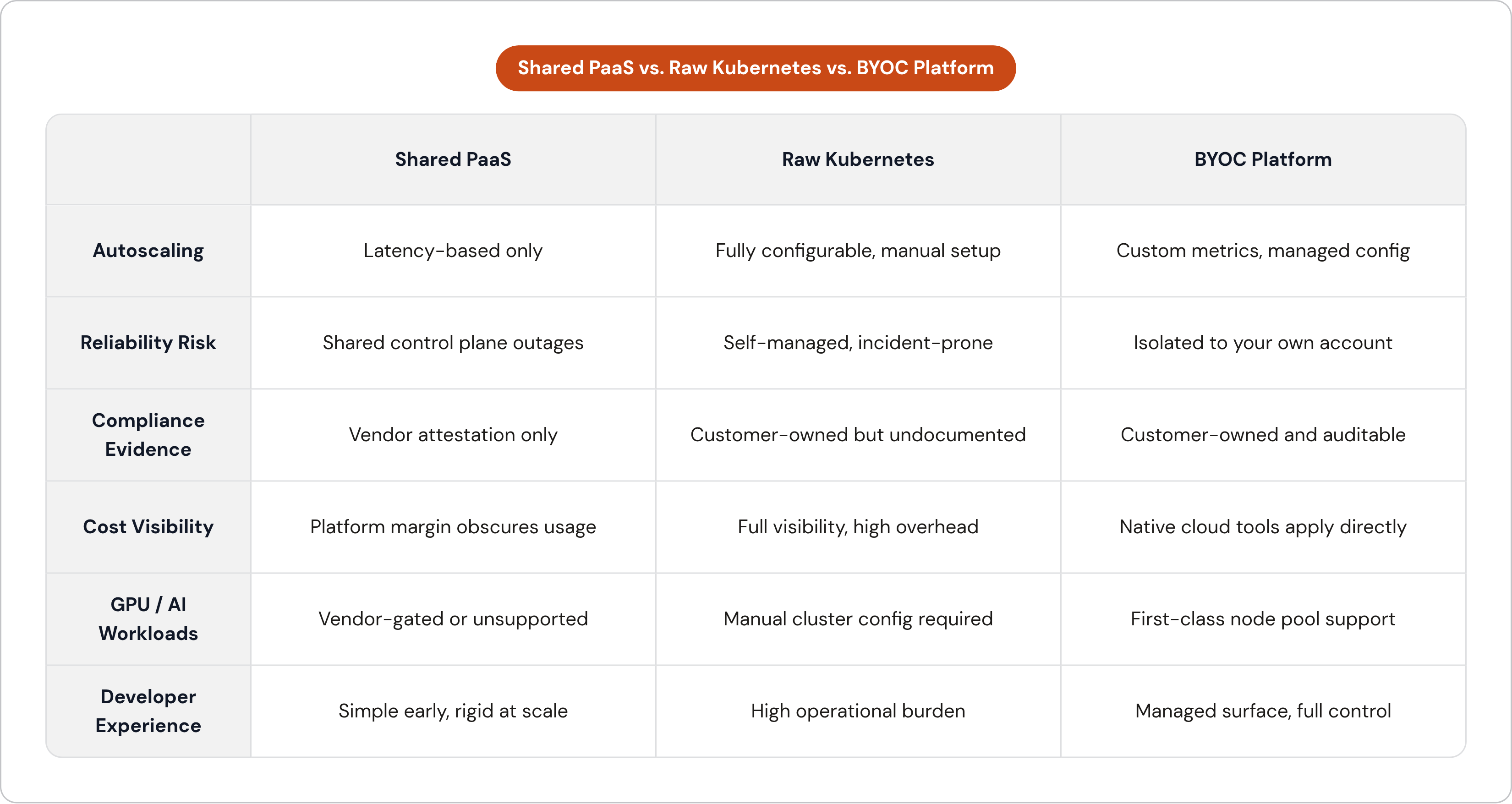
Autoscaling is usually first. Shared platforms scale on latency, which covers a narrow band of workload types. If your service needs to scale on queue depth, GPU utilization, or a custom application metric, you're working against the platform. The metric you need isn't exposed, and the cluster configuration that would expose it isn't yours to touch.
Microservice architectures compound this. Internal networking, sidecar injection, per-service traffic policies: these are cluster-level concerns, and a shared-tenant model grants no cluster-level access by design. Teams that outgrow a single service start building workarounds at the application layer to compensate for infrastructure they can't configure. That's the wrong abstraction boundary. You don't realize how wrong until you've spent three hours debugging a networking issue that would have been a two-line config change in a cluster you actually owned.
The reliability record of shared platforms is a legitimate operational concern that doesn't get discussed honestly enough. When a shared control plane degrades, every tenant degrades simultaneously. You have no visibility into what failed, no ability to intervene, no independent infrastructure to fall back on. For staging, that's tolerable. For a production critical path, it's a risk concentration that's genuinely hard to justify after your first extended outage, when you're staring at a status page you didn't build and your users are asking questions you can't answer.
Compliance is where shared-tenant models hit a structural wall. SOC 2 and HIPAA auditors want evidence of data isolation at the infrastructure level. On a shared platform, that evidence is difficult to produce because the isolation isn't the customer's to document. The vendor's attestation covers the vendor's controls. Your auditor wants your controls. That gap shows up as a recurring finding until you fix the underlying architecture.
Cost structure follows the same trajectory. Shared PaaS pricing is convenient early on and increasingly unfavorable as workloads scale. You're paying cloud costs plus platform margin, with limited visibility into actual resource utilization underneath. At some point the margin stops being the price of convenience and starts being just cost, and you've lost the tooling to do anything about it.
The Operational Cost of Going Directly to Raw Kubernetes Without a Platform Layer
Raw Kubernetes is not a platform. It is the substrate on which a platform is built, and teams that treat it as a finished product discover the difference in headcount and incident rate, usually within the first quarter of running production traffic.
Managing production Kubernetes without automation requires dedicated engineering attention that most teams underestimate before they're inside it. Cluster upgrades, node patching, certificate rotation, secret rotation, ingress configuration, network policy enforcement: these are recurring operational tasks, not one-time setup costs. The tooling sprawl that accompanies them, multiple CI systems, overlapping monitoring stacks, inconsistent environment configuration, multiplies the burden in ways that are genuinely hard to anticipate.
The anti-patterns small teams fall into are recognizable if you've watched enough of them. They adopt too many overlapping tools before settling on a workflow. They build custom internal tooling before the product has validated its market. They over-engineer for hypothetical scale, running multi-region clusters for products with a regional user base. Each of these decisions accumulates technical debt that gets paid down by the same team that accrued it, at the worst possible time.
Practitioners who have migrated from managed PaaS platforms to raw Kubernetes without adding an abstraction layer describe a consistent outcome: deploys that once completed in under a minute start taking hours, engineer time shifts toward infrastructure, and production incident rates climb. The remedy in those cases is rarely "go back to a simple PaaS." It's usually "add a smarter abstraction on top of Kubernetes." The team still runs on Kubernetes; they stop managing it manually.
There's a rough threshold in practitioner experience where informal DevOps practice breaks down, somewhere around thirty engineers. Below that, unstructured Kubernetes operations are a persistent drag on everyone's attention. Above it, a formal platform layer becomes necessary for coordination alone, before you even account for compliance or cost governance. Raw Kubernetes and shared PaaS are both wrong answers to this problem. The right answer is a platform that deploys into your own cloud account and absorbs the operational surface area your team shouldn't be owning.
How BYOC Architecture Changes What a PaaS Can Offer on Reliability and Control
Bring-your-own-cloud architecture shifts the model in a structurally meaningful way. Instead of running workloads on the vendor's shared infrastructure, the PaaS provisions and manages a Kubernetes cluster inside the customer's own AWS, GCP, or Azure account. The developer experience stays managed. The infrastructure is yours.
On reliability, the implications are direct. A degradation on the PaaS vendor's shared control plane doesn't cascade into your workloads, because your workloads run on your infrastructure. Cluster configuration, node pools, and network architecture live in your cloud account and don't vanish if you change vendors. SLAs become verifiable, because you can actually observe the infrastructure those SLAs describe, rather than trusting a status page you have no power over.
The control story is just as concrete. Custom metrics-based autoscaling works because the cluster is yours to configure. Internal service networking, advanced ingress rules, and sidecar injection are accessible. GPU node pools are a configuration option rather than a vendor-gated feature. Cloud provider commitment discounts, reserved instances, and savings plans apply directly to your bill.
Compliance is where the BYOC structural argument is cleanest. Data doesn't leave the customer's cloud account. The auditor reviews your VPC, your IAM policies, your audit logs. You document your own controls. That's the evidence a SOC 2 or HIPAA auditor actually wants, and it's evidence you can produce without filing a support ticket asking your vendor to write documentation on your behalf.
Deployment Velocity: What a PaaS Layer Should and Shouldn't Abstract
The target is simple: a developer pushes code and a production deploy completes without opening a cloud console, writing a manifest, or waiting through a manual approval queue. The PaaS either delivers this or it doesn't.
CI/CD integration is non-negotiable. The platform must connect natively to the repository and trigger builds without requiring a separately maintained pipeline. If a different team owns the CI system, velocity is constrained by inter-team coordination rather than engineering capability, and that friction compounds in ways that are invisible until you're scheduling standups just to coordinate deploys.
What should be abstracted is well-defined. Manifest generation belongs inside the platform: developers describe what they want in terms of replicas, memory, and environment variables rather than Kubernetes YAML. Rolling deploy logic, health checks, and readiness gates should run without developer intervention. Rollback should be one action rather than a kubectl workflow. Preview environments, per-pull-request deploys for staging review, should be available without provisioning separate clusters.
What shouldn't be hidden is equally important. Deploy logs and build output must be visible. When an incident happens, opacity in the deploy pipeline extends the time to diagnosis, and in a production incident every minute of opacity has a real cost. Resource configuration, CPU limits, memory limits, should be editable by developers rather than locked behind a support ticket. Service dependencies should be exposed rather than papered over. A platform that obscures how services connect to each other makes networking problems harder to debug regardless of how clean the developer experience looked on day one. I've watched teams spend days on incidents that would have taken an hour if the platform hadn't been so committed to hiding what was happening underneath.
Compliance as a Platform Capability, Not an Engineering Project
SOC 2 and HIPAA are prerequisites for selling to enterprise customers, healthcare organizations, and any company with a mature vendor risk function. A team that defers compliance until after a contract is signed risks losing that contract. Most teams learn this once.
What compliance actually requires from a Kubernetes deployment is specific. Audit logging must capture all cluster activity and configuration changes. Network segmentation must isolate workloads that handle sensitive data at the infrastructure level. Secrets management must route credentials through a dedicated secrets store rather than through environment variables visible in container logs. CVE patching must happen on a documented cadence, because unpatched nodes are an automatic finding in most audit frameworks. Role-based access control must be enforced at the cluster level rather than only at the application layer.
The BYOC compliance advantage comes from structural clarity. Because the infrastructure lives in the customer's account, the auditor's review stays within the customer's control boundary. VPC configuration, IAM policies, CloudTrail logs: all of it is visible and documentable by the team being audited. That is materially different from asking an auditor to accept a shared-tenant vendor's attestation as a substitute for customer-owned evidence. Auditors, in general, do not love that substitution. Some of them will tell you so directly.
CVE patching gets underestimated almost universally. In a self-managed cluster, patching requires identifying affected nodes, scheduling maintenance windows, coordinating workload migration, and documenting the remediation, then doing it again next cycle, indefinitely. A platform that handles patching automatically converts a recurring audit risk into a configuration state the platform maintains. Teams that haven't been through a major CVE response cycle tend not to appreciate this until they're in one.
Platforms that run on shared infrastructure leave customers unable to close the data-isolation question on their own. That gap surfaces in enterprise due diligence, and it costs deals.
Cost Control in Production Kubernetes and Where PaaS Platforms Help or Obscure It
The cost problem in production Kubernetes isn't pricing tier selection. It's resource waste from over-provisioning and idle compute that nobody is watching closely enough to catch.
Shared PaaS platforms add a margin layer on top of cloud costs and offer limited visibility into the resource utilization underneath. That trade becomes expensive as workloads scale, because the levers that would reduce spend are inaccessible by design. Most teams running on a shared PaaS have no real idea what their workloads cost to run, only what they're being charged, and those two numbers are not the same.
BYOC platforms restore that visibility. The cloud bill is your bill, and native cost management tools from AWS, GCP, and Azure apply directly. You can see which node pools are over-provisioned, which services are idle, which workloads are consuming resources disproportionate to their actual demand.
Over-provisioned node pools are the most common source of avoidable spend. Autoscaling configured on the wrong metric keeps nodes running when demand has dropped. Idle nodes in non-production environments, provisioned for a sprint and never terminated, accumulate cost silently, sometimes for months. I've seen teams discover five-figure monthly waste from environments that outlived the engineers who created them. These are tractable problems with the right visibility; they're invisible without it.
For AI workloads, GPU rightsizing is a significant lever. Running lightweight inference workloads on full dedicated GPU instances is a common and expensive default, the kind of thing that happens when the person who provisioned the infrastructure has moved on and nobody wants to touch the configuration. Fractional GPU allocation is mature enough for production use now, and the cost difference between a well-configured inference deployment and a poorly configured one can be substantial. A platform that surfaces rightsizing recommendations and automates bin-packing may offset its platform fee. One that provisions and walks away does not.
Pricing model transparency is also worth reading carefully. Resource-based pricing, where you pay for what runs, aligns the vendor's incentives with yours. Seat-based or app-count-based pricing does not, and the divergence becomes visible at exactly the wrong moment.
GPU and AI Workload Requirements That General-Purpose PaaS Platforms Miss
AI infrastructure is a distinct category, and treating it as a variation on web application deployment costs real time and money. Inference serving, training jobs, and rapid model iteration impose requirements that differ structurally from anything general-purpose PaaS platforms were designed around.
GPU node pool provisioning must be first-class. A team serving an inference workload needs to select specific GPU SKUs, H100, A100, L4, L40S, based on the model's memory footprint and throughput requirements. If that selection requires custom node annotations or manual cluster configuration outside the platform, the platform isn't serving the use case.
Training runs are batch jobs with a defined lifecycle: they start, they finish, and the infrastructure should scale to zero when they're done. Most PaaS platforms are oriented around long-running services, because that's what the majority of their customers run. A platform that handles both workload types without requiring separate infrastructure paths reduces operational surface area in a way that matters at 2am when something is failing and you're trying to figure out which of your two systems is the problem. Maintaining a separate infrastructure path for training jobs and another for serving is exactly the kind of overhead that accumulates invisibly until it's consuming a meaningful fraction of your platform engineering time.
Inference serving has its own autoscaling requirements. Latency and throughput thresholds for inference differ from those for web traffic, and scale-from-zero matters for cost control when demand is variable. The platform must support autoscaling configurations that reflect those workload characteristics rather than generic HTTP traffic patterns.
Rapid model iteration surprises teams who haven't done it before. Model deployment cycles are shorter than software release cycles. Serving configurations change frequently. A platform that requires manual infrastructure work for each update introduces friction at exactly the point where the team needs to move fast.
GPU pricing varies considerably across cloud providers. Hyperscalers offer broad availability, mature tooling integration, and commitment discount structures. Specialized GPU cloud providers can offer competitive per-hour pricing and faster provisioning for bare-metal configurations. For inference specifically, cost-per-token is a more actionable optimization target than cost-per-GPU-hour, because it connects infrastructure cost to the unit of business output. A platform or tooling layer that exposes this metric enables optimization decisions that raw pricing data alone cannot support.
The Capabilities That Separate Production-Ready PaaS Platforms from Developer Conveniences
A developer convenience tool optimizes for time-to-first-deploy. A production-ready PaaS optimizes for the hundredth deploy, the first security audit, and the first production incident at 3am when your on-call engineer is trying to roll back a broken release without cluster access. Those are different optimization targets, and they produce different platforms. The failure mode of confusing them is quiet at first and expensive later.
Start with reliability. The platform must deploy into the customer's own cloud account rather than shared infrastructure. Cluster upgrades and node patching must be handled automatically rather than delegated back to the engineering team as a periodic project that always gets deprioritized until it becomes urgent. Rollback must be a single action rather than a manual kubectl sequence that presupposes the on-call engineer has cluster access and knows which revision to target. Most convenience-oriented platforms don't think carefully about the rollback case until a customer is in a production incident and suddenly it matters a great deal.
Deployment velocity matters too, but the details are where platforms diverge. Native CI/CD integration is required: a repository push triggers build and deploy without a separate pipeline team. Preview environments for pull requests must be available without provisioning separate clusters. Developers must be able to configure services without writing manifests or opening cloud consoles, while retaining visibility into logs, resource configuration, and service dependencies. Convenience-oriented platforms tend to sacrifice visibility in the name of simplicity, and that's precisely what you miss most when something breaks at the worst hour.
Compliance and security can't be afterthoughts bolted on later. Audit logging and network isolation must be enforced at the infrastructure level. CVE patching must happen on a maintained, documented cadence. SOC 2 and HIPAA compliance posture must be achievable within the platform's architecture rather than deferred to a separate engineering project that re-executes every audit cycle. If a platform requires you to build a parallel compliance layer, it hasn't actually solved the problem.
Cost control is often what determines whether a platform stays in place long-term, which makes it worth evaluating carefully upfront. Resource-based transparent pricing aligns vendor incentives with customer incentives. Autoscaling must be configurable on the metrics that reflect actual workload demand. For GPU workloads, fractional allocation and scale-to-zero must be supported. Convenience tools hand you a bill. Production platforms give you the levers to manage one.
The platforms that clear these bars aren't developer-experience tools that grew up. They are infrastructure platforms that chose to present a developer-friendly surface without compromising on the controls that production requires. You feel the difference the first time something goes wrong.