Heroku Alternatives for Startups That Have Outgrown Dynos
Match your pain point to the right platform before you jump ship.
I've watched this pattern play out at three different companies now. Startups don't leave Heroku all at once, they hit one specific wall and stop. Maybe finance flags the bill. Maybe an outage costs you a customer who was already on the fence. Maybe a security review comes back with a requirement Heroku's architecture just can't meet. Which wall you hit first tells you which alternative actually fits, and most of the advice floating around skips that step and jumps straight to "just use Render."
Heroku's whole pitch was a trade: hide the cloud, flatten the learning curve, let three engineers ship product without anyone on staff who knows what a VPC is. That trade held up for a solid decade. It's aging badly now, mostly because dyno pricing scales in a straight line with zero efficiency built in, because the outages in mid-2025 ran for hours with no real visibility into what broke, and because the abstraction layer that used to be the whole selling point now makes private networking or a clean audit trail almost impossible to set up. Salesforce moved Heroku into what it calls a sustaining engineering phase in early 2026. Translated out of corporate speak, that means no more feature bets, just keeping the lights on. Add the 2022 death of the free tier, and what's left running on Heroku today is mostly teams that outgrew it years ago and never got around to leaving.
Why the "just switch to Render" advice often misses the point
Render comes up in every one of these conversations. I get it: Git-connected deploys, managed databases, a mental model that feels like Heroku with the rough edges sanded off. Put the feature lists side by side and the overlap looks almost total.
Here's what that comparison misses. Render also runs on shared infrastructure. It sits on AWS, charges fixed monthly pricing per service, and abstracts the cloud underneath it in a way that's structurally close to what Heroku already does. A team that hit Heroku's cost ceiling might find Render's pricing familiar; familiar isn't the same as cheap once you're running at real scale, though. And a team that hit the compliance wall, needing infrastructure inside their own cloud account with private networking and an audit trail that actually reflects their environment, hits the same wall on Render. Render's SOC 2 Type II certification covers Render's infrastructure. It does not cover yours. That distinction becomes very expensive to explain once you're mid-deal and the buyer's security team starts asking pointed questions.
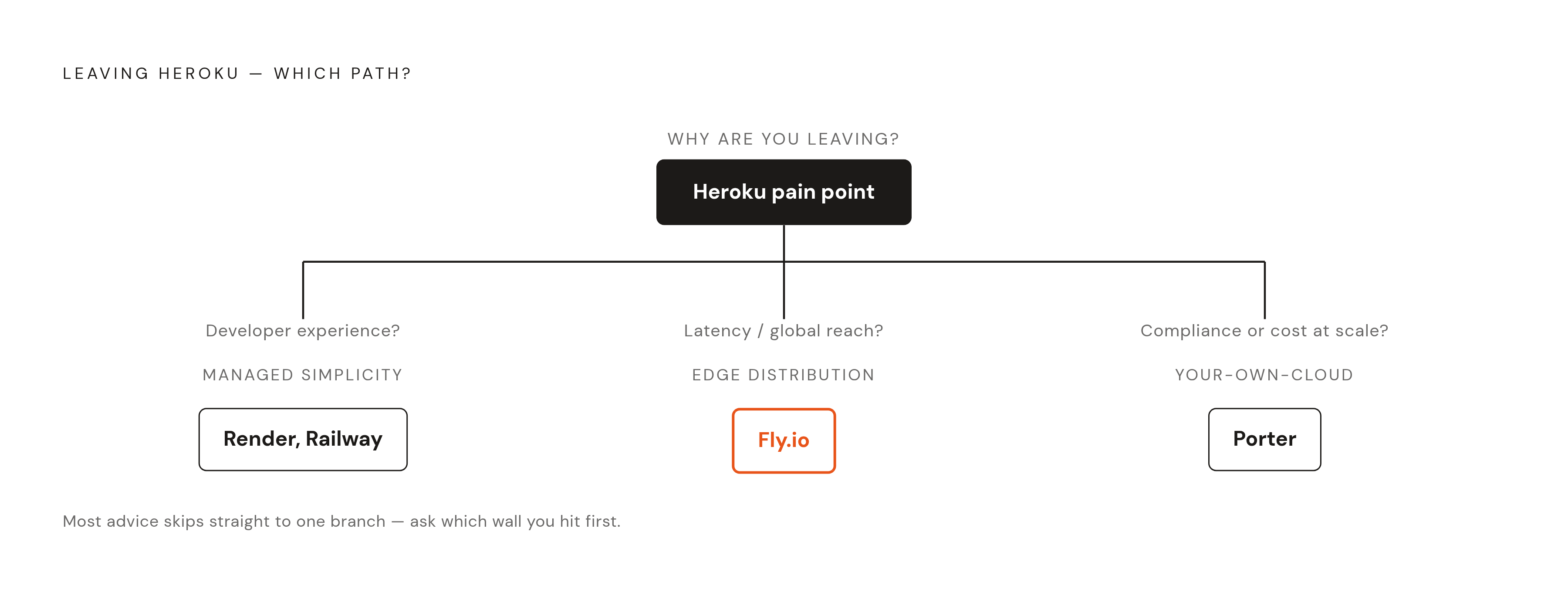
Skip the "which platform feels most like Heroku" question. Ask what kind of infrastructure control you need next. Three philosophies map onto three different pain points: managed simplicity on shared infrastructure (Render, Railway) for teams whose complaint is really about developer experience and not compliance, edge and global distribution (Fly.io) for teams whose users are scattered across the planet and latency is the thing actually hurting them, and your-own-cloud platforms (Porter) for teams whose pain is compliance, cost at scale, or just not wanting to hire a DevOps team to babysit Kubernetes.
What each alternative is actually optimized for
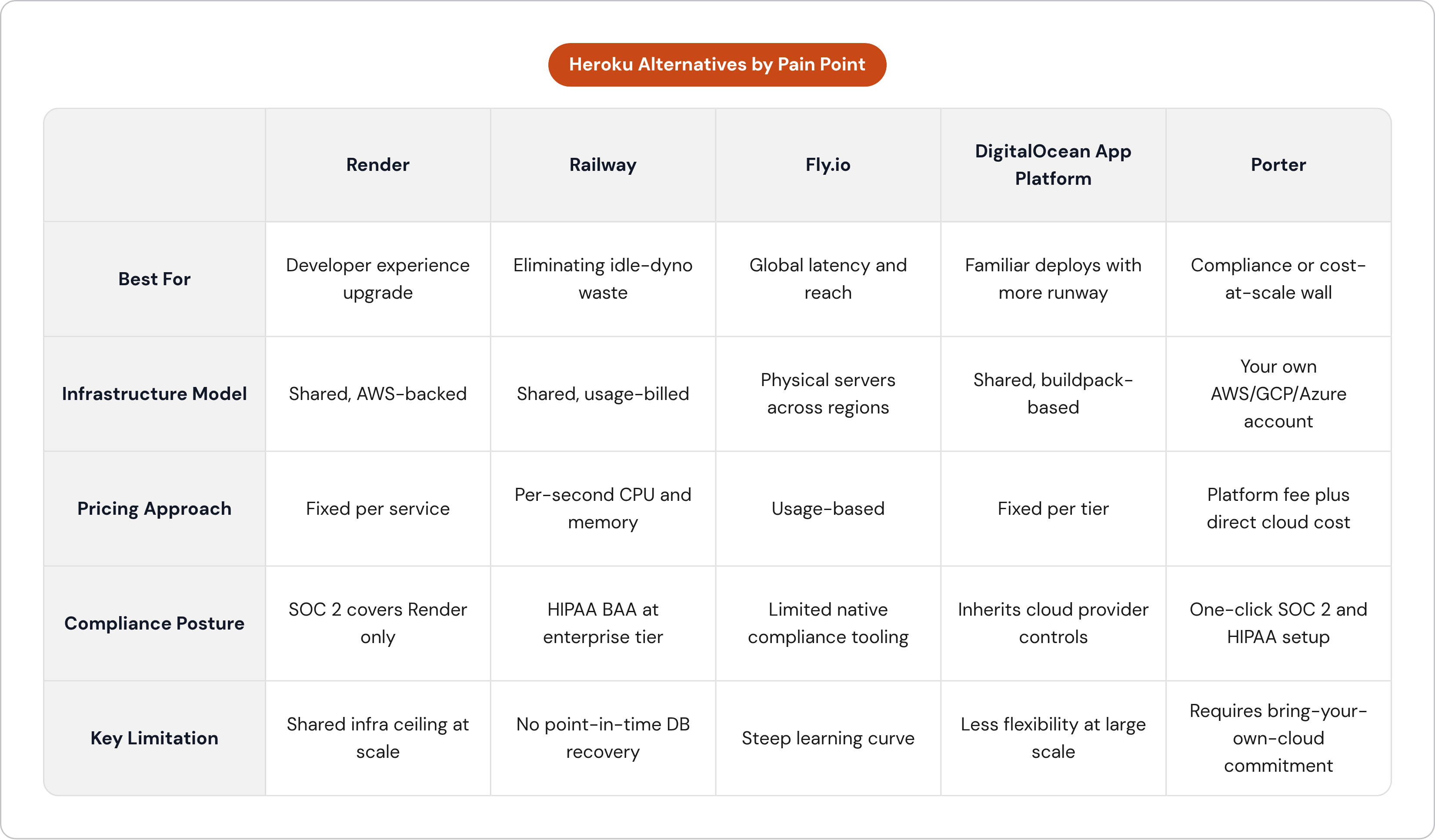
Render fits teams leaving Heroku purely for developer-experience reasons. Fixed monthly pricing per service, Cloudflare protection built in, SOC 2 Type II on Render's own house. It's a smaller company than people assume, though, and I've seen teams hit latency and build-time headaches right when traffic starts climbing. Shared infrastructure only stretches so far.
Railway makes sense if you want usage-based billing, paying for what you actually burn instead of a dyno idling around doing nothing, and you're not yet touching regulated data. It bills by the second for CPU and memory, which kills the idle-dyno waste problem outright. The database layer is where it gets shaky: no point-in-time recovery, no read replicas, no automated failover on the standard tiers. An experimental high-availability Postgres option showed up in early 2026, but Railway itself calls it not production-ready. There's a HIPAA BAA at the enterprise tier, sure, but pair that with the database gaps above and you've got real exposure if you're holding health data.
Fly.io earns its keep when the pain is latency and global reach specifically. It deploys onto physical servers spread across regions instead of parking everything in one cloud provider's data centers, and it's Docker-native with more visibility than Heroku or Render ever gave you. The learning curve is steeper, though. This is not a lift-and-shift; the model underneath is genuinely different.
Vercel and Netlify are great for frontend-heavy work, Next.js and JAMstack builds especially, but neither is a general Heroku replacement. Serverless functions and edge computing weren't built for long-running processes, worker dynos, or stateful backend services. Don't force that fit; it won't hold.
DigitalOcean App Platform runs on Cloud Native Buildpacks, the same architecture that made Heroku's deploy model work in the first place, so Procfile-based apps tend to move over without much drama. From there, the path to more control runs through Droplets, Managed Databases, or Kubernetes as you grow into it. Solid middle ground if you want the familiar deploy feel with a clearer runway than Heroku ever offered.
Self-hosted options like Dokku, CapRover, and Coolify are the zero-platform-cost route. Dokku is basically Heroku running on a server you own, and it works fine for a small team with light traffic and some tolerance for doing their own ops. CapRover runs on Docker Swarm, which handles horizontal scaling across nodes, though Swarm itself is aging out; most of the industry moved to Kubernetes years ago. The trade is blunt: no platform fee, but you own the entire ops burden. Pick this path only if cutting DevOps overhead was never the point.
Some platforms fit teams that hit the compliance or cost-at-scale wall and need infrastructure living inside their own AWS, GCP, or Azure account, without staffing a team to run Kubernetes by hand. They deploy production-ready Kubernetes straight into the customer's own cloud account and keep a Heroku-like developer experience layered on top: VPC setup, CI/CD, autoscaling, CVE patching, one-click SOC 2 and HIPAA posture. Pricing is resource-based with a bring-your-own-cloud tier, so you pay for the platform and your cloud provider for compute directly, with no shared-tenant markup hidden in the bill. These options can also handle GPU workloads out of the box, which matters a lot more than it did two years ago.
How the compliance wall specifically blocks growth and what clears it
SOC 2 and HIPAA aren't paperwork exercises you knock out to check a box. They're the gate you walk through before an enterprise buyer, a hospital system, or basically any customer with a real security review will sign. Heroku's shared infrastructure runs into specific trouble here: there's no way to isolate workloads inside a dedicated VPC, network controls are thin enough that perimeter-based compliance is close to impossible, and Heroku's own compliance scope covers Heroku's infrastructure, never your data environment.
There's a real gap between a platform that is SOC 2 certified and one that gets you SOC 2 certified. Render's SOC 2 Type II status means Render's own infrastructure passed an audit; you still have to build and prove your own controls on top of it, from scratch. A platform that deploys into your own cloud account can configure your environment to compliance standards as part of the deployment itself, including one-click SOC 2 and HIPAA setup. HIPAA specifically demands a signed Business Associate Agreement. Railway offers one at the enterprise tier, but stack that against the database gaps mentioned earlier, no point-in-time recovery, no automated failover on standard tiers, and you're carrying real exposure for anything touching health data. If you're racing a compliance deadline, the fastest path is a platform that deploys into your own cloud account and pre-configures the controls, not one where you're bolting compliance onto infrastructure that was never designed with your audit in mind.
The cost math that makes Heroku's dyno model break at scale
Dynos are fixed allocations. You pay for one whether it's handling a thousand requests a second or sitting there completely idle. At low scale that overhead barely registers. At growth stage it compounds fast: I've seen monthly Heroku bills climb into the tens of thousands well before a company has the headcount to justify building its own infrastructure team. Horizontal dyno scaling is simple, but it's a blunt tool. No autoscaling tied to actual load, no scaling to zero, no fractional resource allocation.
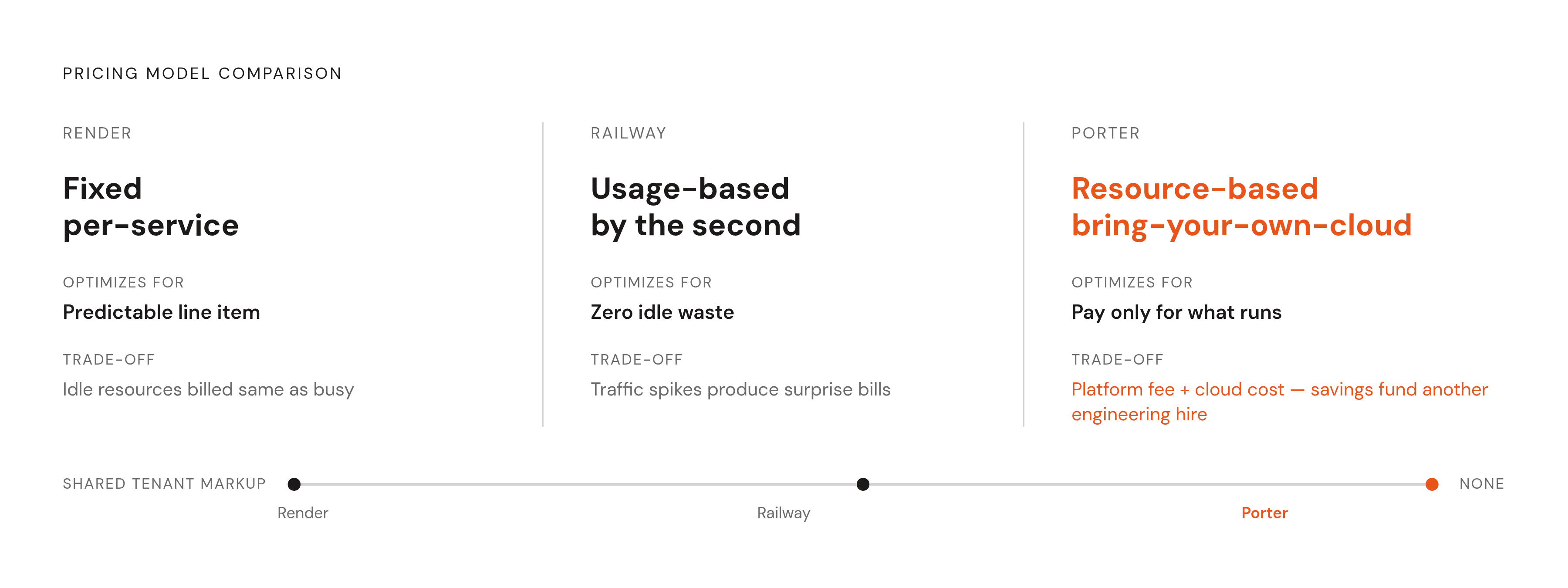
Three pricing models compete in this market, and each optimizes for something different. Fixed per-service pricing, Render's approach, gives you a predictable line item, but an idle resource costs exactly what a busy one costs. Usage-based billing by the second, Railway's approach, kills idle waste but can hand you a surprise bill during a traffic spike. Resource-based, bring-your-own-cloud pricing means a platform fee plus your actual cloud cost with no shared-tenant markup baked into the compute, so you pay for what actually runs and nothing else. CNCF's 2024 survey lists cloud cost predictability as one of the top infrastructure concerns engineering teams weigh when picking a platform, and that tracks with what I hear from teams making this switch. There's a compounding cost too, easy to miss: Heroku add-ons, Postgres, Redis, logging, each carry their own pricing tier, and at scale the add-on stack often ends up costing close to what the dynos themselves cost. Bring-your-own-cloud pricing strips out that layer of margin that shared-tenant platforms quietly build into every resource unit. At real scale, that difference is big enough to fund another engineering hire.
What a migration off Heroku actually involves, step by step
The most common mistake is treating this as a rehost when it should be a replatform. Lift-and-shift just recreates Heroku's constraints somewhere else, under a different logo. Replatforming uses the move as a chance to actually fix what was broken.
Four pitfalls show up again and again. Recreating add-ons carelessly tops the list; databases need real replication and maintenance windows, and Postgres extension compatibility needs checking before cutover, not after something breaks in production. Missing observability is next: logs, metrics, and tracing need to be wired up before traffic flips over, not once an alert fires at 2am. Over-provisioning on arrival is the third: start conservative, gather real usage numbers, then size up. Don't copy Heroku's waste onto the new platform out of habit. And security drift rounds it out: CORS rules, rate limits, WAF configuration, secret management, none of it carries over automatically from Heroku's defaults, and all of it needs explicit reconfiguration. Worker dynos deserve their own mention here too. Map them to whatever the new platform calls its equivalent, Render background workers, Cloud Run jobs, Kubernetes CronJobs, before cutover, or those jobs quietly stop running and nobody notices for a week.
A phased approach cuts the risk down considerably. Wave one: rehost, get the app running on the new platform with minimal changes. Wave two: replatform the database, move to managed Postgres with proper replication, using something like AWS DMS with logical replication to keep downtime low. Wave three: refactor the highest-traffic services into autoscaling containers or serverless, since that's exactly where the dyno model was bleeding the most money. For the actual cutover, weighted DNS routing (Route 53 weighted records shifting traffic gradually) lets you roll back at any point and catch problems before they hit everyone at once. Platforms in this category handle VPC setup, cluster configuration, and CI/CD wiring directly; your team deploys containers, the platform manages the infrastructure layer underneath, and weeks of DevOps work compress down to a few days.
Where AI workloads break the dyno model even faster
AI startups hit Heroku's ceiling earlier and harder than a typical web app ever does. GPU workloads just don't map onto dynos, full stop, and inference serving needs scale-to-zero behavior that Heroku's architecture was never built to support.
Two genuinely different problems hide under the "AI infrastructure" label, and they get treated as one problem far too often. Training and fine-tuning runs long, needs to be fault-tolerant, and spreads compute across multiple GPUs or nodes; burst capacity matters more here than steady-state uptime does. Inference serving is the opposite: continuous, sensitive to latency down to the millisecond, has to absorb traffic spikes without falling over, and needs to scale down to nothing the moment it's idle. Serverless GPU platforms are built for exactly that second problem. GPU compute now eats a large chunk of the typical AI startup's infrastructure budget, so a platform that handles it badly isn't a minor annoyance, it's a hard ceiling on what the product can actually do. The serverless GPU market has grown fast on this exact bet: companies like Modal have reached multibillion-dollar valuations betting that developers want GPU power without managing the infrastructure underneath, which is more or less the same wager that made Heroku work for web apps a decade ago.
For AI startups that need both GPU support and a real compliance story, healthcare AI or enterprise AI selling into regulated buyers especially, bring-your-own-cloud becomes the only approach that satisfies both at once. GPU support inside the customer's own cloud account means inference deployments skip the custom tooling built from scratch, and the compliance posture holds the entire time. Here's the actual fork: if you're doing pure inference serving at scale, look at serverless GPU platforms like Modal, Fireworks, or the Together AI ecosystem. If you've got mixed workloads, inference plus backend plus a compliance requirement sitting on top of both, you want a PaaS running in your own cloud account with GPU support already built in.