Render vs Railway for Early-Stage Startups
Railway's visual interface and usage-based pricing favor early-stage teams with variable traffic.
Railway's interface is a visual project canvas; services, databases, and the connections between them appear as a graph, not a list. Environment variables reference each other directly across services. The mental model is a network, and if you've spent time wiring up microservices in YAML, seeing that topology rendered visually can be clarifying. The build system, Nixpacks and Railpack, detects languages and frameworks automatically; no Dockerfile, no webhook configuration required. Deploy time for a typical Node.js application is generally faster than traditional CI/CD pipelines, though project size and configuration will affect that number.
Railway also owns its underlying bare-metal infrastructure through Railway Metal rather than reselling hyperscaler capacity. According to Railway's published pricing documentation, that choice allows them to offer lower egress and storage costs. The tradeoff buried in that decision becomes relevant later, in the reliability section, but the billing reflects their stated model.
Another approach is organized around a different principle entirely. Some platforms deploy into your own cloud account, whether AWS, GCP, or Azure, and wrap that infrastructure with a PaaS abstraction layer. Infrastructure configuration lives in version-controlled files; one-click deploy reproduces the full environment exactly. The architectural choice here is about the moment you hand infrastructure to a second engineer, or the moment an auditor asks where your data lives and who controls it.
What You Actually Pay on Each Platform, and What the Pricing Model Hides
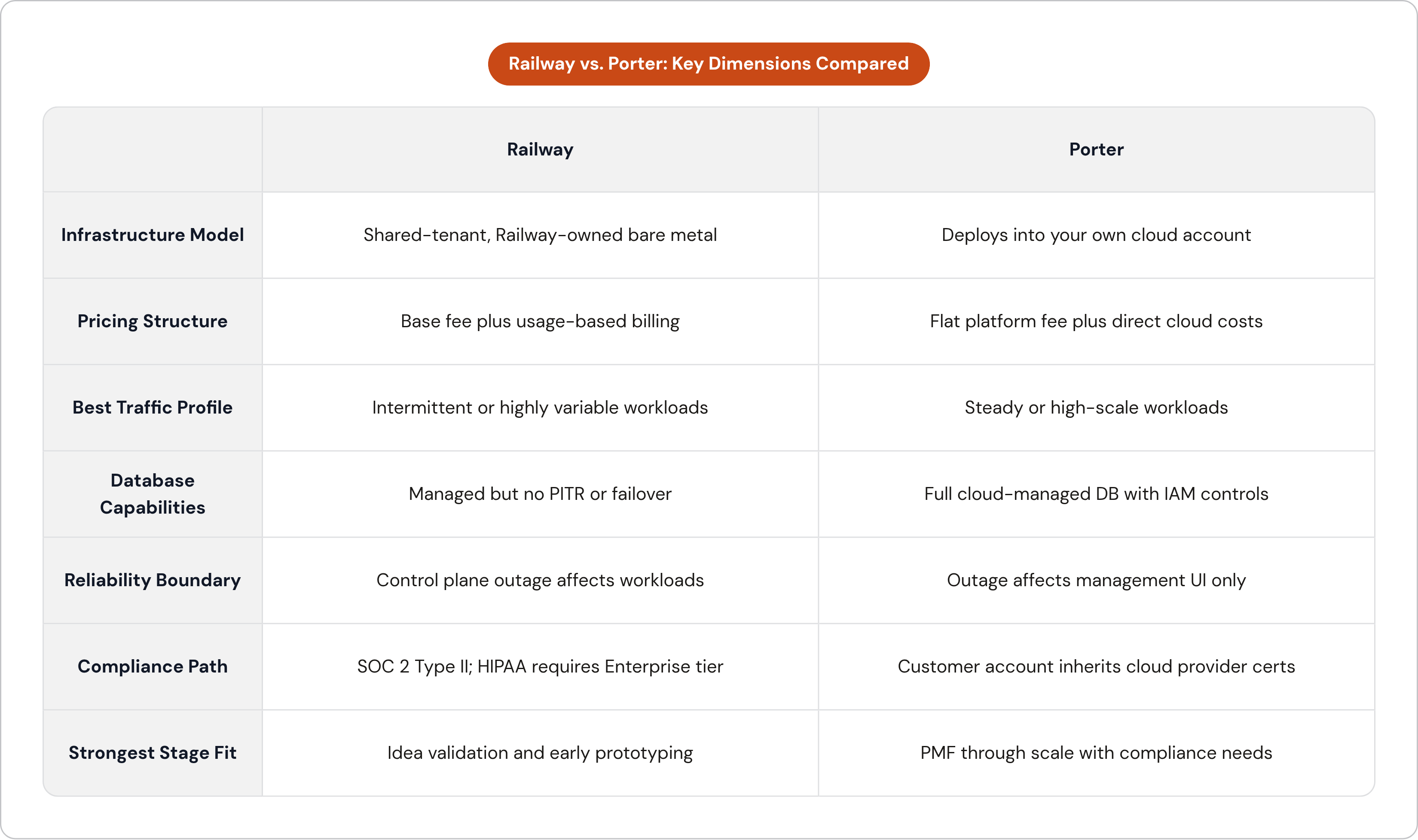
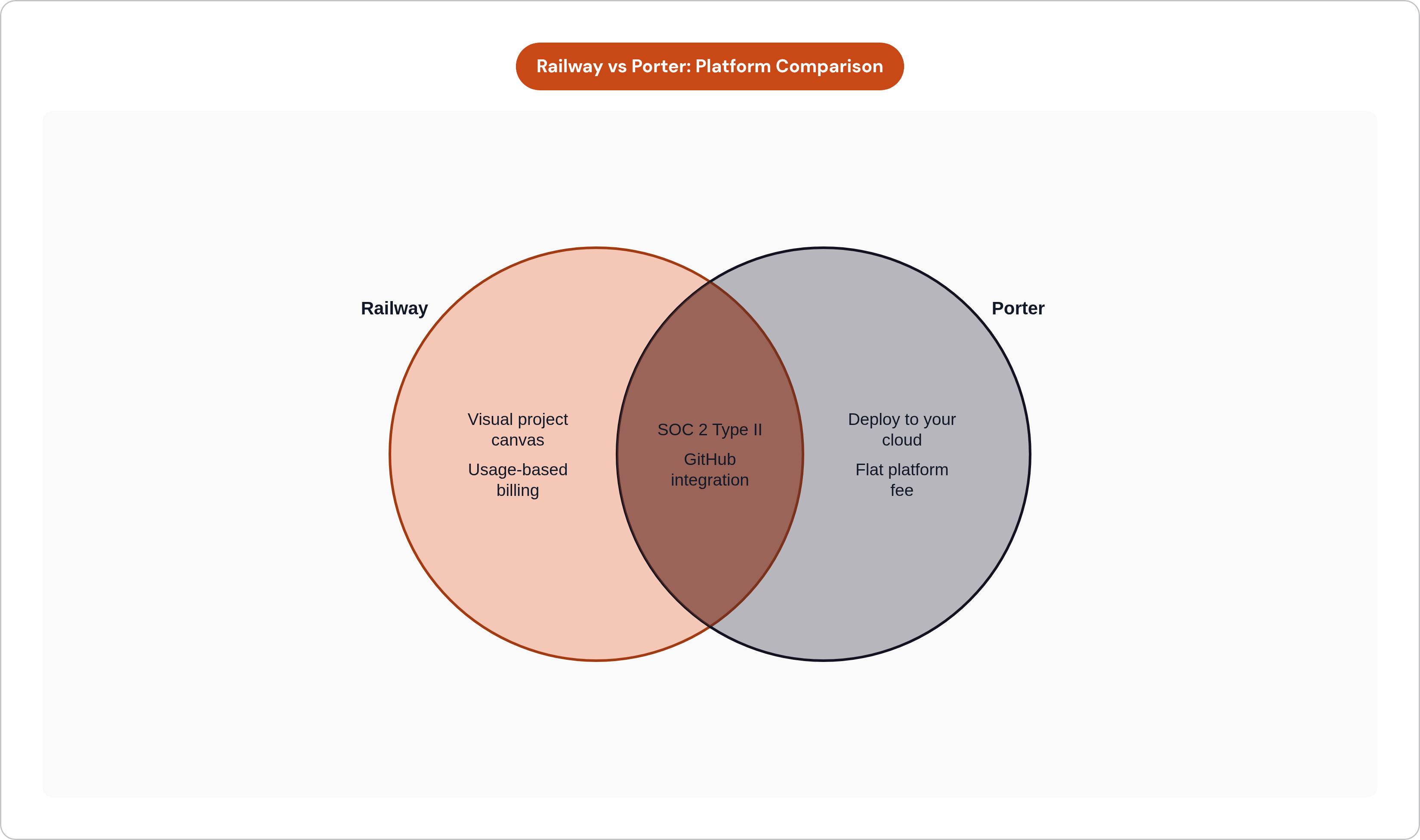
Railway charges a monthly base subscription plus usage costs billed on actual CPU and memory consumed. According to Railway's published pricing, idle services cost very little; the base fee functions as a credit that absorbs light workloads. Teams in early validation with intermittent traffic may pay relatively little in practice, depending on their usage.
This kind of platform's pricing reflects its deployment model. You pay a platform fee and pay your cloud provider directly for the underlying compute. That separation means your infrastructure costs are visible, attributable, and negotiable through your existing cloud relationships. Compute is not marked up within the platform fee.
The practical split comes down to traffic profile. Railway's usage-based billing favors intermittent, low-traffic, or highly variable workloads. The direct-billing model favors teams operating at a scale where infrastructure spend is already a line item worth managing separately from platform cost. For teams running many services simultaneously, the economics shift further still. On shared-tenant platforms, per-service charges accumulate; on a platform using this model, the platform fee stays flat while compute scales with actual usage through your cloud provider.
Day-to-Day Developer Experience: Where Railway Moves Faster and Where the Alternative Catches More
Railway's deployment speed is fast; connect GitHub, push code, receive a live URL. The canvas UI updates in real time; multiple team members see logs, deployment state, and service topology without refreshing. Per-branch preview environments spin up automatically with no pipeline configuration required. Railway has stated on its roadmap a focus toward AI-native development workflows, where tools like Claude Code and Cursor can drive deployments without a human intermediary. Whether that matters to you depends entirely on how your team works.
The deployment experience prioritizes momentum over configuration. That is an advantage during idea validation, when the primary job is determining whether something works before investing further.
A bring-your-own-cloud PaaS that deploys into your own AWS, GCP, or Azure account operates at a different layer. The tooling surfaces things that shared-tenant platforms abstract away: actual infrastructure state, cost attribution per service, and the control plane operations that are otherwise invisible until something breaks. Deployment logs are detailed; environment variable management is structured; monitoring is integrated. Operators who have dealt with limited visibility during incidents on shared-tenant platforms may find the additional transparency useful. It is the difference between watching weather through a window and reading the barometer yourself.
This kind of platform also supports long-running workloads without the timeout constraints that affect some shared-tenant platforms. Cron jobs run as properly scheduled infrastructure; for teams building data pipelines, file processing services, or anything that takes longer than a few minutes to complete, native support eliminates a category of workarounds.
Database Capabilities and What They Mean for Teams That Want Managed Postgres Without an Ops Burden
Railway's database layer offers Postgres, MySQL, Redis, and MongoDB, deployed as containerized services with preconfigured defaults. The on-ramp is fast and the configuration surface is minimal; for early prototyping, that is often sufficient.
The limitation emerges when production requirements arrive. According to Railway's documentation, point-in-time recovery, read replicas, and automated failover are not available in Railway's native database layer. Teams that need those capabilities on Railway are directed toward external managed database providers, which adds a dependency and a billing relationship outside the platform.
The alternative approach is architecturally different. Because it deploys into your own cloud account, you can provision managed database services from your cloud provider directly, such as AWS RDS, Aurora, or Cloud SQL, and connect them to platform-managed application services with full IAM and network controls. For teams building AI workloads that require pgvector or embedding-based search, this means running a managed Postgres instance with the extensions you need, inside your own network perimeter, without routing around the platform's database layer.
The direct implication: if your application's data layer is a primary concern, the question is not just which platform has better Postgres. The question is whether you want your database in a shared-tenant environment at all; for teams anticipating compliance requirements or enterprise data contracts, the architecture you choose now affects the migration cost you pay later.
Reliability and the Incident Record That Railway's Users Need to Factor In
Railway publishes postmortems covering pauses in builds, degraded performance in specific regions, and control plane outages. One notable event in Railway's public incident record is a GCP account suspension that took the control plane offline for several hours, during which workloads on Railway Metal were inaccessible and database backups were unreachable. The postmortem is available on Railway's status site; the details are worth reading directly.
That incident reveals a dependency that Railway's bare-metal positioning can obscure. Railway Metal's economics come from owning physical infrastructure, but the control plane managing that infrastructure ran on a hyperscaler account. When that account had a problem, customer workloads went down. Railway published a postmortem transparently.
The reliability posture of a platform that deploys into your own cloud account is structurally different, and the difference is architectural rather than incidental. When your infrastructure runs inside your own cloud account, a platform-level control plane event does not take your workloads offline; the control plane and the workloads are separated by account boundary. An outage in the platform's management layer affects the management interface, not the running services; that distinction is the difference between filing a support ticket and calling your customers.
For idea validation and pre-revenue products, a multi-hour outage is painful but survivable. For products with contractual uptime obligations, the incident record is a real input and the architecture that produced it deserves scrutiny before you commit.
Compliance Posture on Both Platforms and What It Actually Costs to Get There
Railway holds SOC 2 Type II certification and has HIPAA attestation in place, with a BAA available and compliance documentation accessible through a trust center. According to Railway's published plan documentation, HIPAA BAAs are available only above a minimum monthly spend threshold, and full HIPAA-aligned operation requires Enterprise plan features: SAML SSO, granular RBAC, extended audit log retention, and dedicated VMs. Verify current plan requirements and pricing directly with Railway before building a compliance roadmap around assumptions.
The compliance posture of this deployment model works differently. Because the platform deploys into the customer's own cloud account, SOC 2 and HIPAA compliance work operates against infrastructure the customer already controls. The cloud provider's compliance certifications apply to the customer's account, rather than a shared pool; the platform layers its own SOC 2 controls on top of that. Teams can achieve a compliance posture through this approach that would require substantial engineering effort to assemble independently on a shared-tenant platform.
For most early-stage startups, compliance is not the deciding factor today. But the platform you choose now is the platform you will migrate away from if the compliance tier you need is inaccessible or architecturally incompatible with your requirements. That migration happens when a new enterprise contract is waiting on your security review and your lead engineer is already at capacity.
Matching Your Current Stage to the Platform That Fits It, and Knowing When to Move
For idea validation with one engineer, Railway is often the faster on-ramp. Connect GitHub, get a URL, iterate; the database limitations and reliability history matter less when nothing is in production yet and the primary job is learning whether the thing works at all.
For early product-market fit with a small team and paying users, the deciding factors shift. Traffic profile matters: variable workloads favor usage-based billing, steady workloads favor predictable pricing. Long-running requests and scheduled jobs need native platform support. The question of where your data lives starts to have a real answer because you have real data, and that changes the calculus considerably.
For teams building AI-native products with vector search, embedding pipelines, or GPU workloads, the infrastructure requirements arrive earlier than the team size suggests. Managed Postgres with the right extensions, GPU compute access, and network controls become necessary before the team has assembled the bandwidth to bolt them on from separate services.
For scaling teams with multiple services, reliability expectations, or compliance requirements approaching, a deployment model that runs inside your own cloud account covers the full lifecycle from first deploy through SOC 2, HIPAA, GPU workloads, and cost optimization. If you anticipate outgrowing a shared-tenant model within the next year, evaluate that option now. The migration cost of waiting compounds, and it tends to arrive at a demanding time rather than a calm one.
A common pattern: start on a shared-tenant platform for speed, migrate when production Postgres with point-in-time recovery, predictable billing, and infrastructure ownership become necessary. That migration is expected, not a failure. Build the decision point into your roadmap from the start; when you hit it, you move deliberately rather than under pressure.
Pick the tool that gets you to the next decision point. Then re-evaluate with better information.