Render Alternatives for Teams Hitting Shared Infrastructure Limits
Determine whether you're hitting a feature limit or a structural ceiling before moving platforms.
I've run migrations off Render three times now, for three different reasons, and only one of them actually needed a new cloud account. The other two just needed a better dashboard. That distinction is the whole ballgame, and most teams get it wrong in one direction or the other.
Why "just switch PaaS" only defers the problem for some teams
Two very different flavors of Render frustration exist, and I see teams conflate them constantly.
The first is specific. The dashboard feels clunky, you've outgrown a pricing tier, or you need an integration Render just doesn't have. Annoying, sure, but a lateral move to another platform-as-a-service will probably fix it. You're fighting one implementation of a model, not the model itself.
The second is structural, and no amount of shopping around fixes it. You need a VPC peered into an existing network. You need GPU instances for a fine-tuning run. You need to tell a healthcare customer's security team exactly where PHI lives and who can touch it. Switching to a different shared platform leaves every bit of that unresolved, because the constraint traces back to the sharing itself, not the vendor.
Here's the mechanic that actually matters: on any shared-tenant PaaS, an incident on someone else's workload can degrade yours, and you never own the compute underneath you. You're renting a slice of somebody else's fleet. Fine trade when you're early and speed beats control. Stops being fine the moment cost, compliance, or architecture start pushing back.
So sort yourself honestly before you compare a single product. Feature problem, or architecture problem? Everything from here maps to one side of that fork.
Lateral PaaS moves: Railway, Fly.io, DigitalOcean App Platform, and Koyeb compared on what actually changes
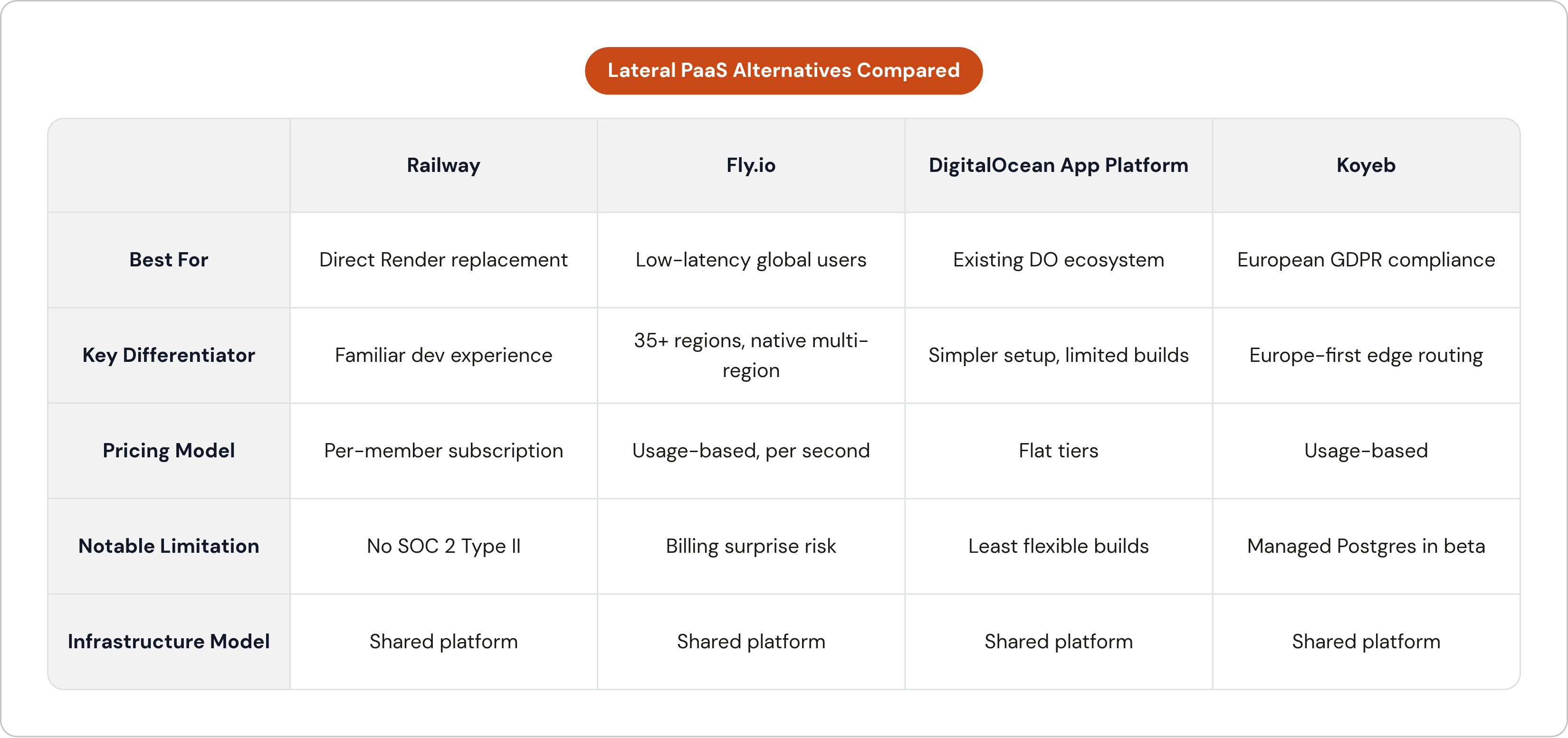
If this is a feature problem, here's what each lateral option changes, and what it leaves precisely where it was.
Railway feels the most like Render of anything out there. Connect a repo, deploy, done, with built-in Postgres, Redis, and cron included. If your gripe with Render is the experience or the pricing tier, Railway fixes it cleanly. But Railway has no SOC 2 Type II attestation, which rules it out for some enterprise buyers before a single feature gets evaluated. It's still a shared-infrastructure platform too, so the ceiling you hit on Render just gets repainted. And Railway moved to per-member pricing after killing its free tier back in 2023, so the cost math shifts depending on headcount.
Fly.io runs containers on its own hardware across more than 35 regions, with native multi-region networking that Render and Railway don't offer. If your real pain is latency for international users, or cold starts wrecking response times, this is a legitimate answer. The catch is usage-based billing, compute by the second, volumes by the hour, bandwidth by region, and teams used to flat PaaS pricing sometimes get a nasty surprise on the first real invoice. Persistent volume durability has had rough patches historically too. And you still don't own the account underneath you.
DigitalOcean App Platform makes sense mainly if you're already living in DigitalOcean's ecosystem, on their managed databases or object storage. Simpler than Render in a few spots, more limited in others, especially build flexibility. Structurally it's the same story: shared platform, zero control over the compute layer.
Koyeb, out of Paris, is the strongest pick for European teams staring down GDPR data-residency requirements a US-primary platform can't satisfy. Git-push deploys, Dockerfile and buildpack support, global edge routing, a managed Postgres offering that was still in beta the last time I checked. Probably the closest thing to a Render clone built for Europe first.
Every option above is still a shared platform. The ceiling moves. It doesn't disappear.
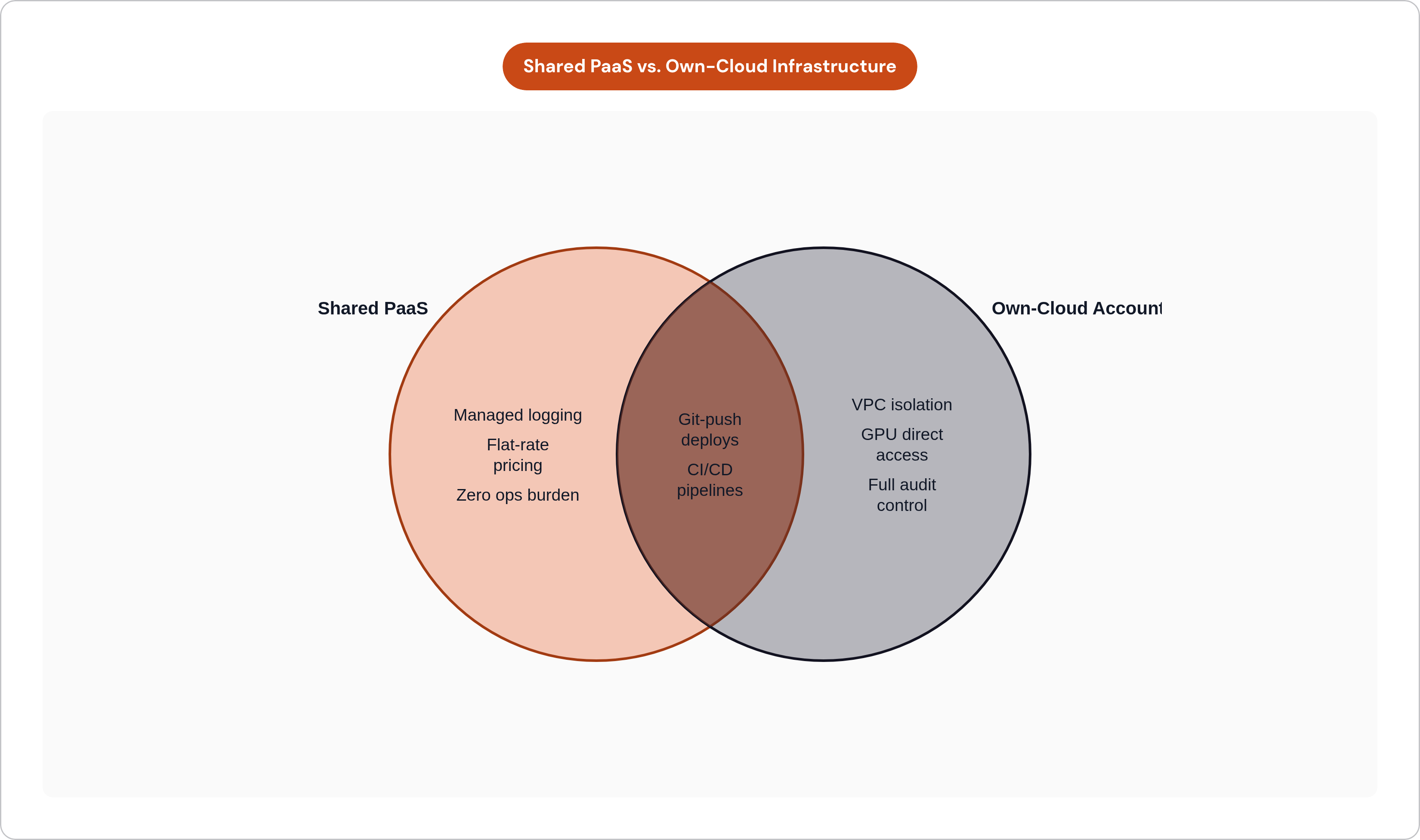
When the right move is infrastructure in your own cloud account
"Own cloud account" has a specific meaning here. The platform deploys directly into your AWS, GCP, or Azure account. You own the VPC, the compute, the data plane. The platform sits on top as a control layer, separate from the infrastructure it's managing.
That's what actually resolves the stuff a lateral PaaS move can't touch.
Compliance gets real once you're there. A SOC 2 auditor can inspect infrastructure you control; a shared platform's attestation covers the platform's own controls, not your slice of the tenant. That gap matters enormously the moment a healthcare or fintech customer's security team starts asking pointed questions.
Cost economics shift too. You pay cloud provider rates instead of PaaS markup stacked on top of cloud provider rates, and egress stops compounding the way it does on a shared platform as usage climbs.
Control stops living in a support queue. VPC peering, private subnets, custom Postgres parameters, cross-region failover, these become choices you make yourself instead of features you wait on a roadmap for.
GPU access opens up too. You provision hyperscaler GPU instances directly, no shared-platform middleman rationing capacity or marking up the price.
The honest tradeoff: more responsibility lands on your plate. Either your team absorbs that operational load directly, or you need a platform built specifically to absorb it for you. That's the actual decision, and it's what the next section walks through.
Own-cloud platforms compared: Encore, Coolify, Porter, and what each one actually handles for the team
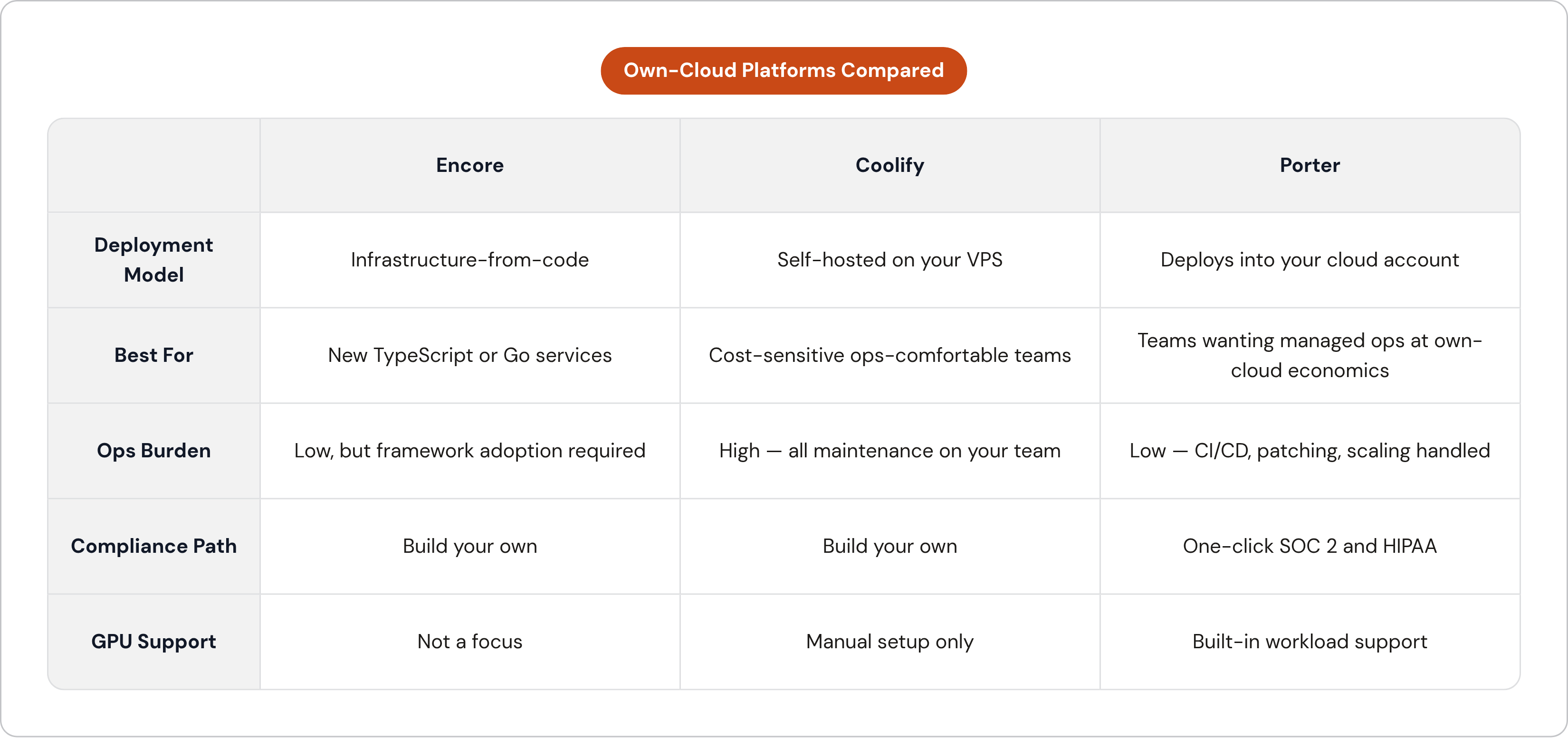
Three platforms deploy into your own cloud account, and they differ enormously in how much operational weight they take off your team.
Encore runs on an infrastructure-from-code model. You declare databases, queues, cron jobs, and secrets in TypeScript or Go, and Encore provisions the real resources behind them, RDS, SQS, S3, inside your AWS or GCP account. Production defaults are solid out of the box: private VPCs, least-privilege IAM, encryption at rest. The catch is you're adopting a framework, not just a deploy layer, so there's real upfront investment before your first push. Great fit for a new TypeScript or Go service built from scratch. Rough fit if you've already got containerized workloads you don't want to rewrite.
Coolify is open-source and self-hosted. Install it on a VPS and you get a dashboard that feels a lot like Render's, at a fraction of the cost. But full ownership of the stack means full ownership of the maintenance too: OS patches, security updates, backups, monitoring, scaling, all of it lands on your team. Compliance coverage is whatever you build yourself; there's no managed SOC 2 or HIPAA path baked in. Right call for cost-sensitive teams genuinely comfortable doing ops work who just want the dashboard experience without the PaaS tax on top.
Coolify maximizes ownership, at the cost of ops burden landing entirely on you. Encore maximizes automation, at the cost of adopting its framework wholesale.
AI workloads specifically: why shared PaaS is a poor fit and what the own-cloud path enables
AI workloads break shared PaaS assumptions in ways a regular web app never does.
Cold starts don't just get slower, they get worse in kind. Large model files have to load into memory, dependencies need to initialize, GPUs need warm-up time before they're actually useful for anything. Serverless and shared PaaS platforms weren't built around that latency profile, and no amount of platform-side tuning erases it.
Billing risk is a different animal entirely. A recursive agent loop or an uncapped inference job can run your bill up overnight, and shared platforms generally offer thin guardrails against it. Your own cloud account gives you budget alerts and hard limits you set yourself, instead of discovering the damage after the invoice lands.
GPU availability is the bigger structural gap, honestly. Most shared PaaS platforms don't expose GPU instances at all, or only through narrow, constrained integrations. Google Cloud Run supports NVIDIA L4 GPUs for inference on models up to roughly 9 billion parameters, which covers a lot of ground but leaves out plenty of real workloads. And this demand isn't a niche concern: GMI Cloud's 2025 data puts the share of AI startups relying primarily on hosted GPU solutions, rather than building their own stack, above 65%.
Own-cloud infrastructure gets you direct access to hyperscaler GPU instances, H100s, L4s, L40S, at cloud provider rates instead of PaaS markup. Hyperscalers typically run two to four times more expensive than specialist GPU clouds for equivalent silicon, but they carry the compliance certifications that actually matter once you're selling to enterprise AI customers.
Specialist inference platforms like Fireworks AI, Together AI, and Modal are worth knowing about here too. They sit at a different layer though, a complement for pure inference workloads rather than an answer to where your infrastructure actually lives.
Compliance as a migration trigger: what SOC 2 and HIPAA actually require from your infrastructure
Nobody explains this part clearly enough: a shared PaaS's SOC 2 attestation covers the platform's own controls. It does not cover your tenant. An auditor reviewing a healthcare or fintech product needs to inspect infrastructure your team actually controls, and a platform-level attestation doesn't transfer down to you, no matter how strong it is on paper.
HIPAA has specific expectations at the infrastructure layer. PHI needs encryption at rest and in transit, access needs logging, and you need a signed Business Associate Agreement you can produce on demand. A shared PaaS might hand you that BAA, but data isolation and audit access stay bounded by what the shared model can expose. Often that's less than what a regulated customer's security review actually wants.
SOC 2 Type II asks for more than that anyway: evidence of controls operating consistently over a period of time, not a point-in-time snapshot. On a shared platform, you're at the mercy of the platform's own audit timeline and scope, which isn't yours to control or speed up when a deal is sitting on the line.
Move to your own cloud account and that dependency disappears entirely. VPC isolation, IAM policy, encryption configuration, audit logs: all of it sits inside your reach and your auditor's reach.
If you're expecting an enterprise deal or a contract in a regulated industry, compliance isn't a future problem to plan around. It's a reason to migrate before the deal closes, not after it falls through because your infrastructure couldn't answer the questionnaire.
How to run the migration without a gap in service or visibility
The most underrated risk in any migration is the monitoring gap. Render, like most PaaS platforms, gives you logging and health dashboards for free, and teams don't notice how much they leaned on that until it's gone. Set up monitoring and alerting on the new infrastructure before real traffic touches it, not after the first incident teaches you the hard way.
Database migration has its own quiet trap. The mechanics are simple enough, pgdump to export, pgrestore to import, but connection pooling is the part everyone forgets. Shared PaaS platforms handle pooling transparently in the background, so plenty of teams don't even know PgBouncer exists until the new host falls over under load it was handling fine a week earlier.
Egress costs are the other silent gotcha. PaaS pricing bundles bandwidth into one flat monthly number; raw cloud billing does not. Put a CDN in front of static assets and object storage before cutover, and you head off a surprise invoice that shows up about a month too late to do anything about.
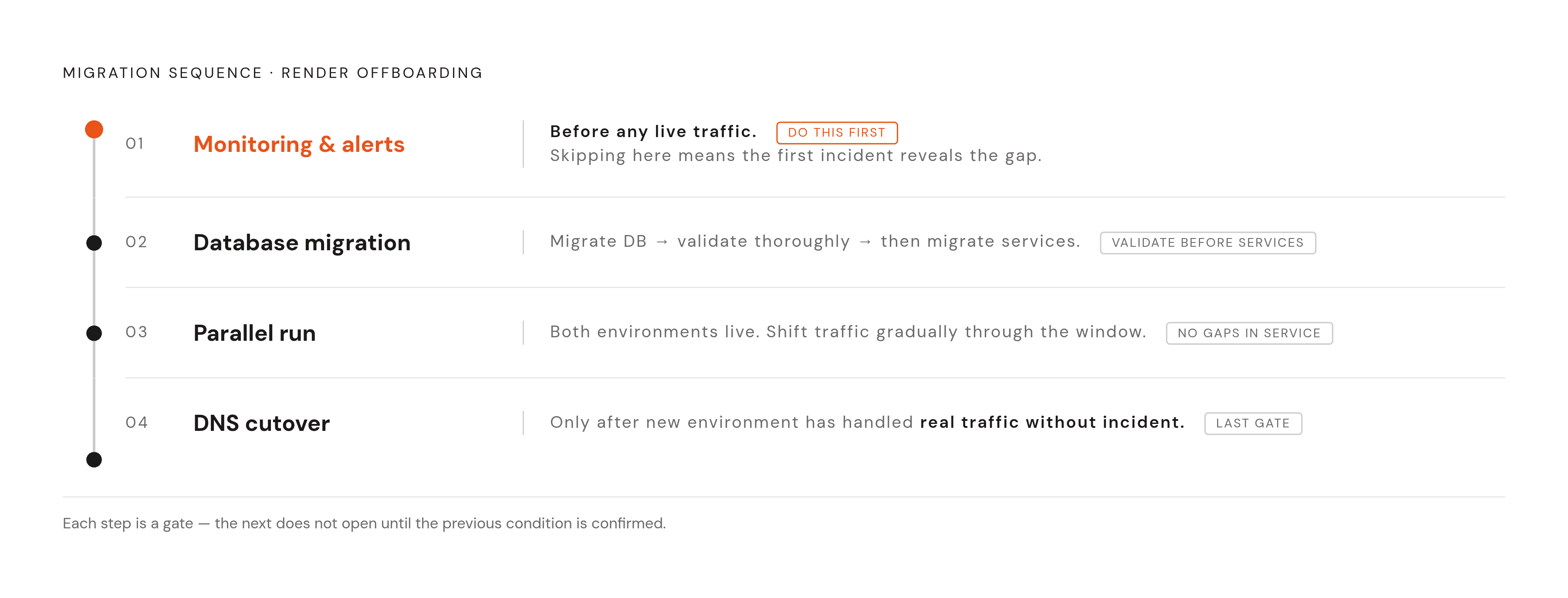
A sequence that actually holds up in practice:
- Stand up monitoring and alerting first, before any live traffic touches the new environment
- Migrate the database, validate it thoroughly, then migrate services
- Run both environments in parallel through a traffic-shifting window
- Cut DNS over only once the new environment has handled real traffic without incident
Ownership of your infrastructure layer isn't the hard part anymore. Carrying the full operational weight of running it yourself still is, and picking the right platform is how you get one without the other.